
Application Background
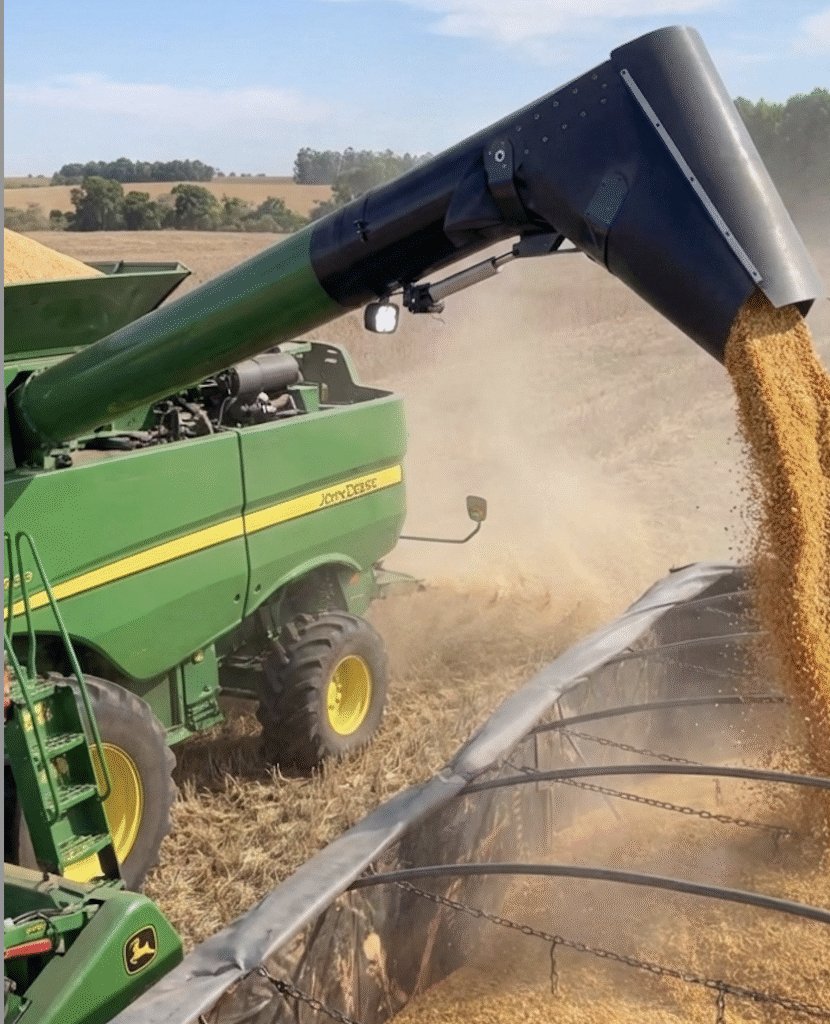
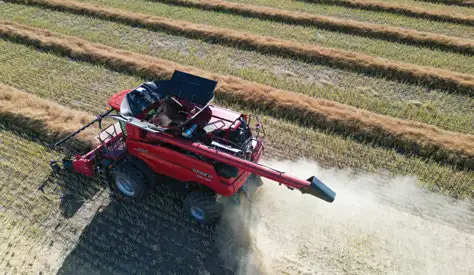
In modern agricultural machinery, combine harvesters rely on unloading auger systems to transfer harvested grain efficiently into trailers or storage vehicles.
To ensure accurate grain discharge and safe operation, the auger angle, position, and opening sequence must be precisely controlled under harsh working conditions. Electric linear actuators are increasingly used in these systems to replace traditional manual or hydraulic adjustment mechanisms.
Role of the Electric Linear Actuator
In a combine harvester auger system, the electric linear actuator is typically used to:
- Adjust the position or angle of the unloading auger
- Control extension and retraction during operation and transport
- Ensure stable positioning during grain discharge
- Improve operator control and repeatability
Unlike lifting equipment, the actuator does not carry the grain load directly. Instead, it provides controlled movement and reliable positioning as part of the mechanical system.
Operating Conditions and Challenges
Agricultural machinery presents one of the most demanding environments for linear actuators:
- Continuous exposure to dust, grain particles, and debris
- Strong vibration and shock during field operation
- Outdoor use with temperature variation and moisture
- Frequent operation during harvest seasons with limited downtime
In such conditions, actuator reliability is not defined by peak force alone, but by long-term durability and resistance to environmental stress.
Typical Design Considerations
When electric linear actuators are used in combine harvester auger systems, several engineering factors are critical:
- Ingress protection:
IP65 or higher to protect against dust and moisture - Self-locking capability:
Prevents unintended movement caused by vibration during operation - Robust mechanical structure:
Internal gears and lead screw design must withstand continuous vibration - Mounting method:
Clevis or pivot mounting allows angular movement and reduces stress - Stroke and force selection:
Actuator force is selected based on mechanical leverage and system geometry, not the weight of the grain itself
Advantages of Electric Actuators in Agricultural Equipment
Compared to traditional hydraulic or manual systems, electric linear actuators offer several advantages in harvesting machinery:
- Precise and repeatable positioning
- Simplified system design with fewer hydraulic components
- Reduced maintenance requirements
- Improved operator safety and control
- Easy integration with electronic control systems
These benefits make electric actuators particularly suitable for modern agricultural equipment focused on efficiency and reliability.
Real-World Reliability
In combine harvester applications, equipment performance is measured not by laboratory tests, but by operation in real fields — season after season.
Electric linear actuators that perform reliably under dust, vibration, and continuous use demonstrate their suitability not only for agricultural machinery, but also for other demanding industrial environments.
Related Specifications
Voltage: 12vdc
Stroke: 250mm
Load: 2000n