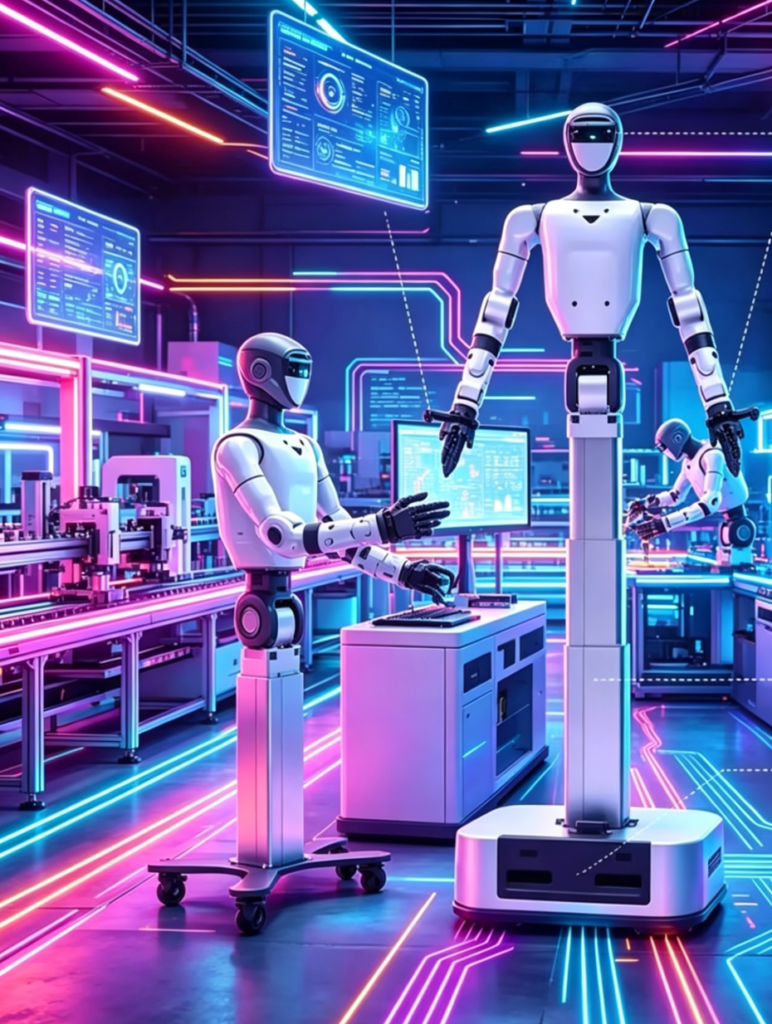
Embodied robots need more than navigation, sensing, and control. In many real-world applications, lifting columns for embodied robots are used to add stable vertical motion, adjustable working height, and compact structural integration. When engineers evaluate a robot lifting mechanism, they usually look beyond stroke alone and focus on load, closed height, rigidity, control compatibility, and installation layout.
Why embodied robots need vertical motion solutions
An embodied robot operates in the physical world, which means it must interact with shelves, workstations, handles, tools, sensors, and people at different heights. A fixed-height structure limits the robot’s usefulness. If the robot cannot raise or lower its camera, arm, tray, display, or tooling, it may struggle in mixed environments.
This is where an electric lifting column becomes valuable. Instead of relying only on arm reach or a complex multi-axis structure, designers can build a controlled vertical axis directly into the robot body. That approach often simplifies task execution and improves mechanical stability.
Typical reasons to add vertical motion to an embodied robot include:
- adjusting sensor height for perception and mapping
- raising an end effector to match target working positions
- changing tray or platform height for delivery and handling
- improving ergonomic interaction in service or healthcare settings
- reducing the motion burden on the robotic arm itself
What is an electric lifting column in robotics?
An electric lifting column is a guided linear lifting mechanism designed to move vertically while maintaining better stability than a standard exposed-drive linear actuator in many upright applications. In robot design, it is often used as a compact telescopic or column-style actuator that supports controlled up-and-down motion.
For embodied robots, the value of a lifting column is not only movement. Its real advantage is structure. A well-designed electric lifting column can provide guided vertical travel, compact retracted length, cleaner integration into a robot chassis, and straightforward electrical control.
Key benefits of lifting columns for embodied robots
Stable vertical movement
Embodied robots often carry cameras, grippers, screens, bins, or lightweight tooling above the base. If the vertical axis lacks rigidity, perception accuracy and task repeatability can suffer. A lifting column helps provide guided motion that supports steadier elevation changes.
Better use of space
A telescopic electric lifting column can deliver meaningful stroke within a relatively compact closed length. This matters in mobile robots and service robots, where internal packaging space is limited and designers must control the robot footprint.
Reduced burden on arm structure
If a robot arm has to perform both reach and large vertical compensation, the arm may become heavier, more expensive, or harder to control. Using a dedicated lifting column for height adjustment allows the arm to focus on manipulation while the vertical mechanism handles elevation.
Typical application scenarios
Service robots in commercial environments
Service robots in hotels, hospitals, offices, and retail spaces may need adjustable tray height, display height, or sensor height. A lifting column allows the robot to interact with users of different heights and handle variable counter or shelf positions.
Warehouse and intralogistics robots
Mobile robots used for picking support, bin transfer, or workstation supply may need vertical lift to align with shelves, carts, or transfer stations. In these cases, an electric lifting column can act as a compact robot lifting mechanism for controlled height matching.
Inspection and patrol robots
Embodied robots used in industrial inspection may need to raise cameras, LiDAR, thermal sensors, or communication devices. A lifting column can improve viewing range and sensor positioning without requiring a more complex articulated structure.
Healthcare and laboratory robots
Robots assisting with carts, instrument presentation, or sample transfer often benefit from adjustable work height. A lifting column helps the robot adapt to benches, bedsides, and lab equipment while maintaining a simpler mechanical layout.
Why not just use a linear actuator?
A linear actuator is still a useful solution in robotics, but it is not always the best fit for vertical body motion. In many cases, a standard linear actuator is better suited for push-pull motion within a defined linkage or hinged mechanism. If used directly for exposed vertical lifting, it may require extra guides, brackets, and stabilization structures.
A lifting column is often preferred when the application needs upright guided motion, cleaner telescopic structure, compact integration into a column form, improved resistance to offset load effects, and a more finished appearance for service or commercial robots.
Important selection considerations
Choosing the right lifting column for an embodied robot requires more than matching stroke and load values. The mechanism must work as part of the full robot system.
Key factors to review include:
- Load: What mass must be lifted, including tooling, brackets, cables, and dynamic margin?
- Stroke: What vertical travel is actually required in the task cycle?
- Retracted length: How much installation height is available inside the robot body?
- Offset load and center of gravity: Is the payload centered, or does it create moment loads?
- Speed: Does the robot need fast height changes or smooth controlled motion?
- Positioning accuracy: Does the task require precise repeatable height control?
- Duty cycle: How often will the lifting action operate each hour or day?
- Power supply: Does the robot platform use 12V, 24V, or another standard?
- Control interface: How will the column connect with the robot controller?
- Environment: Will the robot operate in dust, humidity, cleaning zones, or outdoor conditions?
- Cable management: How will sensor and power cables move during extension and retraction?
- Safety: What anti-collision, overload, pinch-point, or emergency-stop requirements apply?
What information should be prepared before inquiry?
To evaluate a suitable electric lifting column for a robot project, it helps to prepare the following information:
- required load capacity
- required stroke
- maximum closed height allowed
- installation orientation
- size of top mounting platform
- position of the payload center of gravity
- desired lifting speed
- duty cycle expectations
- input voltage and control method
- operating environment details
- whether the robot is mobile or fixed-base
- whether the application includes shock, vibration, or uneven floor movement
Future trends in embodied robot vertical actuation
As embodied robots move from demonstration to deployment, vertical actuation will become more application-specific. Designers are increasingly looking for modules that are compact, controllable, and easy to integrate into production-ready systems.
Several trends are becoming clearer:
- more robots will combine mobile base motion with vertical positioning
- sensor modules will need adjustable height for better environmental perception
- service robots will require quieter and smoother lifting performance
- compact electric lifting columns will be used to simplify robot architecture
- integrated feedback and smarter control will matter more than raw motion alone
Conclusion
Lifting columns for embodied robots are a practical solution when a robot needs controlled vertical movement, compact integration, and better structural guidance than a simple exposed actuator arrangement. They are especially useful in service robotics, inspection systems, mobile automation, and other embodied platforms that must interact with objects and people at different heights.
If you are evaluating an electric lifting column for a robot project, the best starting point is not the catalog stroke alone. Focus on load, closed length, center of gravity, control requirements, and the real task environment. With those factors defined clearly, it becomes much easier to choose a suitable robot actuator solution for reliable vertical motion.
FAQ
What are lifting columns for embodied robots used for?
They are used to add controlled vertical motion to a robot platform, such as raising sensors, trays, displays, tools, or manipulation modules.
What is the difference between a lifting column and a linear actuator?
A lifting column is usually better suited for guided vertical lifting in a compact column structure, while a linear actuator is often used for push-pull motion inside another mechanism.
Why is an electric lifting column useful in service robots?
It helps service robots adapt to counters, shelves, bedsides, and user interaction heights without depending only on arm movement.
What should engineers check before selecting a robot lifting mechanism?
They should review load, stroke, retracted length, center of gravity, control method, duty cycle, and operating environment.
Can lifting columns be used in mobile robots?
Yes. They are often integrated into mobile robots when the application requires vertical adjustment of payloads, sensors, or interaction modules.