
Note: This is an engineering application guide based on public industry context. It does not disclose any customer project details.
Intro
How to apply electric linear actuators in product development fixtures, prototype machines, adjustable test rigs, guards, guides, and industrial positioning modules.
Quick Recommendation
For product development fixtures and industrial prototype positioning, start with the motion requirement first: load, stroke, speed, duty cycle, mounting geometry, safety behavior, and the environment around the moving mechanism. Choose a linear actuator or lifting column only after these constraints are clear.
Interactive Motion Demo
Where It Fits
- Adjustable prototype fixtures used during mechanical design validation
- Test rigs that need repeatable linear movement without a pneumatic supply
- Machine guards, guides, or tooling supports that change position between product variants
- Compact positioning axes for development labs, pilot lines, or custom industrial machines
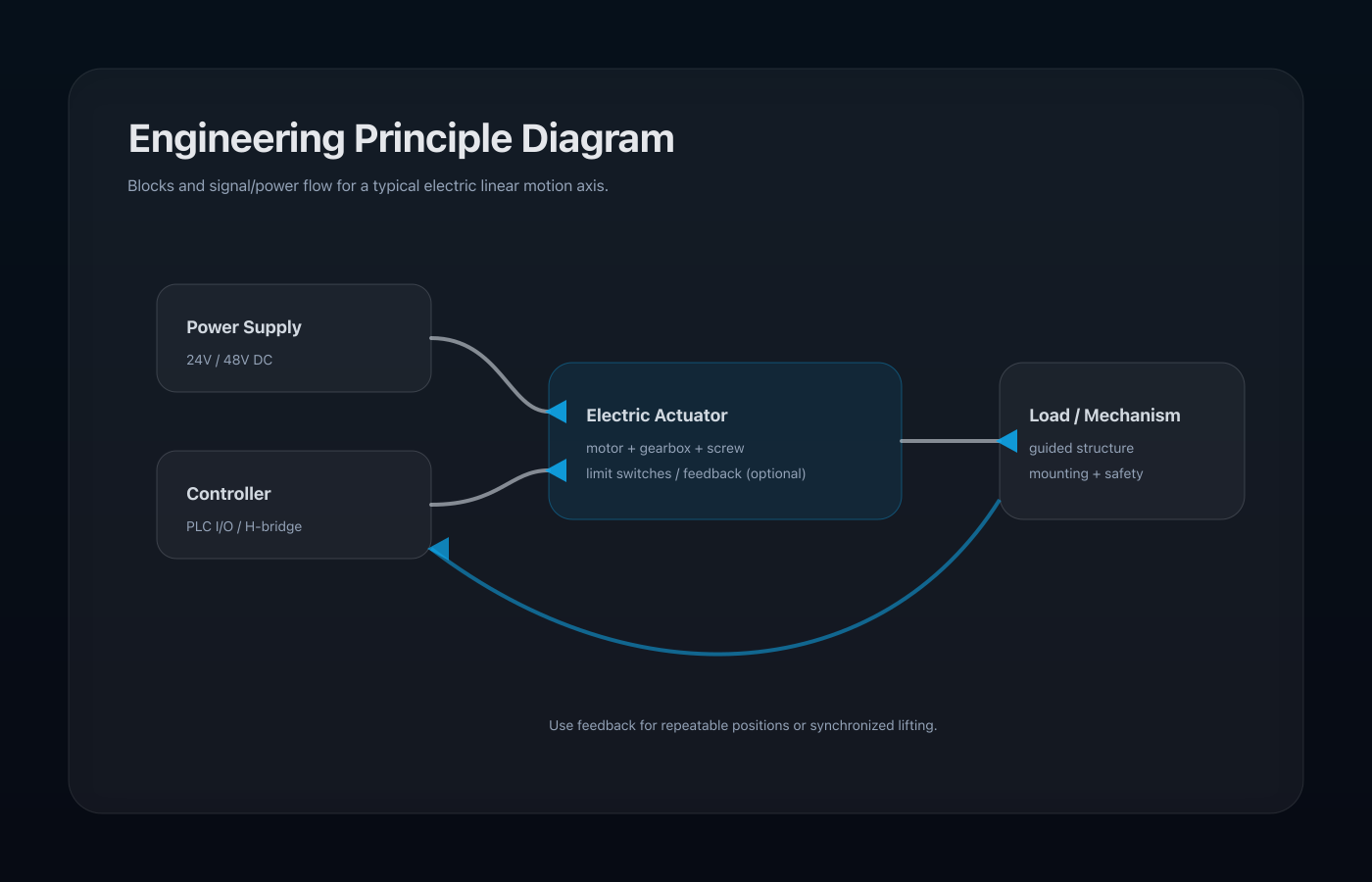
Engineering Principle Diagram
Basic Sizing Logic
- Define the movement: travel distance, required angle or height change, and whether the motion is open/close or repeatable positioning.
- Estimate the working load: include the moving part, accessories, user-applied force, friction, and any off-center load.
- Confirm mounting geometry: the same actuator can produce very different useful force depending on pivot points and moment arm.
- Add safety margin: allow for wear, misalignment, impact, contamination, and user misuse.
Product Parameter Selection Example
| Parameter | Example Choice | Selection Basis |
|---|---|---|
| Rated load | 800-5,000 N depending on fixture mass | Includes moving fixture weight, tooling force, friction, and safety margin |
| Stroke | 100-500 mm | Matched to the adjustment range required by the prototype or test setup |
| Speed | 5-20 mm/s | Fast enough for setup efficiency, slow enough for controlled testing |
| Feedback | Hall sensor or potentiometer when repeatability matters | Useful for test logs, recipes, and PLC-controlled positions |
| Duty cycle | Intermittent or medium duty | Chosen from how often the fixture moves during testing |
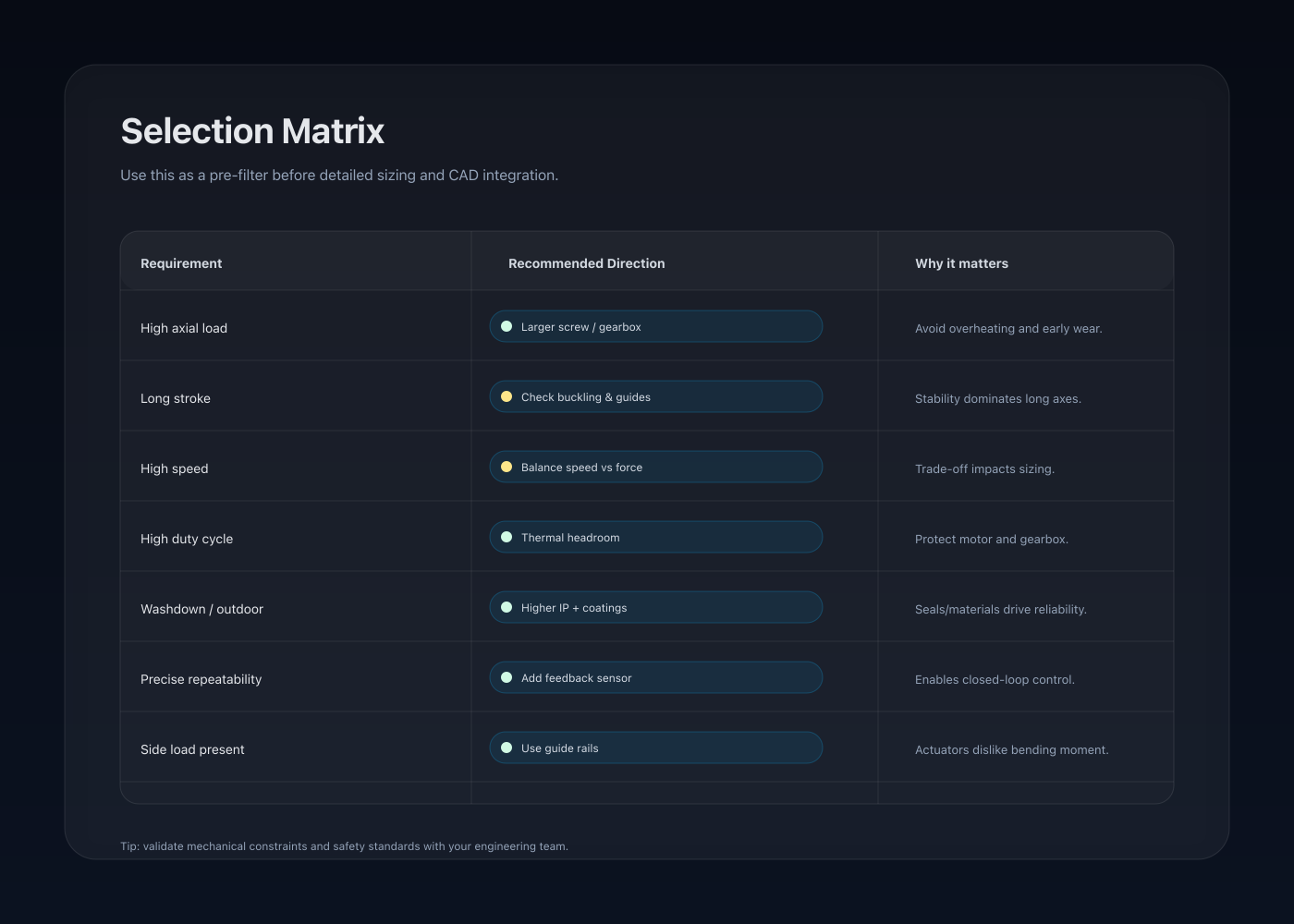
How to Use the Selection Matrix
Use the matrix below as a first-pass screening tool. It narrows the actuator family before final engineering checks for load, stroke, speed, protection rating, brackets, and control logic.
- Start with the moving part. Identify whether it is a light panel, heavy cover, guided platform, or synchronized frame.
- Check the geometry. Verify actuator force at the worst angle or highest load position.
- Match the environment. Indoor, clinical, industrial, dusty, or outdoor use changes IP rating and material choices.
- Choose the control level. Simple switches, limit switches, feedback, or synchronized control are selected from the workflow.
Selection Matrix
Engineering Points
- Separate guiding from pushing: guide rails carry side load, the actuator provides axial force.
- Design slotted brackets or adjustable mounts early so stroke can be tuned during prototype validation.
- Use feedback when test positions must be repeated across product variants.
- Add mechanical stops and current limits before operators use the fixture.
Required Information
- Load, stroke, target speed, and duty cycle
- Mounting space and bracket constraints
- Whether the actuator must hold position during power loss
- Control method: switch, PLC, remote, feedback, or synchronized controller
- Environmental requirements: noise, IP rating, corrosion, cleaning, or user safety
FAQ
Do I need position feedback?
Use feedback when the system needs repeatable intermediate positions, synchronized movement, or controller confirmation.
Is self-locking required?
Self-locking or a mechanical holding method is recommended whenever unintended movement could affect safety, alignment, or usability.
Can one actuator be enough?
One actuator may be enough for a compact guided mechanism. Wide, heavy, or off-center structures often need guides, linkages, or synchronized actuators.
Related Pages
Public context checked: EWS Sweden AB is associated with product development and engineering design services in Stockholm; the article is framed as a general engineering application guide, not a disclosed customer project.