
Intro
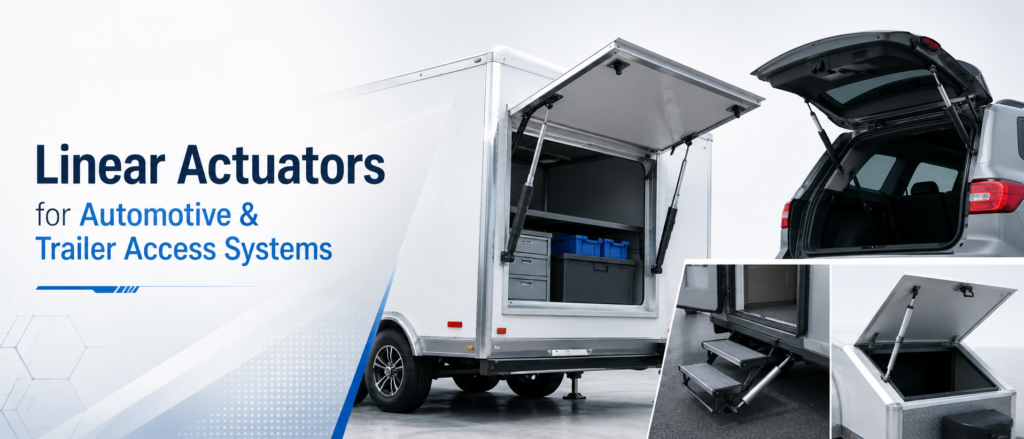
Automotive accessories, trailers, RV compartments, pickup covers, and service panels often need compact electric motion. A linear actuator can provide controlled push-pull movement where pneumatic or hydraulic systems would add complexity.
Quick Recommendation
For automotive and trailer access systems, start with a 12V or 24V DC linear actuator, then confirm force and stroke from the actual hinge geometry. Prioritize compact mounting, vibration resistance, limit switches, weather protection, and a manual release or lockout when emergency access matters.
Interactive Motion Demo
The demo below shows the basic movement: a linear actuator extends to open a hinged hatch, trailer cover, or service access panel.
Where It Fits
| Vehicle Area | Typical Motion | Why an Actuator Helps |
|---|---|---|
| Trailer hatch | Open and hold a hinged lid | Reduces manual lifting and supports controlled access. |
| RV compartment door | Lift or tilt a service panel | Improves convenience in tight spaces around vehicles. |
| Pickup tonneau cover | Raise a cover section or guided panel | Supports powered cargo access with compact installation. |
| Electric step | Deploy and retract a linkage | Provides repeatable movement from a switch or vehicle signal. |
| Service access panel | Move a maintenance cover or shield | Keeps access predictable and reduces operator effort. |
Basic Sizing Logic
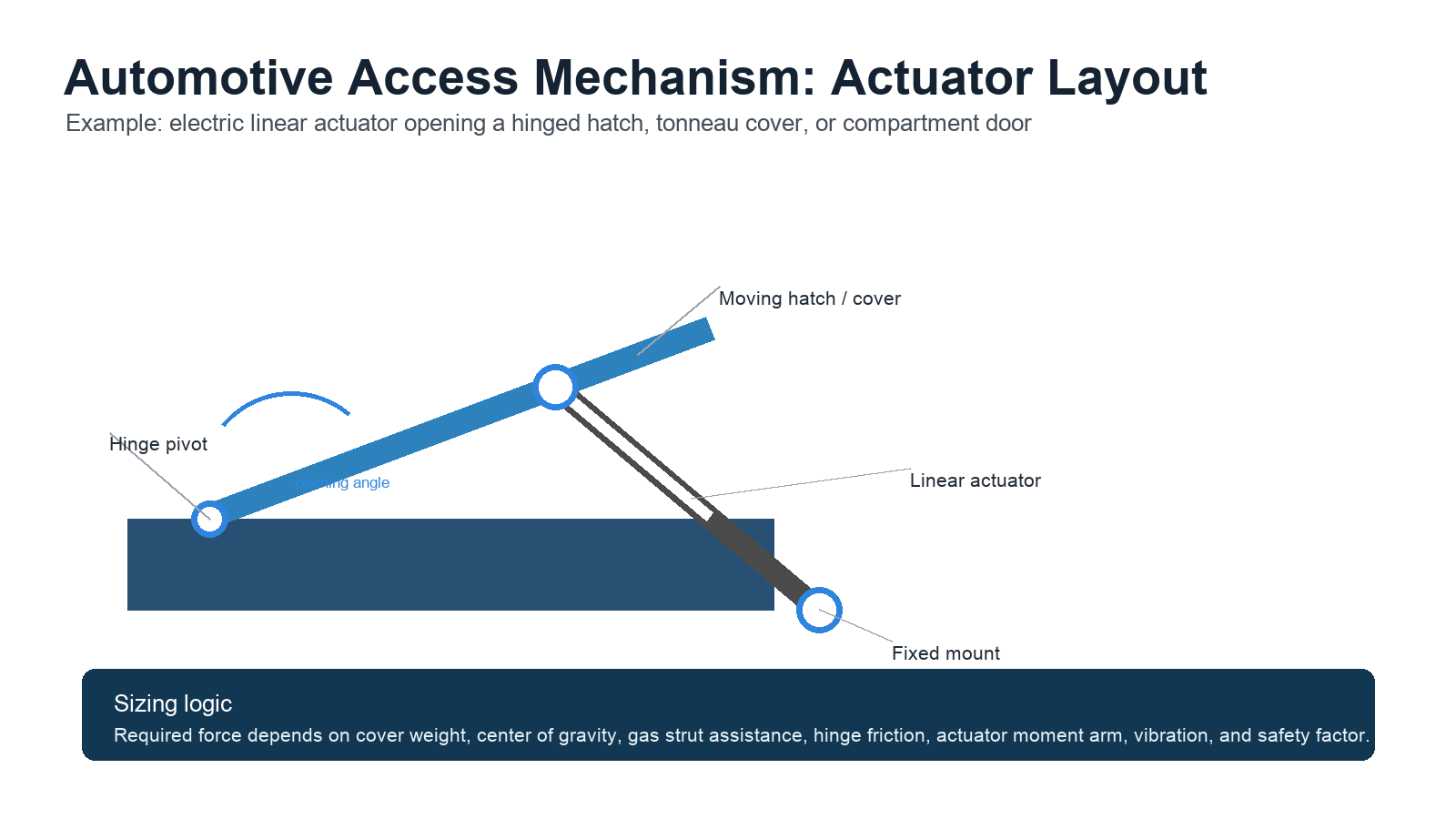
For a hinged vehicle cover, selection begins with torque and linkage geometry:
Actuator force ≈ cover resisting torque ÷ actuator moment arm
The resisting torque comes from cover weight, center-of-gravity distance, hinge friction, gas strut assistance, seal drag, vibration, wind load, and the maximum opening angle. Add a safety factor for road shock, installation tolerance, and aging hardware.
Product Parameter Selection Example
Assume a trailer or RV compartment uses a hinged access cover. The cover opens several times per day, must move smoothly, and may be exposed to road vibration and outdoor humidity.
| Parameter | Example Choice | Selection Basis |
|---|---|---|
| Rated force | 1,500–4,000 N | Selected from cover weight, hinge geometry, seal friction, and shock margin. |
| Stroke | 150–400 mm | Enough to reach the required opening angle without poor linkage angles near full travel. |
| Speed | 3–12 mm/s | Slow enough for controlled movement and reduced impact at end positions. |
| Voltage | 12V DC or 24V DC | 12V fits many vehicle systems; 24V is common in larger equipment and control cabinets. |
| Protection | Weather-resistant housing and protected cable routing | Important for road splash, dust, vibration, and outdoor storage. |
| Control | Limit switches, relay/controller, optional feedback | Open/close systems need end limits; position feedback helps when intermediate positions matter. |
| Safety | Manual release or lockout where required | Access panels should not trap users or block emergency maintenance access. |
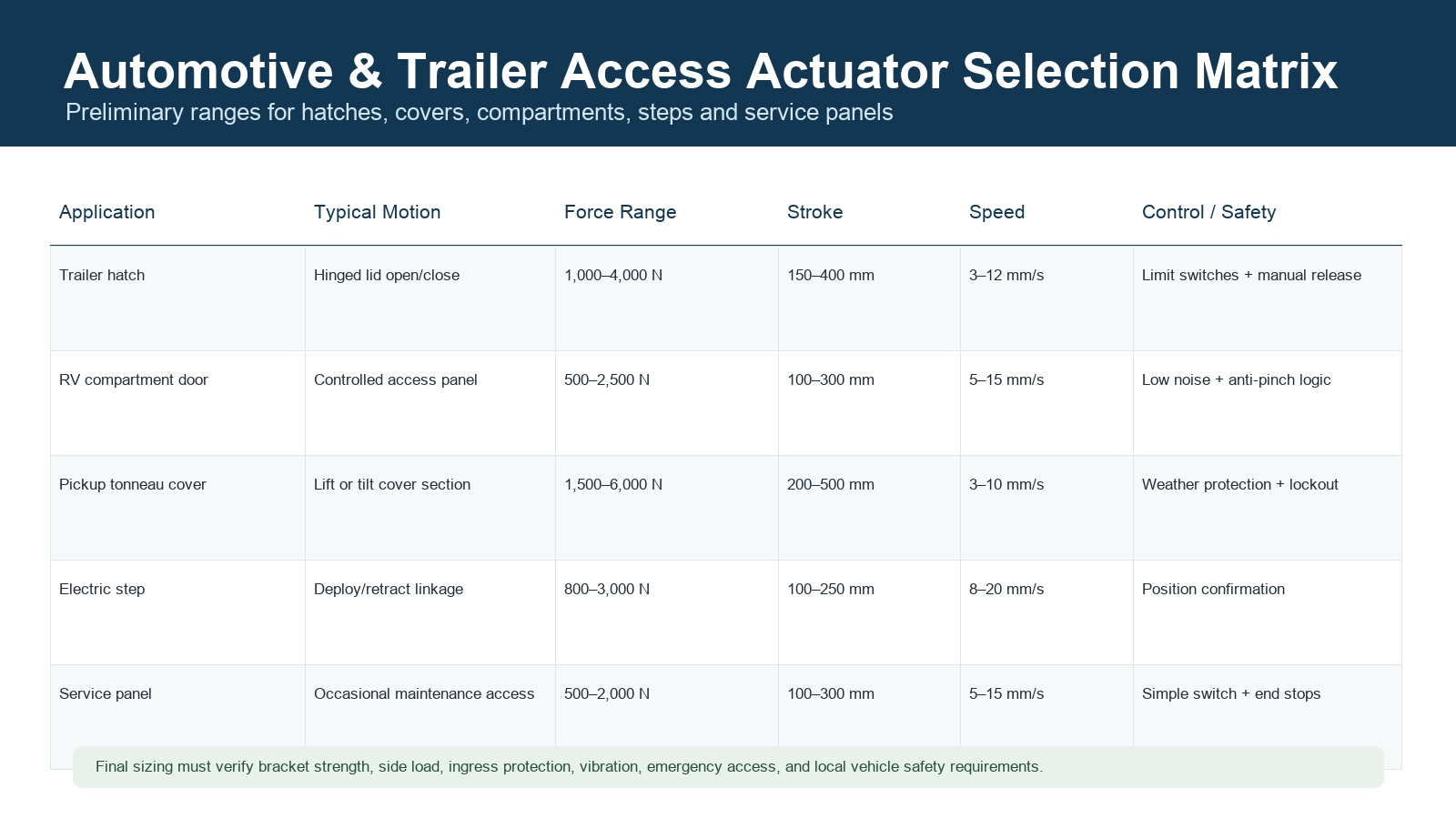
Selection Matrix
Engineering Points
- Control side load. The actuator should push axially; hinges, guides, or linkages should handle side forces.
- Protect wiring. Route cables away from pinch points, sharp edges, road splash, and moving linkages.
- Plan emergency access. Covers and panels may need a manual release or service lockout.
- Validate vibration. Vehicle systems see road shock, so brackets and fasteners matter as much as actuator force.
Information Needed for Accurate Sizing
- Cover or panel weight and dimensions
- Hinge location and desired opening angle
- Available actuator mounting points
- Voltage, control method, and desired speed
- Weather exposure, vibration level, and emergency access needs
FAQ
Can a linear actuator replace a gas strut?
Yes in many powered access systems, but the design must check force through the full travel range. Some systems may use both gas struts and actuators.
Is 12V DC enough for vehicle access systems?
Often yes, especially for light covers or steps. Larger vehicles or industrial trailers may use 48V DC for better current management.
Do I need feedback?
Feedback is useful when the cover must stop at intermediate positions or report position to a controller. Simple open/close systems may only need limit switches.
What is the biggest design risk?
Side load and poor bracket geometry. Even a strong actuator can fail early if it is forced to bend rather than push or pull axially.