
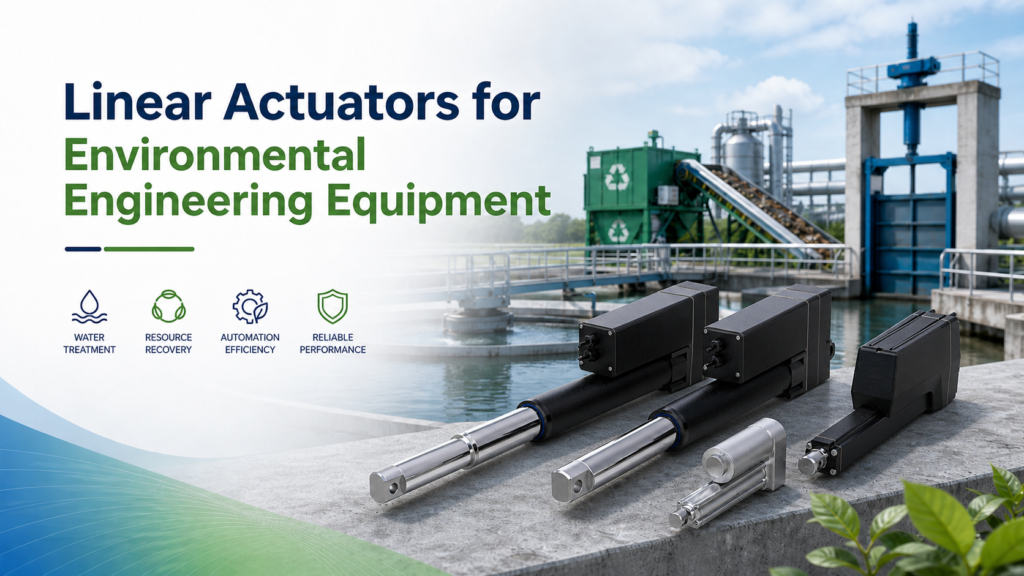
Environmental engineering equipment often needs controlled linear motion in wet, dusty, corrosive, or high-duty industrial spaces. A linear actuator can automate dampers, process covers, sampling gates, cleaning line shields, and recycling equipment when the design requires repeatable stroke, compact installation, and simple electrical control.
Quick Recommendation
For environmental equipment, start with a sealed 24V DC electric linear actuator, then size force and stroke from the actual linkage geometry. In wet or dusty areas, prioritize IP protection, protected wiring, corrosion-resistant hardware, limit switches, and a control layout that prevents movement during maintenance.
Interactive Motion Demo
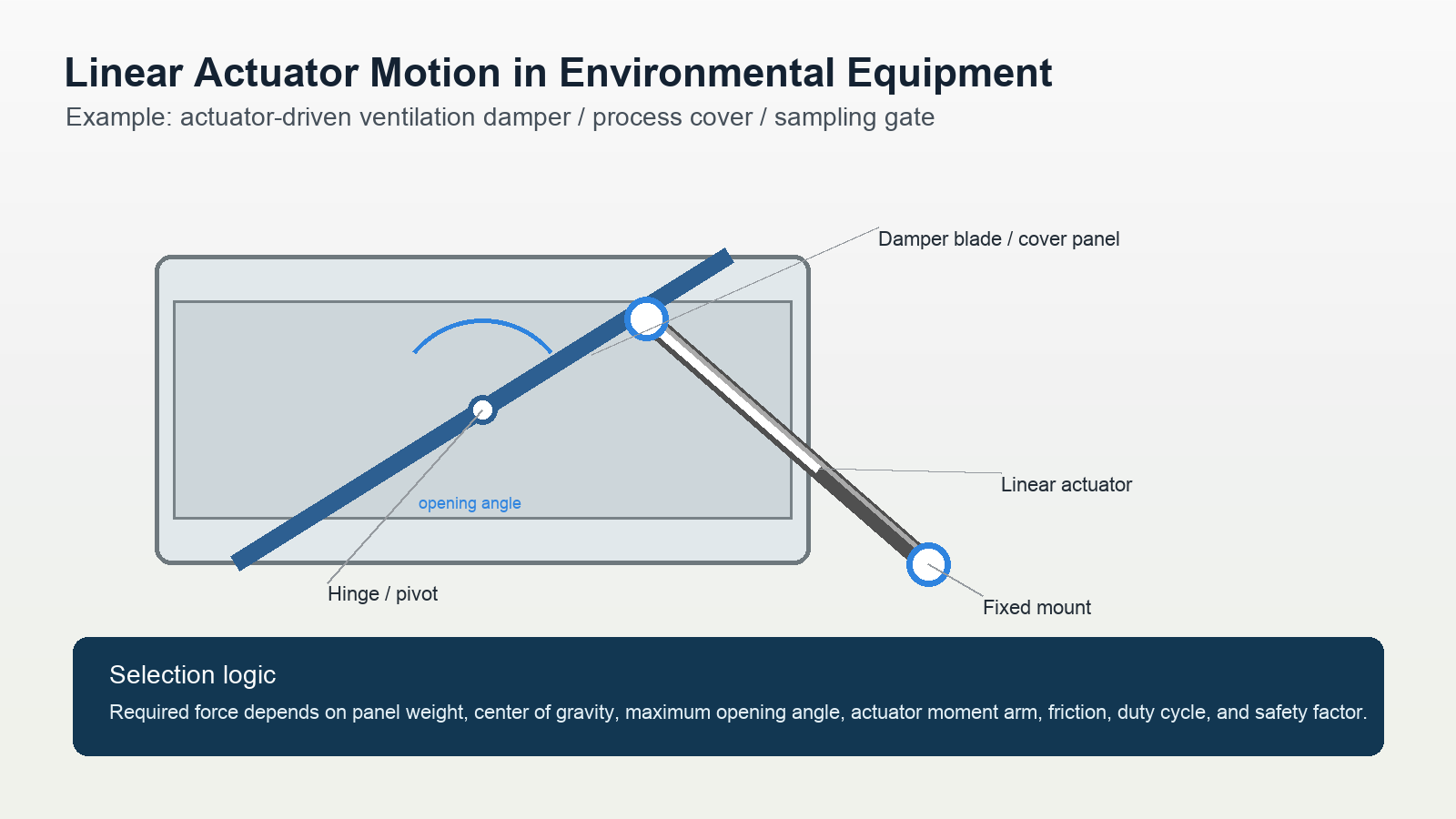
The demo below shows the basic motion concept: an actuator extends to open a damper blade, process cover, or sampling gate.
Where Linear Actuators Fit
| Equipment Area | Typical Motion | Why an Electric Actuator Helps |
|---|---|---|
| Ventilation and fume ducts | Open, close, or modulate a damper blade | Simple position control for airflow, extraction, and process ventilation. |
| Process tanks and treatment skids | Lift covers, shields, or inspection hatches | Cleaner operation than manual lifting, especially around wet or chemical equipment. |
| Sampling systems | Move a gate, probe, or small collection arm | Repeatable stroke improves sampling consistency and reduces operator exposure. |
| Cleaning and recycling lines | Adjust guards, diverters, guides, or covers | Supports automated changeover and keeps moving parts inside a compact envelope. |
Basic Sizing Logic
Actuator selection should begin with the actual side-view geometry. For a hinged damper or cover, the required force depends on the load torque and actuator moment arm:
Actuator force ≈ resisting torque ÷ actuator moment arm
The resisting torque comes from panel weight, center-of-gravity distance, airflow pressure or liquid splash load, seal friction, and the maximum opening angle. A safety factor should be added for contamination, aging seals, misalignment, and emergency operating conditions.
Product Parameter Selection Example
Assume an environmental treatment skid uses a hinged stainless inspection cover. The cover is opened several times per shift, must hold position during inspection, and may be exposed to humidity and cleaning water.
| Parameter | Example Choice | Selection Basis |
|---|---|---|
| Rated force | 3,000–6,000 N | Selected from cover weight, hinge torque, seal friction, and safety factor. |
| Stroke | 200–350 mm | Enough to reach the required opening angle without poor linkage angles at either end. |
| Speed | 3–8 mm/s | Slow enough to avoid impact when opening or closing a heavy cover. |
| Voltage | 24V DC | Common for industrial control cabinets, relays, sensors, and safety circuits. |
| Protection | IP65 or higher where needed | Recommended for wet, dusty, or washdown-adjacent environmental equipment. |
| Holding method | Self-locking or external lock | Prevents unintended movement during inspection, cleaning, or power loss. |
| Feedback | Optional hall sensor or potentiometer | Useful when the PLC needs repeatable intermediate positions instead of only open/close. |
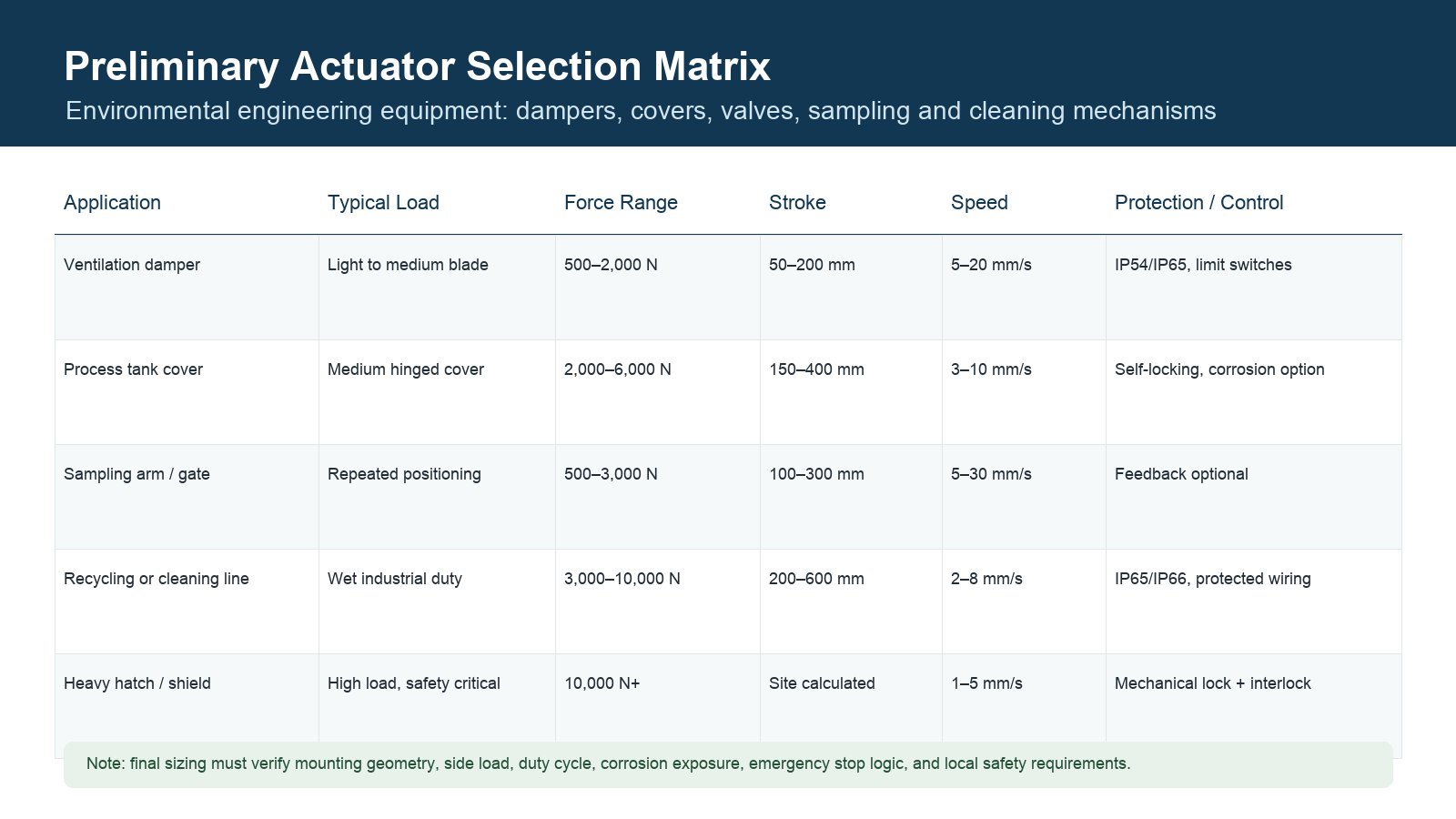
How to Use the Selection Matrix
The selection matrix below is a first-pass screening tool, not a final engineering calculation. Use it to narrow the actuator family before confirming exact force, stroke, speed, and protection rating from the real equipment geometry.
- Start from the moving part. A light ventilation damper, a hinged process cover, and a heavy safety shield create very different torque loads.
- Check the mounting geometry. The same cover may require very different actuator force depending on bracket position and moment arm.
- Match the environment. Wet, dusty, outdoor, or washdown-adjacent equipment should use higher IP protection and protected cable routing.
- Decide the control level. Simple open/close motion may only need limit switches, while modulating dampers or repeatable sampling systems may need position feedback.
Engineering Points That Matter
Protect the actuator from the environment. Place the actuator away from direct splash zones when possible, route the cable downward or through protected conduit, and avoid mounting positions that trap water around seals.
Control side load. Linear actuators are designed for axial force. Brackets must keep the rod aligned through the full stroke so the actuator is not forced sideways.
Use limit and safety logic. Dampers, hatches, and shields should have end limits, overcurrent protection, emergency stop logic, and maintenance lockout where operators may access the equipment.
Match duty cycle to the process. A cover opened twice per day has a different requirement from a modulating damper that moves many times per hour.
Information Needed for Accurate Sizing
- Moving part weight and dimensions
- Hinge or pivot location
- Required opening angle or travel distance
- Available actuator mounting points
- Expected duty cycle and movement speed
- Exposure to water, dust, chemicals, heat, or outdoor conditions
- Control method: switch, relay, PLC, synchronized controller, or feedback loop
FAQ
Can a linear actuator be used for a ventilation damper?
Yes. A linear actuator can open, close, or modulate a damper when the linkage is sized correctly and the actuator is protected from side load and environmental exposure.
Is 24V DC suitable for environmental equipment?
24V DC is commonly used because it integrates well with control cabinets, sensors, relays, and safety circuits. For remote equipment, 12V DC may also be used.
Do wet environments require a special actuator?
They often require higher IP protection, sealed wiring, corrosion-resistant hardware, and careful mounting. The actuator should not be treated as a waterproof structural member unless the model is rated for that use.
When is feedback needed?
Feedback is useful when the equipment needs intermediate positions, repeatable airflow settings, or PLC confirmation of actuator position.
Can one actuator move a heavy cover?
Sometimes, but heavy or wide covers may need two synchronized actuators or a mechanical linkage to avoid twisting. Final design should check bracket strength and load balance.
For related actuator options, see 24V linear actuator, motion control, and electric linear actuator application topics.