
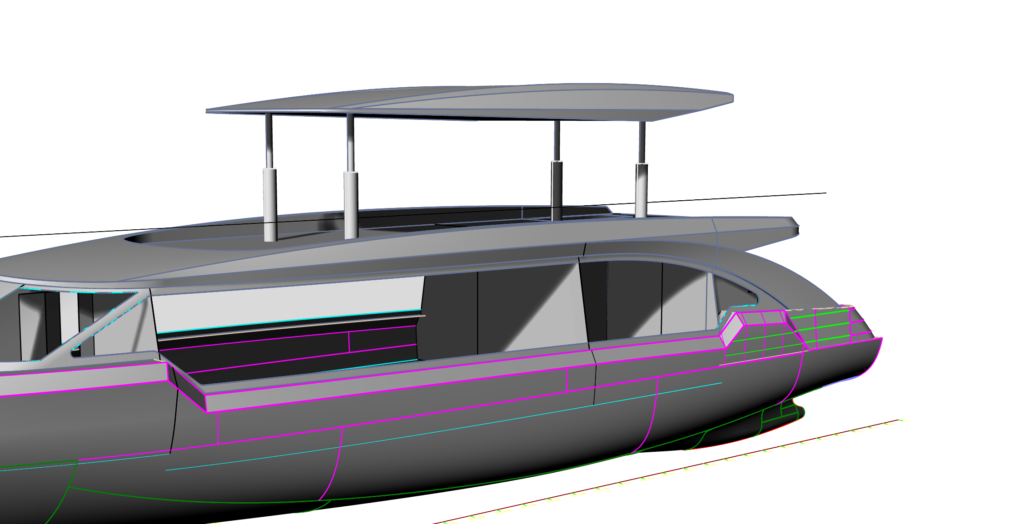
A marine canopy lifting system must carry the canopy and resist loads created by vessel acceleration, vibration, and motion. This engineering example uses a canopy mass of about 480 kg, a stainless steel outer tube, and a 400 W explosion-proof servo motor.
The final design still requires a defined dynamic load case, mounting analysis, environmental rating, and safety review.
Marine lifting design combines structural load, corrosion exposure, installation limits, drive control, and electrical safety. The actuator, support structure, motor, and controls should therefore be evaluated as one system.
Why ship canopy lifting is a demanding application
At rest, the lifting system supports the canopy’s static weight. During vessel motion, acceleration and payload inertia can increase the force and bending moment at the lifting points.
Use a documented dynamic factor or vessel acceleration envelope instead of sizing the system from the 480 kg mass alone.
Humidity, salt-laden air, water spray, and condensation can affect materials, seals, bearings, connectors, and motors. Specify the exposure zone, ingress-protection target, corrosion strategy, drainage, and inspection interval before selecting components.
Project requirements
In this case, the main requirements were clear:
- Canopy load: approximately 480 kg
- Operating condition: vessel movement causing inertia and dynamic impact
- Environment: damp, moisture-prone, and water-exposed marine conditions
- Safety expectation: reliable motion and suitable drive configuration for demanding working conditions
- System power: 220vAC
- Initial height 1.2m, stroke length 1.5m
- Speed 0.1m/s
An indoor catalog configuration may not cover this combination of dynamic load, moisture exposure, corrosion control, and safety requirements. Suitability must be checked against the complete operating envelope.
Custom solution provided by GeMinG Tech
The proposed configuration centered on two elements:
- Stainless steel outer tube
- 400W explosion-proof servo motor
- 4pcs lifting columns with synchronous control system
- Telescopic 3-stage lifting column design
Why stainless steel matters in marine lifting systems
The outer tube contributes to guidance, protection, and structural performance. In marine and near-water service, its material and surface treatment should be selected for the expected humidity, spray, and salt exposure.
A stainless steel outer tube can reduce corrosion risk, but it does not replace correct alloy selection, sealing, drainage, fastener compatibility, cleaning, and scheduled inspection.
Why a 400W explosion-proof servo motor was selected
Drive sizing must include the canopy mass, transmission efficiency, acceleration, wind load where applicable, and the required speed. Vessel motion can also affect peak torque and holding requirements.
A 400 W servo motor was selected for controlled motion in this example. An explosion-proof version is appropriate only when the hazardous-area classification and applicable standards require the corresponding certified motor and electrical installation.
Servo control can provide position feedback and defined motion profiles. Required accuracy, synchronization, braking, overload response, and emergency behavior should be documented before the control package is selected.
Key design considerations
Projects like this are usually decided by engineering details rather than headline specifications. For marine canopy lifting, the most important considerations typically include:
- Actual moving load and structural distribution
- Dynamic inertia after vessel movement begins
- Mounting position and load path
- Corrosion and moisture exposure level
- Water protection and sealing requirements
- Motor safety grade and control method
- Required stability during lifting and holding
- Long-term maintenance expectations
Evaluate the complete use case before finalizing the lifting architecture. Structure, material, drive, feedback, and safety functions must work together under the same load assumptions.
Why not use a standard actuator solution?
A standard actuator can be suitable when its rated load, duty cycle, environmental protection, bending-moment limit, and safety features cover the application. Otherwise, the configuration or supporting structure needs to be adapted.
This example therefore uses a tailored lifting configuration instead of assuming that a generic actuator is suitable. The final choice should be supported by calculations and application testing.
Typical applications for similar custom solutions
Although this case focuses on a ship canopy, the same design logic can apply to other heavy-duty and moisture-exposed systems, such as:
- marine covers and deck structures
- service hatches and protective canopies
- port or dockside equipment with wet-environment exposure
- vehicle or mobile equipment structures operating in harsh outdoor conditions
- special lifting modules that require corrosion-conscious structural design
Similar equipment may require a project-specific combination of structure, motor, feedback, and environmental protection.
Information to prepare before inquiry
To evaluate a similar marine canopy or heavy lifting project efficiently, it helps to prepare the following information:
- total moving load
- dimensions of the canopy or moving structure
- center of gravity and support point arrangement
- stroke or lifting travel required
- installation space limitations
- operating voltage and control requirements
- environmental details such as humidity, splash, and corrosion exposure
- whether explosion-proof or other safety requirements apply
These inputs allow an engineer to compare a custom electric lifting system, a servo-driven structure, and other feasible architectures on the same basis.
Conclusion
This 500 kg-class marine canopy example illustrates why static mass alone is not enough for selection. Vessel motion, inertia, moisture exposure, installation strength, and safety requirements must be included in the design basis.
The stainless steel outer tube and 400 W servo configuration are example choices, not universal specifications for every vessel.
For a technical review, provide the load data, center of gravity, travel, speed, lifting-point layout, environment, power supply, controls, duty cycle, and required certifications.
Frequently Asked Questions
The design must account for static load, vessel acceleration, payload inertia, mounting geometry, moisture exposure, corrosion protection, and the applicable electrical and safety requirements.
Stainless steel can improve corrosion resistance in humid or water-exposed environments. The alloy grade, surface treatment, sealing, drainage, and maintenance plan should still be selected for the actual exposure conditions.
A servo motor can support controlled motion and position feedback. Explosion protection is relevant only when the installation's hazardous-area classification and applicable standards require a certified motor and electrical system.
Provide canopy mass, center of gravity, stroke, speed, mounting layout, number of lifting points, vessel acceleration assumptions, duty cycle, power supply, control interface, environment, and required safety or hazardous-area certifications.