
Electric lifting columns for chemical machinery provide guided up-and-down motion. They can raise a mixing, grinding, dispersing, emulsifying, or stirring head. The lift should be selected from the full machine load and work cycle.
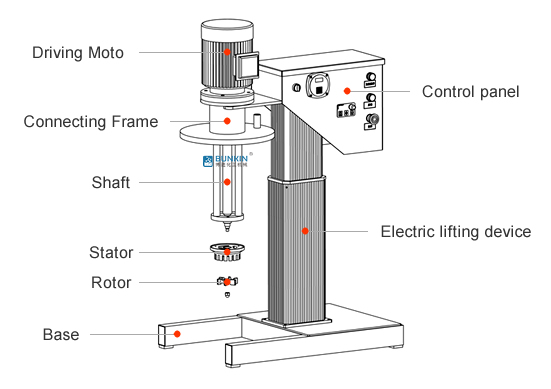
Where the lifting column is used
- High-speed dispersers
- Industrial mixers and agitators
- Basket mills and wet grinding equipment
- Emulsifying and stirring machines
- Process skids with changeable vessels
The column does not replace the machine frame. The frame must carry side load and process forces. It must also guide the head when mixing torque, vibration, or an offset load is present.
How vertical motion supports the process
The head moves down into the vessel for processing. It then moves up for a vessel change, cleaning, inspection, or service. A controlled lift can make these steps easier to repeat.
Travel limits and position feedback may help the control system. Their value depends on the process. Define the required positions and fault behavior before choosing the controls.
Key selection data
- Load: process head, motor, shaft, guard, cables, and hoses
- Offset: distance from the column center to the moving center of gravity
- Travel: work height, vessel-clearance height, and safe end clearance
- Motion: speed, starts per cycle, and duty cycle
- Environment: dust, vapor, splash, cleaning chemicals, and temperature
- Controls: voltage, limits, feedback, brake, and emergency behavior
Product parameter selection example
Assume the process head and motor have a combined mass of 120 kg. Their center of gravity is 350 mm from the column center. The machine needs 900 mm of vertical travel.
Start with the static force from the mass. Then calculate the offset moment. Add the approved dynamic factor for starts, stops, and process vibration. Check the frame and guides with the same load case.
Next, confirm stroke, closed height, speed, duty cycle, and brake behavior. Finally, check the cleaning method and process environment. This example explains the process; it does not select a model.
Environment and safety
Corrosive vapor, washdown, or hazardous areas need a separate review. Material choice and ingress protection must match the real exposure. Hazardous areas may also require certified electrical equipment.
The machine builder should review pinch points, falling loads, guards, limits, and emergency stops. A brake or other holding method may be needed after power loss.
GEMING supplies electric lifting columns and control options for industrial machinery. A technical review needs the machine drawing, load, offset, stroke, duty cycle, and environment.
Frequently asked questions
Possible uses include dispersers, mixers, basket mills, emulsifiers, and stirring systems. The machine frame must support and guide the process head.
It can raise the process head for vessel changes, cleaning, inspection, and service. It can also set a repeatable work height.
Provide the moving mass, load offset, stroke, speed, duty cycle, mounting layout, process environment, and cleaning method.
It may be possible when the stroke, frame clearance, head shape, and controls cover all planned vessels. Verify each work position.