
Note: This application guide is based on public food-processing equipment context and general engineering requirements. It does not disclose confidential project details.
Intro
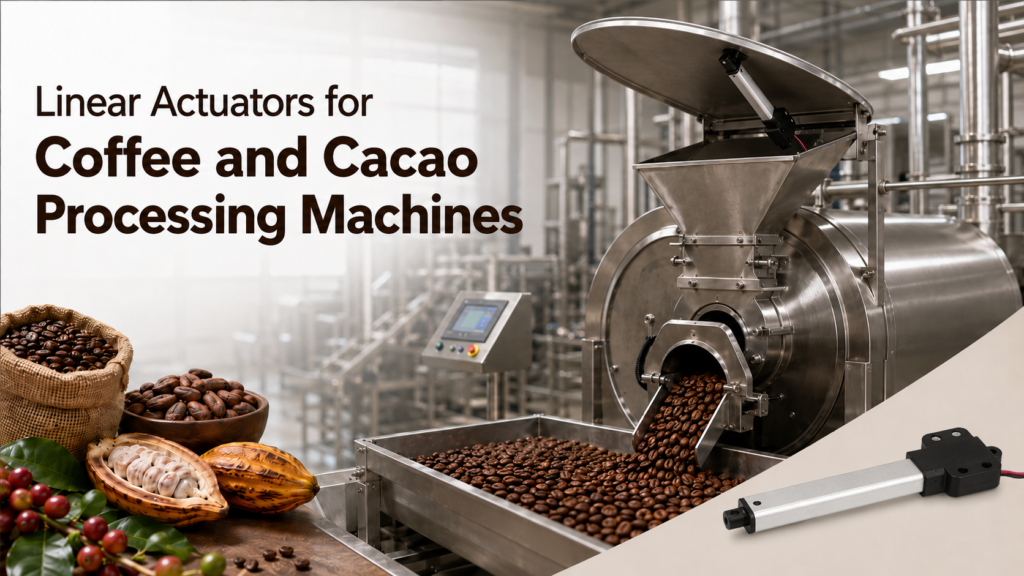
Coffee and cacao processing machines use many small but important moving mechanisms: hopper gates, roaster air dampers, discharge doors, inspection covers, sorting diverters and cleaning access panels. Electric linear actuators can make those movements cleaner, more repeatable and easier to control than purely manual linkages.
Why This Application Fits Electric Actuators
A linear actuator is useful when the machine builder wants a defined stroke, stable end positions, simple low-voltage control and compact installation. For food-processing equipment, the final design must also consider dust sealing, cleaning method, heat isolation and operator guarding.
Interactive Motion Demo
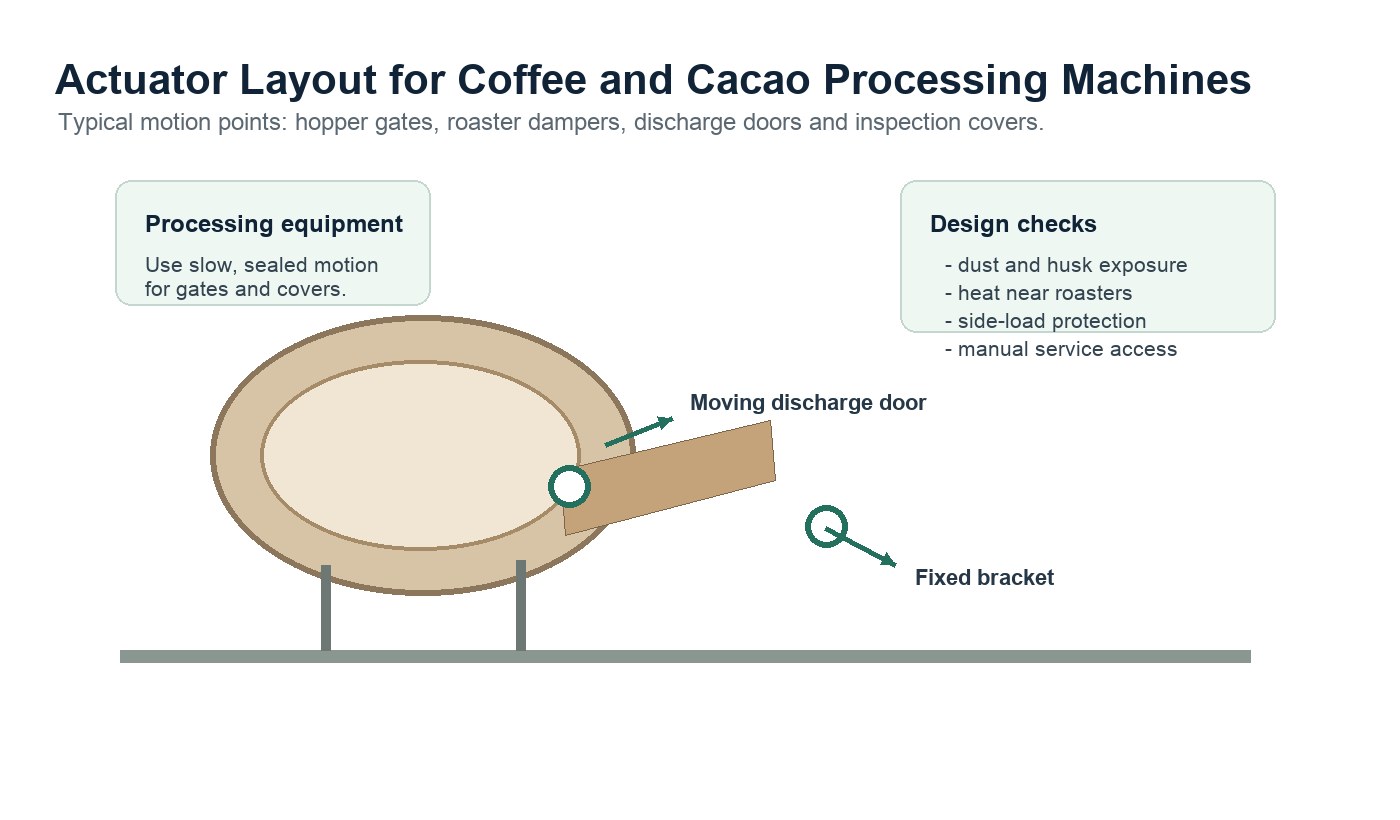
The demo below shows a simplified discharge door on a coffee or cacao processing drum. As the actuator extends, the door opens and the stroke increases.
Common Use Cases
| Machine Area | Typical Motion | Actuator Benefit |
|---|---|---|
| Hopper gate | Open or meter bean flow | Repeatable dosing and cleaner operator control. |
| Roaster air damper | Adjust hot-air path or exhaust flap | Supports repeatable process settings. |
| Discharge door | Open a drum, chute or outlet door | Controlled unloading without manual force. |
| Inspection cover | Lift or open a service panel | Improves maintenance access and guarding options. |
| Sorting diverter | Move a small gate or guide | Supports automated routing between process stages. |
Product Parameter Selection Example
Assume a coffee roaster or cacao processing drum uses a powered discharge door and a smaller air damper. The actuator must open reliably in a dusty environment and avoid sudden movement around operators.
| Parameter | Example Choice | Selection Basis |
|---|---|---|
| Rated force | 1,000-4,000 N for discharge doors; 300-1,500 N for dampers | Based on door weight, hinge geometry, friction from dust, and safety margin. |
| Stroke | 100-300 mm for doors; 50-150 mm for dampers | Chosen from the opening angle and available bracket geometry. |
| Speed | 3-15 mm/s for doors; 2-15 mm/s for dampers | Slow movement improves safety and reduces impact at end positions. |
| Voltage | 24V DC | Common for machine controllers, relays, sensors and low-voltage control panels. |
| Protection | IP54/IP65 depending on dust and cleaning exposure | Husk, powder and cleaning processes require protected seals and cable routing. |
| Feedback | Limit switches; position feedback optional | Limit switches suit open/close motion; feedback helps repeatable process settings. |
| Temperature | Use heat isolation near roasters | Keep motor and seals away from direct high-temperature zones. |
Engineering Notes
- Do not let the actuator carry side load. Hinges, shafts or guides should carry bending forces.
- Keep heat away from the motor. Use linkage distance, shielding or bracket placement near roasting equipment.
- Plan cleaning and dust control. Choose appropriate IP rating and avoid exposed cable traps.
- Guard pinch points. Doors and gates should include safe clearances, interlocks or guarded access where needed.
Information Needed for Accurate Sizing
- Door, gate or damper weight
- Hinge location and target opening angle
- Available actuator mounting points
- Dust, heat and cleaning exposure
- Cycle frequency and duty cycle
- Voltage, controller type and feedback requirement
FAQ
Can a linear actuator be used on a coffee roaster discharge door?
Yes, if the actuator is kept away from excessive heat and the hinge geometry is sized correctly.
Is feedback required for a hopper gate?
Feedback is useful when the machine needs repeatable partial openings for recipe control. Simple fully open or closed movement may only need limit switches.
What protection rating is suitable?
IP54 may be enough for light dust, while IP65 or better is preferred near heavier dust, cleaning water or exposed cable areas.
What is the main mechanical risk?
Side load from poor bracket alignment. The actuator should push axially while hinges or guides support the moving mechanism.