
Note: This application guide discusses general laboratory and preclinical research equipment. It does not describe any specific customer project.
Intro
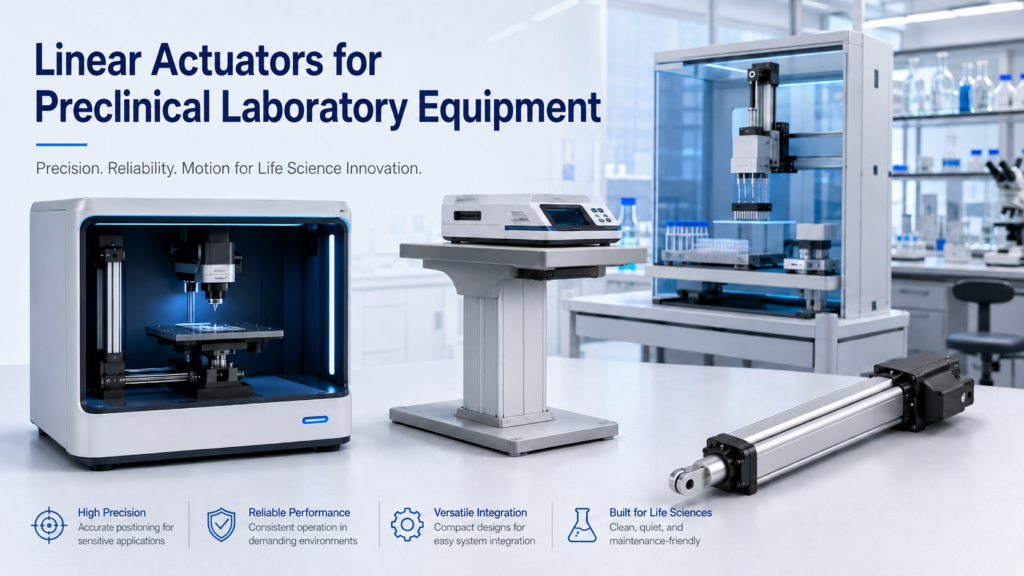
Linear actuators for laboratory equipment are useful when an instrument needs quiet, compact and repeatable electric motion. In preclinical research and laboratory animal facility equipment, actuators can move access doors, chamber covers, positioning stages, service panels, small lift modules and safety shields.
Real Application Context
Preclinical and laboratory animal research equipment commonly includes ventilated caging systems, animal housing products, anesthesia and ventilator systems, behavioral research instruments, pharmaceutical research instruments and precision laboratory modules. These products often combine mechanical access, controlled positioning, clean cable routing and repeatable movement.
A linear actuator is not selected because the equipment is large. It is selected because the motion must be predictable: open a door to a fixed angle, raise a small platform, adjust a test module, or move a cover at a controlled speed. In a research environment, stable movement and low vibration are usually more important than high speed.
Interactive Motion Demo
The demo below shows a simplified access door for a benchtop laboratory instrument. The actuator opens the door through a controlled stroke.
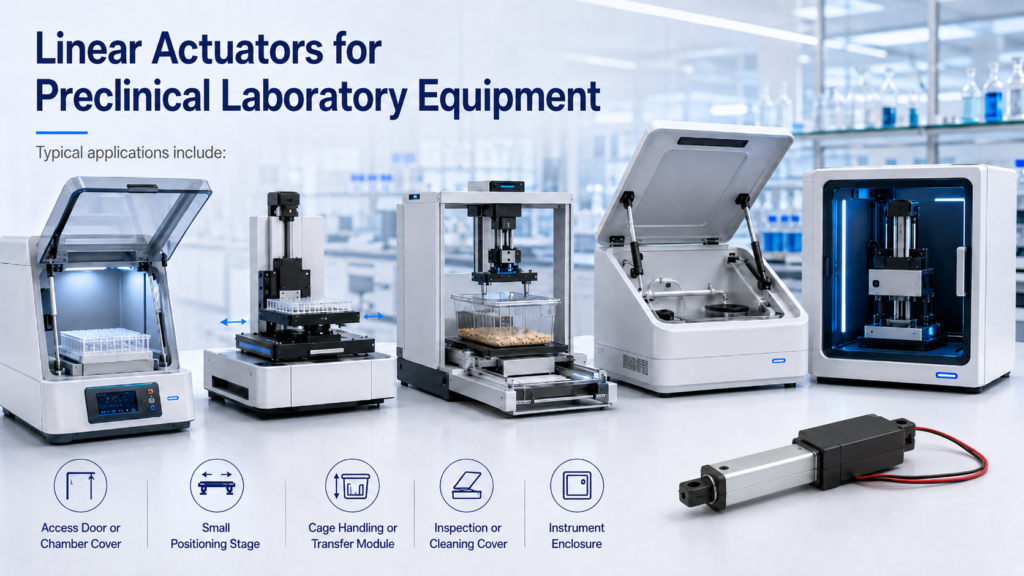
Common Use Cases
| Equipment Area | Typical Motion | Why Electric Actuation Helps |
|---|---|---|
| Access door or chamber cover | Open and close a guarded panel | Provides consistent travel, soft motion and controlled service access. |
| Small positioning stage | Raise, lower or tilt a module | Improves repeatability compared with manual adjustment. |
| Cage handling or transfer module | Move a gate, latch or compact lift | Supports cleaner workflow and lower operator effort. |
| Inspection or cleaning cover | Lift a light service panel | Improves maintenance access while allowing interlock logic. |
| Instrument enclosure | Move a shield or cover | Helps protect optical, sensor or sampling areas during operation. |
Product Parameter Selection Example
Assume a benchtop laboratory instrument uses a powered access door and a small internal positioning stage. The equipment operates near researchers, so the movement should be quiet, predictable and easy to stop.
| Parameter | Example Choice | Selection Basis |
|---|---|---|
| Rated force | 300-1,500 N for small stages; 500-3,000 N for covers | Based on moving part weight, hinge friction, bracket geometry and safety margin. |
| Stroke | 30-120 mm for small stages; 80-250 mm for doors | Chosen from required travel, opening angle and available internal space. |
| Speed | 2-12 mm/s | Slow movement reduces vibration, noise and pinch risk near operators. |
| Voltage | 24V DC | Common for laboratory equipment controllers, sensors and safety circuits. |
| Feedback | Limit switches for end positions; Hall feedback for presets | Use feedback when the instrument stores repeatable positions or reports status to software. |
| Noise | Low-noise gearbox and soft start/stop control | Research environments need smooth movement without sudden starts or harsh end stops. |
| Protection | IP54/IP65 depending on cleaning and dust exposure | Choose protection based on the real cleaning process and particle exposure. |
Engineering Notes
- Separate movement from guidance. Rails, hinges or columns should carry side loads; the actuator should push and pull axially.
- Control vibration. Low speed, rigid brackets and smooth acceleration help protect sensitive sensors and test modules.
- Plan cleaning access. Avoid cable traps and hidden debris points around moving covers.
- Use interlocks where needed. Powered access doors and moving shields may require position confirmation before a test cycle starts.
- Consider lifting columns for guided vertical motion. If a platform must remain stable under off-center load, a compact lifting column may be better than an exposed actuator.
Information Needed for Accurate Sizing
- Moving part weight and center of gravity
- Required stroke, door angle or stage travel
- Available mounting points and internal space
- Required speed and acceptable noise level
- Controller voltage and feedback requirement
- Cleaning process, dust exposure and service access needs
FAQ
Can a linear actuator be used inside compact laboratory equipment?
Yes. Compact actuators are suitable for access doors, covers, latches and small positioning stages when the stroke and mounting geometry are correct.
Is feedback required?
Feedback is useful for stored positions, software confirmation or repeatable intermediate travel. Simple open/close covers may only need limit switches.
What speed is suitable for lab equipment?
Many laboratory mechanisms work best at moderate speeds, often around 2-12 mm/s, because smoothness and low vibration matter more than speed.
What is the main mechanical risk?
Side load from poor bracket geometry. The actuator should not be used as a guide rail.