
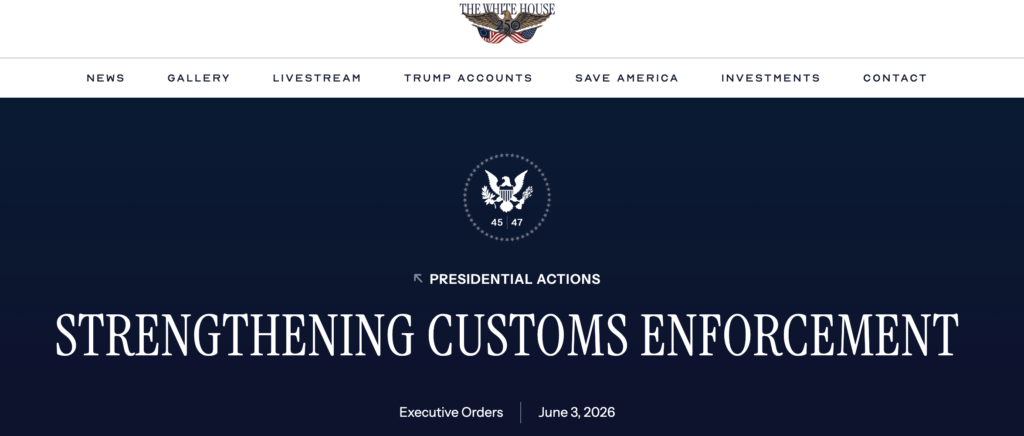
In June 2026, the White House issued an Executive Order titled “Strengthening Customs Enforcement.” The order directs the Department of Homeland Security and U.S. Customs and Border Protection to strengthen several areas of U.S. import enforcement, including importer-of-record accountability, bonding requirements, foreign importer eligibility, import disclosure, supply chain certification, and penalties for non-compliance.
For U.S. buyers importing industrial products such as electric linear actuators, lifting columns, motion systems, and customized mechanical components, this is not just a policy headline. It may affect how future shipments are prepared, how DDP deliveries are arranged, and how much documentation may be required before goods can enter the United States smoothly.
This article summarizes what the new customs enforcement direction may mean for U.S. importers and overseas suppliers.
1. The Importer of Record Will Become More Important
The Importer of Record, often called the IOR, is the party responsible for ensuring that imported goods are correctly declared to U.S. Customs. This includes product classification, declared value, country of origin, duty payment, and compliance with relevant U.S. import laws.
Under the new enforcement direction, U.S. Customs is expected to place more emphasis on whether the IOR is clearly identified, financially responsible, properly bonded, and in good standing with CBP.
This matters because many international shipments, especially DDP shipments, involve more parties than customers may realize: exporter, freight forwarder, customs broker, importer of record, warehouse, and final buyer. If the IOR role is unclear or assigned to an unsuitable party, the risk of customs delay, additional documentation requests, shipment hold, penalty, or refusal may increase.
2. Foreign Importers of Record May Face Higher Requirements
One of the most important points in the Executive Order is the treatment of foreign importers of record.
In many cross-border transactions, an overseas seller, freight forwarder, or logistics provider may act as the importer of record to deliver goods to the U.S. buyer under DDP terms. This can be convenient, especially for small or low-value shipments. However, U.S. authorities are now paying closer attention to whether foreign IORs can be effectively held accountable for customs compliance.
The order directs CBP to impose higher requirements on foreign IORs, including restrictions on informal entry and stronger requirements for formal entry. This may make some DDP shipment structures more difficult, more expensive, or slower in the future.
For U.S. buyers, the practical point is simple: if your shipment depends on a foreign party acting as the importer of record, it is worth reviewing this arrangement early with your customs broker.
3. More Product and Supply Chain Information May Be Required
The Executive Order also directs CBP to strengthen import disclosure and certification requirements. Future imports may require more detailed information about the goods, the manufacturer, the product model, specifications, materials, production methods, and supply chain compliance.
For industrial components, this may include:
- Product model number
- Technical specification sheet
- Material or composition information
- Country of origin
- Manufacturer information
- Application or end-use description
- Commercial invoice and packing list
- HS code reference
- Certificate of conformity or origin, where applicable
For customized electric linear actuators and lifting columns, buyers may also need drawings, voltage/current specifications, stroke length, load rating, IP rating, control method, and other technical details to support customs clearance.
This does not mean every shipment will face additional review. However, the direction is clear: incomplete, vague, or inconsistent import documentation will become a bigger risk.
4. Penalties for Incorrect Declarations May Become More Serious
The Executive Order asks CBP to strengthen enforcement against customs non-compliance, including undervaluation, misclassification, illegal transshipment, forced-labor-related violations, and other duty-evasion practices.
For importers, this means that “small shortcuts” can become expensive. Examples include:
- Declaring a lower value than the actual transaction value
- Using an incorrect HS code to reduce duty
- Providing a vague product description such as “parts” or “metal item”
- Misstating the country of origin
- Using a logistics provider that does not clearly explain the import structure
- Relying on informal DDP channels without proper documentation
Industrial buyers should be especially careful because machinery parts, electrical devices, actuators, and control systems often require accurate technical descriptions and proper classification.
5. What This Means for DDP Shipments
DDP can still be a useful shipping term when properly arranged. It allows the buyer to receive goods with fewer logistics tasks. However, under a stricter customs enforcement environment, DDP should not be treated as a simple “door-to-door price.”
A compliant DDP shipment may require:
- A qualified customs broker
- A clearly defined importer of record
- Correct commercial invoice value
- Accurate product description and HS code reference
- Proper duty and tax calculation
- Complete technical documents
- Clear responsibility between buyer, seller, and logistics provider
For U.S. customers who prefer DDP delivery, the best approach is to plan earlier. Shipments arranged before new rules are fully implemented may be easier to process under existing logistics arrangements, while future DDP shipments may require more preparation time, more documents, and more broker review.
6. Recommended Actions for U.S. Buyers
If you regularly import industrial components from overseas suppliers, we recommend the following steps:
Confirm who will act as the Importer of Record
Do not assume that the freight forwarder or overseas seller automatically takes this responsibility. The IOR should be clearly identified before shipment.
Use accurate product descriptions
Avoid vague descriptions. For example, instead of “machine parts,” use “electric linear actuator,” “electric lifting column,” or “DC motor-driven linear actuator,” followed by model number and technical specifications.
Prepare technical documents in advance
For actuator and lifting column shipments, prepare datasheets, drawings, product specifications, and certificates where required.
Avoid undervaluation
The declared value should reflect the actual commercial transaction. Low declared values may create customs risk and delay.
Work with a licensed customs broker
A qualified broker can help review HS code, duty rate, entry type, bond requirement, and IOR responsibility.
Place time-sensitive DDP orders earlier
If your project requires DDP delivery, especially before production deadlines, installation dates, or inventory planning cycles, it is better to confirm the order and shipping arrangement earlier rather than wait until enforcement changes create additional uncertainty.
7. How We Support U.S. Customers
As a manufacturer of electric linear actuators, lifting columns, and customized motion systems, we support U.S. customers with export documentation and product information needed for customs clearance.
We can provide:
- Commercial invoice
- Packing list
- Product datasheet
- Model and specification information
- Country of origin certification
- Technical drawings, when required
For U.S. shipments, we recommend accurate declaration, complete documentation, and early coordination with a licensed customs broker. For customers who request DDP delivery, we can help coordinate logistics options, but the importer-of-record structure and customs responsibilities should be reviewed carefully before shipment.
Conclusion
The new U.S. customs enforcement direction signals a clear shift toward stricter importer accountability, stronger documentation requirements, and heavier penalties for non-compliance.
For U.S. buyers, the safest strategy is not to delay preparation. If you plan to import electric linear actuators, lifting columns, or customized motion systems under DDP terms, early order confirmation and complete documentation can help reduce uncertainty, avoid customs delays, and keep your project schedule under control.
If you have an upcoming U.S. shipment or a DDP delivery request, contact us early so that we can review the product specifications, shipping terms, documentation requirements, and estimated delivery schedule before production and export.
Source basis:
White House Executive Order “Strengthening Customs Enforcement,” White House Fact Sheet on customs enforcement, and CBP importer guidance on importer responsibility.
Strengthening Customs Enforcement – The White House
Fact Sheet: President Donald J. Trump Strengthens Customs Enforcement