
EU customs duty and CPSC eFiling are two 2026 compliance topics that exporters should prepare for before booking international shipments. The EU change affects low-value imports up to €150. The U.S. CPSC change affects most regulated consumer products that require certificates of compliance. They are separate rules, but they create the same practical message for exporters: shipment data must be prepared earlier, more accurately, and in a format that brokers and importers can use.
This article is based on official sources from the European Commission, the Council of the European Union, and the U.S. Consumer Product Safety Commission. It also separates official legal requirements from carrier workflow fields and commercial fees, because those are often mixed together in day-to-day shipping notices.
1. EU low-value customs duty change from July 1, 2026
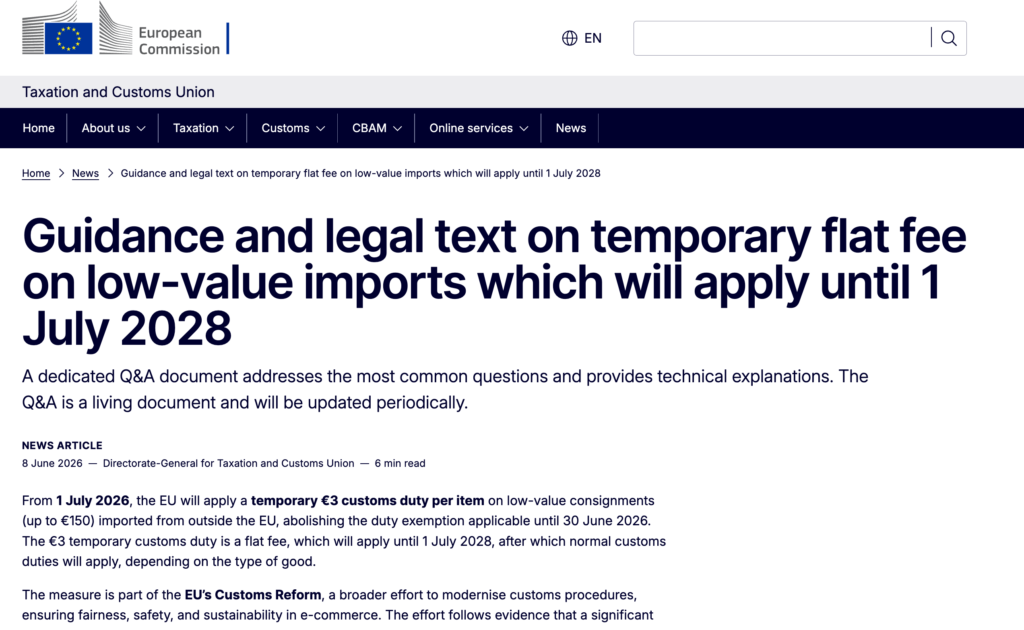
The European Commission states that from July 1, 2026, the EU will apply a temporary €3 customs duty per item on low-value consignments up to €150 imported from outside the EU. This abolishes the customs duty exemption that applies until June 30, 2026. The temporary duty applies until July 1, 2028, after which normal customs duties will apply depending on the type of good.
The Council of the European Union has also stated that the interim flat-rate customs duty of €3 will be levied on each item category contained in a small parcel entering the EU from July 1, 2026 to July 1, 2028. This wording matters. In logistics practice, many carriers and brokers will need clearer HS code, item category, and shipment data to calculate and declare the shipment correctly.
What changes for 0-150 EUR shipments?
Before this change, many low-value consignments under €150 were exempt from customs duty, although VAT and customs declarations could still apply. After July 1, 2026, low-value consignments can no longer be treated as duty-free simply because they are below €150. Exporters should expect more attention to HS codes, declared value, IOSS flow, buyer type, and tariff-line data.
For goods valued at or above €150, the shipment remains subject to normal customs duty rate logic based on classification, value, origin, and applicable EU customs rules. The €3 temporary duty is specifically described by official sources as a temporary flat duty for low-value consignments up to €150.
B2B / B2C data is a logistics workflow issue exporters should not ignore
Many shipping notices now ask exporters to provide the business model, such as B2B or B2C. This is not just a label for sales reporting. It can affect the way a carrier, broker, or platform identifies the shipment flow, duty handling, IOSS treatment, importer information, and clearance process.
If the B2B / B2C field or similar order data is missing, the shipment may be held while the carrier asks for clarification. Some carrier workflows may contact the shipper through their internal notification system, request missing data, or charge additional fees for manual review. These operational fees are not the same as EU customs duty, but they can still affect total landed cost and delivery time.
2. U.S. CPSC certificate eFiling from July 8, 2026
The U.S. Consumer Product Safety Commission has updated certificate requirements under 16 CFR part 1110. CPSC states that imported products generally become subject to the eFiling requirement on July 8, 2026. Products entered from a Foreign Trade Zone have a later effective date of January 8, 2027.
CPSC’s General Certificate of Conformity page states that beginning July 8, 2026, importers of most regulated consumer products will be required to electronically file certificate data with U.S. Customs and Border Protection through a Partner Government Agency Message Set. This does not create the certificate requirement itself from zero. CPSC certificate requirements have existed for regulated products for many years. The 2026 change is about electronic filing of certificate data at import.
What certificate data may be filed?
Importers can prepare for two filing paths. One path is a full electronic filing through the CPSC PGA Message Set, with certificate data submitted at entry. The other path is using CPSC’s Product Registry, where certificate data is uploaded in advance and then referenced during import filing. In both cases, the importer of record remains responsible for accurate and timely data.
For exporters, this means the U.S. importer may ask earlier for product model information, applicable safety rules, test reports, manufacturing details, laboratory information, and certificate documents. If your product is not a CPSC-regulated consumer product, the rule may not apply. If it is regulated and requires a certificate, the importer will need complete certificate data before the goods arrive.
Interactive readiness check
The demo below helps visualize which data points can create clearance risk. It is not a legal calculator, but it can help sales, logistics, and compliance teams understand why shipment booking data and product certificate data should be checked before dispatch.
Practical action list for exporters
For EU shipments, confirm the buyer type, shipment value, HS code, item category, number of tariff lines, IOSS or non-IOSS flow, and importer or consignee data. If the shipment contains multiple HS codes, confirm whether the carrier charges additional tariff-line fees and whether the broker needs item-level data before pickup.
For U.S. shipments, first confirm whether the product is a regulated consumer product subject to CPSC certification. If yes, coordinate with the importer of record before shipping. The importer may need product certificate data, testing information, manufacturing information, and PGA filing details through ACE or the CPSC Product Registry.
For GeMinG customers buying linear actuators, electric lifting columns, controls, or customized motion assemblies, the correct shipping documentation depends on product configuration, destination, declared value, and importer role. Product selection pages such as the multi-stage column height calculator help with technical configuration, but customs and product compliance data should be reviewed separately with the importer and broker.
What exporters should avoid
Do not assume that a low-value parcel is duty-free simply because it is below €150. Do not treat carrier service charges as government duty. Do not wait until goods are already in transit to ask whether the buyer is B2B or B2C. Do not ship regulated U.S. consumer products without confirming who will submit CPSC certificate data.
Most shipment delays are not caused by one missing document alone. They usually happen when value, HS code, importer identity, product category, certificate data, and carrier order fields are not aligned. Preparing these data points before pickup is the most practical way to reduce risk.
FAQ
Is the EU €150 customs duty exemption already removed?
No. The official EU date for the temporary €3 customs duty on low-value consignments up to €150 is July 1, 2026. Until June 30, 2026, the existing exemption remains in place according to the European Commission guidance.
Does the EU rule mean every shipment under €150 pays only €3 total?
Not necessarily. Official sources describe a temporary €3 duty per item or item category / tariff heading for low-value consignments. VAT, carrier fees, broker fees, and other service charges are separate issues.
Does CPSC eFiling apply to every U.S. import?
No. It applies to products that are subject to CPSC certificate requirements. Importers should confirm whether the product requires a Children’s Product Certificate or General Certificate of Conformity.
Official sources reviewed
European Commission: Guidance and legal text on temporary flat fee on low-value imports.
Council of the European Union: Council gives final green light to new customs duty rules for small parcels.
U.S. CPSC: Certificates of Compliance and eFiling update, CPSC eFiling program page, and General Certificate of Conformity guidance.