
Note: This application guide discusses general light-aircraft auxiliary mechanisms. It does not describe any specific project, and final aircraft use must follow applicable aviation design, testing and certification requirements.
Intro
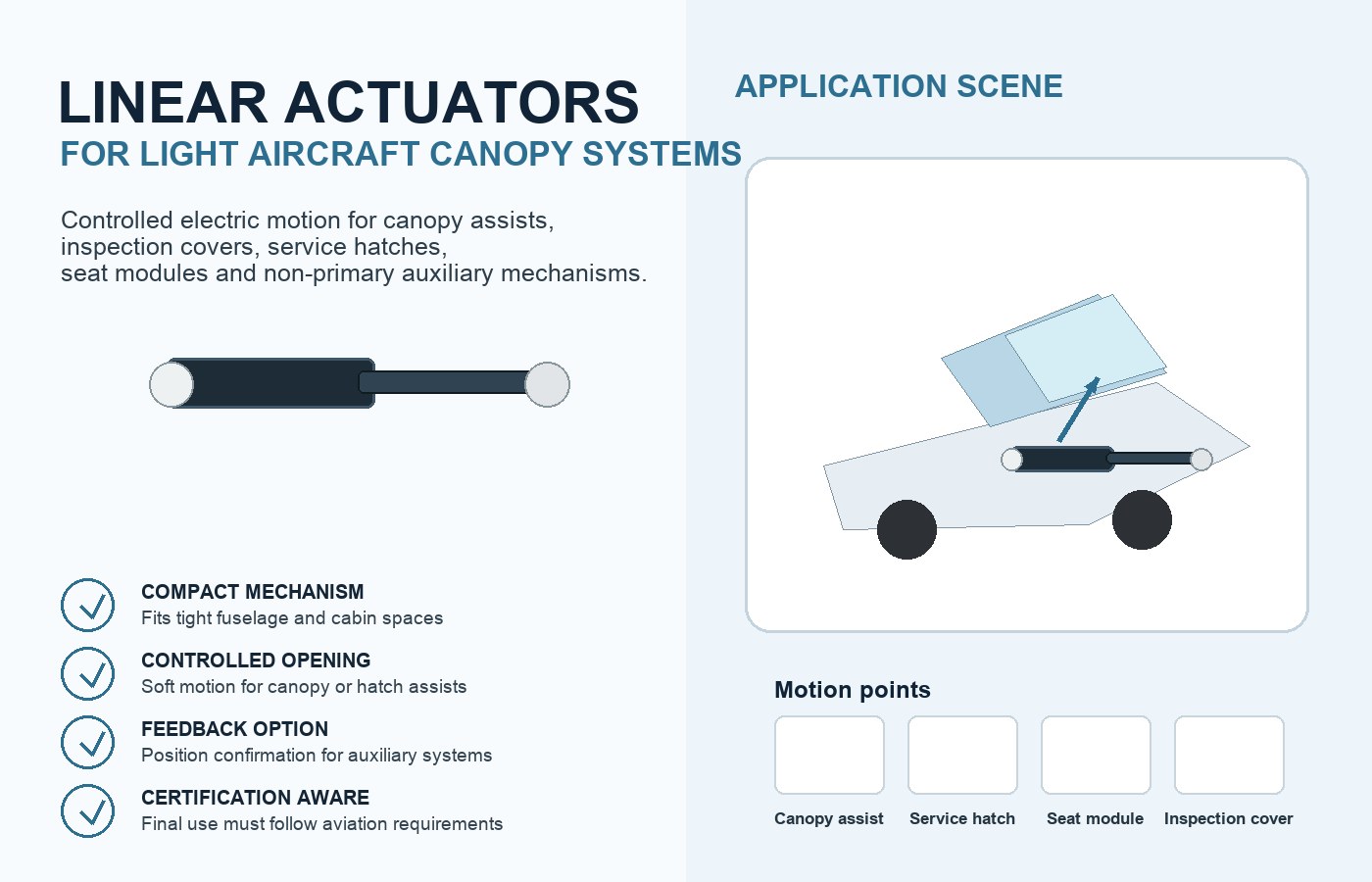
Linear actuators for light aircraft canopy systems can be useful for approved auxiliary motion: canopy assist, inspection hatches, service covers, seat modules and small non-primary mechanisms. The key word is auxiliary. Primary flight controls, certified trim systems and safety-critical actuation require a much higher aviation design and certification process than a standard industrial actuator selection.
Real Application Context
Light aircraft and ultralight aircraft are used for recreational flying, pilot training, observation, medical transport, aerial photography and other civil missions. Their structures often need compact, lightweight mechanisms for access panels, canopy movement, inspection hatches, seats, small equipment mounts and service covers.
Electric actuation is attractive when the mechanism needs controlled travel in a tight space. It can reduce manual effort, improve repeatability and simplify low-voltage control. However, aircraft environments add requirements that are not present in ordinary industrial equipment: vibration, temperature, weight limits, manual release, emergency egress, fail-safe behavior and documentation for the final approval path.
Interactive Motion Demo
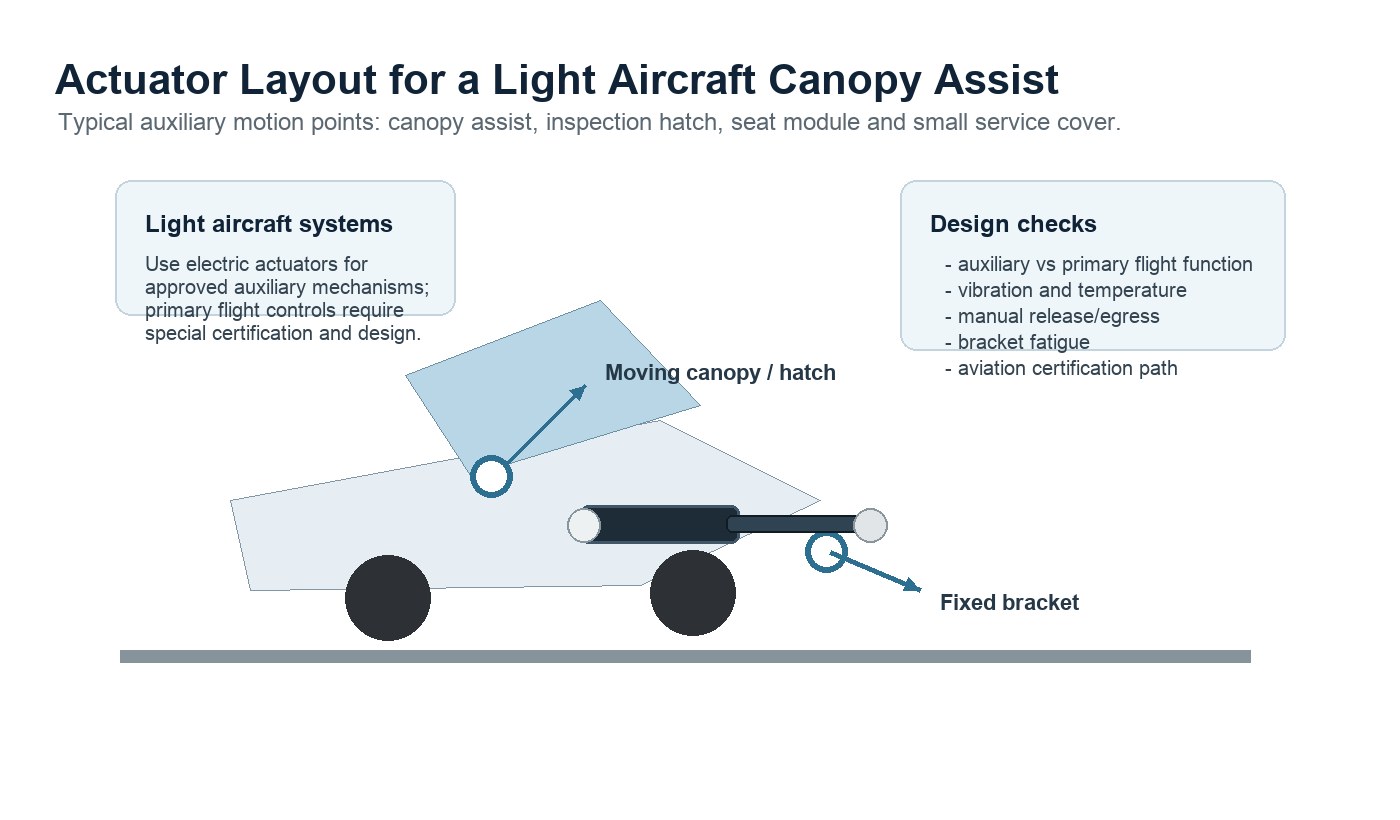
The demo below shows a simplified canopy or hatch assist mechanism. As the actuator extends, the canopy opens through a controlled angle.
Common Use Cases
| Aircraft Area | Typical Motion | Why Electric Actuation Helps |
|---|---|---|
| Canopy assist | Open or support a hinged canopy | Reduces manual effort and creates controlled movement. |
| Inspection hatch | Open a light maintenance panel | Improves service access in compact aircraft structures. |
| Seat or comfort module | Adjust a small seat component or support | Allows controlled positioning where manual access is limited. |
| Equipment mount | Move a camera, sensor or auxiliary module | Supports repeatable non-primary positioning. |
| Service cover | Lift or hold a small cover | Helps maintenance while keeping the mechanism compact. |
Product Parameter Selection Example
Assume a light aircraft auxiliary canopy assist uses a hinged canopy with separate mechanical latching and emergency manual release. The actuator helps open and hold the canopy during ground operation; it is not a primary flight-control device.
| Parameter | Example Choice | Selection Basis |
|---|---|---|
| Rated force | 500-2,000 N for light hatches; higher only after load calculation | Based on canopy weight, hinge geometry, gas spring/counterbalance support and safety margin. |
| Stroke | 100-300 mm | Chosen from required opening angle, closed length and bracket location. |
| Speed | 3-12 mm/s | Slow movement improves control and reduces impact at end positions. |
| Voltage | 12V DC or 24V DC | Depends on aircraft electrical architecture and current limits. |
| Feedback | Limit switches or Hall feedback | Useful for position indication, open/closed confirmation and interlock logic. |
| Manual release | Required for access and emergency egress review | A powered canopy should not trap the occupant or block maintenance if power is unavailable. |
| Environment | Vibration, temperature and moisture checks | Aircraft auxiliary mechanisms see vibration and temperature ranges beyond many indoor devices. |
Engineering Notes
- Separate auxiliary motion from flight-critical control. A canopy assist, hatch or equipment mount is very different from a primary flight-control actuator.
- Use mechanical latching where needed. The actuator should not be the only structure holding a canopy or hatch closed in flight.
- Protect emergency access. Canopy and hatch systems need manual release or alternate access logic as required by the aircraft design.
- Check vibration and fatigue. Brackets, pins and rod-end geometry must survive repeated vibration, not only static lifting force.
- Document the approval path. Final aircraft use should be reviewed under applicable aviation standards, maintenance documentation and test requirements.
Information Needed for Accurate Sizing
- Canopy, hatch or module weight
- Hinge position and target opening angle
- Available closed length and mounting space
- Counterbalance, gas spring or latch arrangement
- Aircraft voltage, current limit and controller logic
- Manual release, vibration, temperature and certification requirements
FAQ
Can a linear actuator open a light aircraft canopy?
It can assist a properly designed canopy or hatch mechanism, but final use must be validated for the aircraft. Mechanical latching, manual release and certification requirements are critical.
Can this type of actuator be used for primary flight controls?
A standard industrial-style actuator should not be assumed suitable for primary flight controls. Flight-critical systems require dedicated aviation design, redundancy, testing and certification review.
Is feedback required?
Feedback is useful when the cockpit or controller needs open/closed confirmation, position display or interlock logic.
What is the main mechanical risk?
Underestimating bracket fatigue and emergency-release requirements. The static force calculation is only one part of the aircraft mechanism design.