
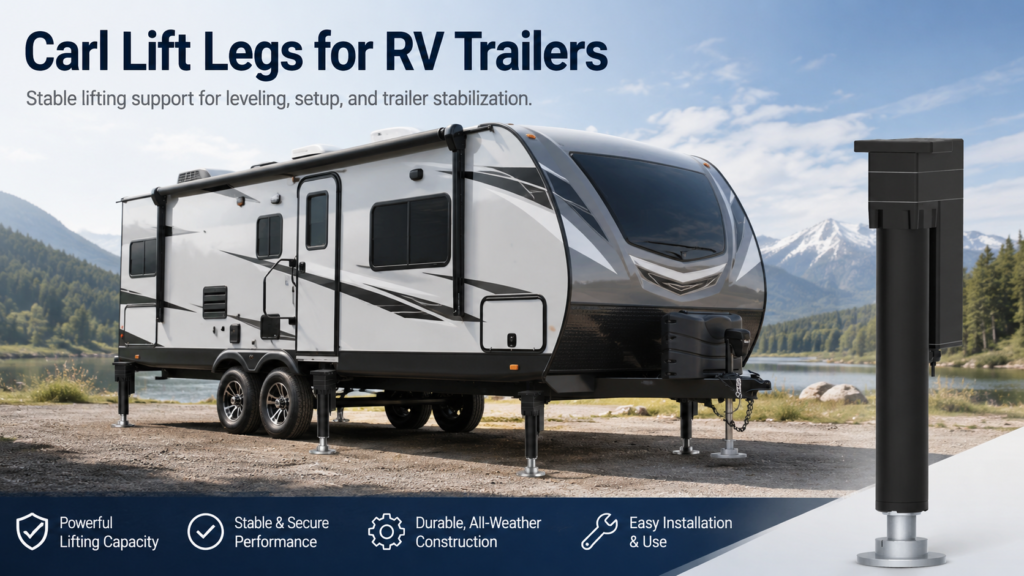
Car lift legs for RV trailers are electric support legs used to stabilize a trailer, motorhome, emergency vehicle, or generator vehicle when parked. For RV users, the value is direct: the vehicle can be leveled on uneven ground, body shaking can be reduced, and long-stay parking can place less continuous load on the tires and suspension.
Based on the GeMinG car lift legs product page and the attached RV trailer product catalog, the key product logic is not only lifting. The system must support the vehicle safely, hold position through self-locking or rated static support, and work with synchronized control so four legs can level the vehicle as a system.
Application: Why RV Trailers Need Electric Lift Legs
When an RV trailer is parked on a campsite, roadside work area, or service yard, the ground is rarely perfectly level. Manual jacks can work, but they take time and depend heavily on user operation. Electric lift legs improve the process by giving controlled height adjustment for each corner of the vehicle.
For longer parking periods, lift legs also help distribute body weight. This can reduce vehicle sway when people move inside the RV and can reduce continuous tire deformation during weeks or months of parking. For heavier special vehicles, the same concept is used during loading, maintenance, generator service, and field operation.
Product Data From GeMinG
The GeMinG car lift legs reference page lists three main electric lifting leg options. The page states that electric lifting legs can support efficient and stable parking, automatic leveling, single-leg adjustment, and four-leg support to reduce vehicle body shaking. The same page also gives concrete product data:
- TL2Z electric lifting legs: 300-500 mm stroke, 24/48 V DC, dynamic 2T / static 7T load, automatic leveling.
- TF75Z electric lifting legs: 300-500 mm stroke, 48 V DC or 220 V AC, dynamic 70 kN / static 120 kN load, automatic leveling.
- TK10Z electric lifting legs: 300-1300 mm stroke, 48 V DC or 220 V AC, dynamic 120 kN / static 200 kN load, automatic leveling.
Interactive Demo: Leveling Logic for RV Lift Legs
The demo below shows the basic leveling logic. Adjust the front and rear leg stroke or switch between camping, service, and heavy-load scenarios. It is not a final model selector; it is a practical way to show why vehicle weight, stroke difference, and four-leg support must be considered together.
Model Selection Matrix
Lift leg selection should not be based on one number alone. A leg may have high static support capacity, but the final system also depends on four-leg distribution, chassis strength, side moment, parking slope, and whether the legs work independently or through synchronized control.
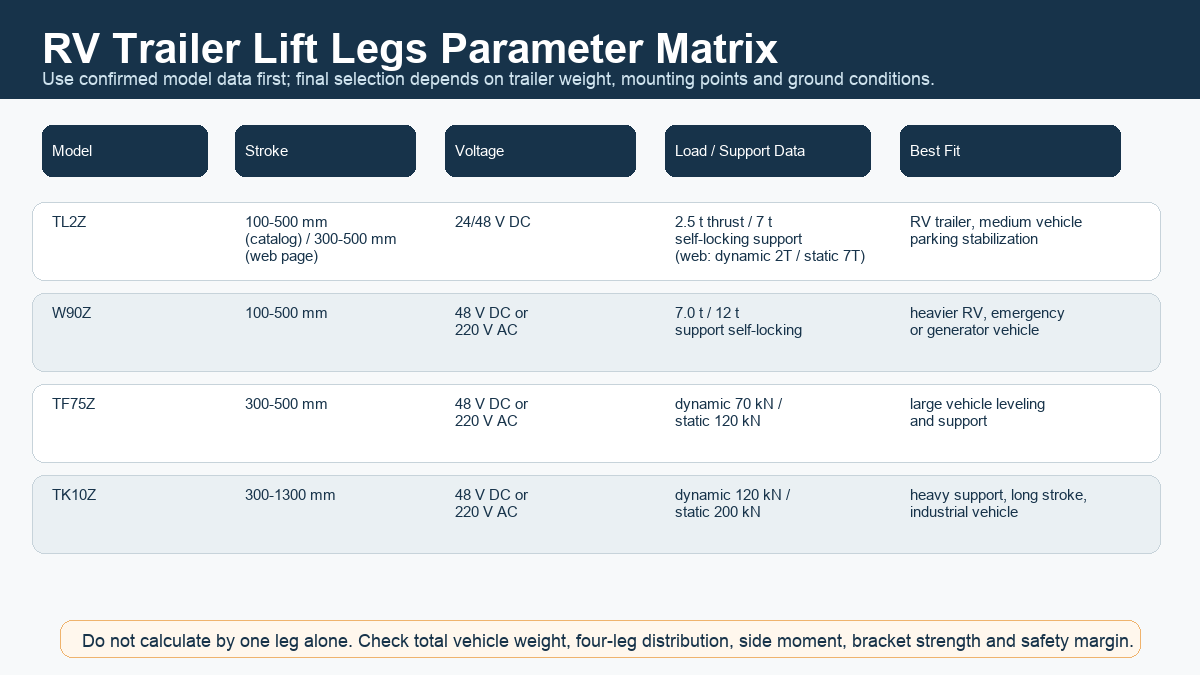
For small and medium RV trailers, TL2Z is a practical starting point because it supports 24/48 V DC control and automatic leveling. For heavier motorhomes, emergency vehicles, or generator vehicles, W90Z, TF75Z, or TK10Z may be more appropriate depending on load, voltage preference, and stroke requirement.
Key Selection Questions Before Ordering
- Vehicle weight: provide the loaded vehicle weight, not only the empty chassis weight.
- Number of support points: four legs are common, but heavier platforms may need a different layout.
- Required stroke: check real campsite slope, parking height, and ground clearance.
- Voltage system: confirm whether the vehicle uses 24 V DC, 48 V DC, or has 220 V AC available.
- Control method: decide between one-button leveling, single-leg adjustment, or integrated vehicle control.
- Mounting bracket: verify original frame holes, beam strength, side load, and installation angle.
- Environment: outdoor RV use should consider IP65 protection, mud, rain, dust, and low-temperature operation.
Why Electric Lift Legs Are Better Than Simple Manual Jacks
Manual stabilizers can be acceptable for light use, but they do not provide the same level of synchronized adjustment. Electric lift legs allow faster setup, repeatable height control, soft start and stop, and integration with automatic leveling. For commercial RV builders or special vehicle manufacturers, this also improves user experience and product consistency.
Compared with hydraulic systems, electric lift legs can offer simpler installation, cleaner maintenance, and easier integration with vehicle electrical systems. The correct choice depends on the vehicle weight, duty cycle, control requirement, and cost target.
Integration With GeMinG Motion Products
Car lift legs are part of a broader electric motion system. The same RV trailer catalog also includes roof lifting electric cylinders, parking lifters, synchronous control, feedback options, EtherCAN / Modbus RTU customization, and built-in high and low limit signals. This makes it possible to design a complete vehicle motion package rather than selecting each actuator separately.
For related GeMinG products, see TF75Z Electric Lifting Legs, TK10Z Electric Lifting Legs, TL2Z Electric Lifting Legs.
Conclusion
Car lift legs for RV trailers are not just convenience accessories. They are support and leveling systems that affect parking stability, body comfort, tire load, and service safety. TL2Z is suitable as a starting option for RV trailer leveling, while W90Z, TF75Z, and TK10Z support heavier vehicle platforms. Final selection should always confirm real vehicle weight, support layout, stroke, voltage, mounting structure, and safety margin.
FAQ
What is the main function of Car lift legs on an RV trailer?
They level and stabilize the RV trailer when parked, reducing sway and helping the vehicle adapt to uneven ground.
Can one lift leg support the entire vehicle?
No. Lift legs should be selected as a system. Four-leg load distribution, frame strength, ground contact and safety margin must be checked.
Which model is suitable for a medium RV trailer?
TL2Z is a practical starting point because it supports 24/48 V DC, automatic leveling, and static support data up to 7 tons. Final selection still depends on the loaded vehicle weight and mounting layout.