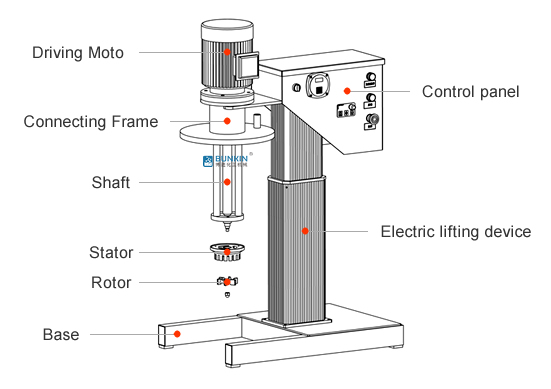
In the chemical machinery industry, many process systems depend on stable vertical positioning as much as they depend on mixing power itself. Whether the equipment is used for fluid dispersion, mixing, grinding, emulsifying, or stirring, the lifting mechanism directly affects process control, cleaning convenience, batch changeover, and operator safety. This is why electric lifting columns for chemical machinery are becoming increasingly valuable in modern production and pilot-scale equipment.

Application examples in the market show how electrically lifted basket mills and electrically lifted mixers are used in process equipment for wet grinding, dispersion, and material agitation. These types of machines highlight a practical industry trend: manufacturers need lifting systems that are smooth, controllable, compact, and suitable for repeated up-and-down operation in demanding process environments. For GeMinG Tech, this is exactly where a well-designed electric lifting column can provide meaningful value.

Why lifting matters in chemical machinery

In chemical process equipment, the lifting structure is not just a support function. It directly influences how the machine enters the vessel, how the mixing or grinding head is positioned, how the operator changes containers, and how cleaning or maintenance is performed. If the lifting system is unstable, difficult to control, or poorly matched to the load, the entire machine becomes harder to use and less reliable in daily production.

This is especially important in machinery used for high-speed fluid processing. Dispersion, grinding, emulsification, and stirring equipment often works with different tank sizes, variable product viscosities, and frequent batch changes. The lifting system must therefore support both process flexibility and mechanical stability.

Typical equipment where electric lifting columns can be used

Electric lifting columns are suitable for a range of chemical machinery and adjacent process equipment, including:

In all of these cases, the lifting mechanism must do more than move vertically. It must hold position, support repeated operation, coordinate with the process vessel, and help the machine operate more efficiently in real production conditions.

Application logic in fluid dispersion and grinding equipment

Reference applications in the market show that electric lift basket mills are used as integrated wet dispersion and grinding equipment for medium and low viscosity materials. In these systems, the process head is lowered into the vessel for operation and raised for cleaning, tank change, or maintenance. This operating method creates a clear need for stable and repeatable vertical movement.

For equipment like this, an electric lifting column can help improve:

In wet grinding and dispersion systems, reliability matters because production often involves repeated batches and different formulations. A lifting solution that is easy to control and mechanically stable helps reduce downtime and improves practical usability.

Key benefits of electric lifting columns in chemical machinery

Stable vertical movement

In process machines, vertical movement needs to be smooth and controlled. A well-designed lifting column provides guided motion that helps support better mechanical consistency than a simpler unguided lifting arrangement.

Cleaner machine integration

Chemical machinery benefits from structures that are easier to clean, easier to protect, and easier to integrate into compact equipment designs. A lifting column can help simplify the machine structure compared with more exposed lifting arrangements.

Improved operator convenience

Operators often need to raise the processing unit to inspect, clean, replace vessels, or change materials. Electric lifting can make these tasks more efficient and reduce manual effort.

Support for different vessel sizes and process setups

In pilot, lab, and small-scale production equipment, the same machine may work with different containers or process volumes. Adjustable lift helps improve flexibility across changing requirements.

Better suitability for customized machinery

Many process machines are not fully standardized. Load, stroke, head structure, installation height, and environmental requirements often vary by customer. Electric lifting columns are well suited to custom machinery development where integration details matter.

Important selection considerations

When selecting a lifting solution for chemical machinery, engineers should evaluate more than stroke and load. The most important factors usually include:

These factors become especially important in equipment used for coatings, inks, adhesives, dyes, pharmaceuticals, ceramics, and other process-sensitive materials. In many cases, the best lifting solution is determined by the full machine design rather than by lifting force alone.

How electric lifting columns support modern process equipment design

As chemical machinery becomes more specialized, equipment builders are under pressure to improve usability, process repeatability, cleaning efficiency, and safety. A reliable electric lifting system helps support all of these goals. Instead of treating lifting as a basic mechanical add-on, more designers now treat it as part of the overall machine function.

This is particularly relevant in equipment that handles fluid materials with frequent formula changes, multiple tank sizes, or high cleaning demands. In these cases, smooth electric lifting helps bridge the gap between process efficiency and operator practicality.

Conclusion

Electric lifting columns for chemical machinery are a practical and increasingly important solution for equipment used in fluid dispersion, mixing, grinding, emulsifying, and stirring applications. Whether the machine is a basket mill, a high-speed disperser, an electric lift mixer, or a customized process system, the lifting mechanism influences machine stability, operator experience, and overall process efficiency.

For equipment builders and integrators, the key is to evaluate the real working conditions of the machine, including load, stroke, structural layout, process environment, and cleaning requirements. With the right configuration, an electric lifting column can help create a more reliable and more practical solution for chemical machinery applications.

If you are developing process equipment that requires stable vertical movement, GeMinG Tech can help review your machine structure, load requirements, stroke range, and environmental conditions to assess a suitable lifting solution.

FAQ

What chemical machinery can use electric lifting columns?

They can be used in basket mills, dispersers, mixers, agitators, emulsifying machines, pilot systems, and other process equipment that requires controlled vertical adjustment.

Why is lifting important in dispersion and grinding equipment?

The lifting system affects head positioning, tank changeover, cleaning access, maintenance efficiency, and overall operator convenience.

Can lifting columns be customized for chemical process machines?

Yes. Many applications require customized stroke, load support, material selection, control integration, and protection levels based on the machine design.

What should engineers evaluate before selecting a lifting solution?

They should review load, stroke, retracted height, installation layout, environmental exposure, duty cycle, and any special material or safety requirements.