
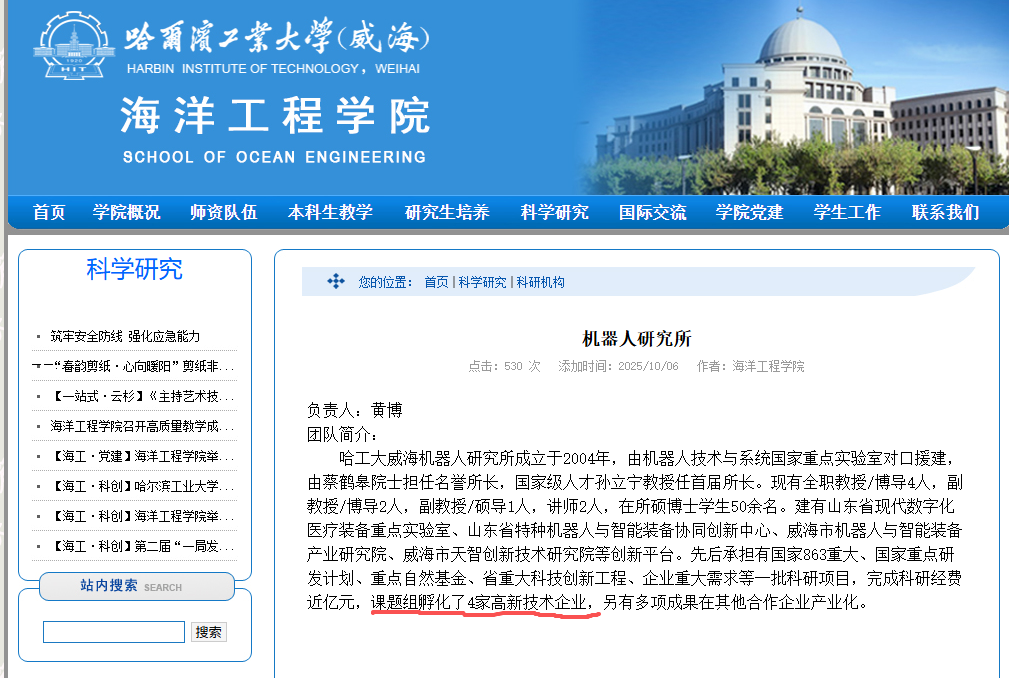
Robotics collaboration project is becoming an important part of GeMinG’s product development and application engineering work. Recently, GeMinG communicated with the Robot Research Institute of Harbin Institute of Technology, Weihai, around a robotics project involving electric actuators, lifting columns, motion control, and customized mechanical integration.
The discussion focused on how actuator products can better support robot platforms in real engineering environments. In robot systems, an actuator is not only a component that moves forward, backward, upward, or downward. It also affects structural stability, positioning repeatability, safety margin, service life, and the way the complete machine responds under load.
Why this robotics collaboration project matters
Robotics projects usually place higher demands on electric motion components than standard machinery. A robot workstation may need controlled vertical lifting, accurate tool positioning, compact installation, stable support for sensors or grippers, and reliable movement during repeated cycles. If the actuator is not selected correctly at the early design stage, the whole robot system may face vibration, limited stroke, insufficient stiffness, wiring interference, or difficult commissioning.
That is why early technical communication is valuable. By discussing load, stroke, speed, mounting space, control method, and safety requirements before the prototype stage, the actuator solution can be designed around the robot system instead of being added as an afterthought.
Application direction discussed in the project
GeMinG’s product experience covers linear actuator systems, electric lifting column products, servo-driven lifting solutions, control boxes, hand controllers, and customized motion assemblies. These products can be used in different robotics-related scenarios, including robot height adjustment, sensor lifting, mobile robot work modules, end-effector positioning, inspection equipment, and auxiliary axes for industrial automation.
For robotics use, the key is not simply choosing the strongest actuator. The correct solution depends on the real load case. Engineers need to confirm the static load, dynamic load, load center, required stroke, operating speed, duty cycle, installation direction, protection level, power supply, and controller interface. In some applications, a compact actuator is enough. In other applications, a lifting column or guided lifting structure is more suitable because it provides better resistance to side load and bending moment.
Combining academic research and manufacturing experience
The Robot Research Institute of Harbin Institute of Technology, Weihai has a long-term research background in robotics and intelligent equipment. GeMinG brings manufacturing experience in electric actuators and lifting systems. The value of this cooperation is to connect research requirements with practical product engineering.
For a robotics project, laboratory verification and industrial application often have different requirements. A motion module may work in a short demonstration, but production use also requires repeatability, temperature control, structural reliability, protection against dust or moisture, stable wiring, and safe behavior under abnormal conditions. GeMinG’s role is to help evaluate these practical constraints and provide actuator solutions that can be manufactured, assembled, tested, and maintained.
How GeMinG actuator solutions support robotics
GeMinG actuator and lifting column products can help robot developers solve several common engineering problems. They can extend the working height of a robot station, lift inspection modules to different positions, adjust tooling height for multiple workpieces, support camera and sensor platforms, and provide controlled linear movement where pneumatic or hydraulic systems are not ideal.
Compared with pneumatic solutions, electric actuators provide easier position control and cleaner installation. Compared with hydraulic systems, electric motion systems can reduce leakage risk and simplify maintenance in many light and medium-duty robot applications. For heavy-load or high-stability applications, GeMinG can evaluate whether a servo actuator, lifting column, dual-column structure, or customized guided module is more suitable.
Looking ahead
This robotics collaboration project reflects GeMinG’s continued investment in intelligent equipment and automation applications. The company will keep improving product reliability, structural design, motor control options, and customized engineering support for robot manufacturers, research teams, and automation integrators.
GeMinG welcomes more robotics and intelligent equipment projects where electric actuators, lifting columns, and motion control systems are required. By understanding the real application conditions early, GeMinG can help customers select a more reliable motion solution and reduce uncertainty during prototype development.