
Note: This application guide discusses general laboratory containment equipment design. It does not describe any specific project.
Intro
Linear actuators for laboratory hoods can support controlled movement for fume hood sashes, biosafety cabinet access panels, service covers and compact laboratory modules. The actuator is not the safety system by itself; airflow design, filtration, certification and operating procedures remain separate requirements.
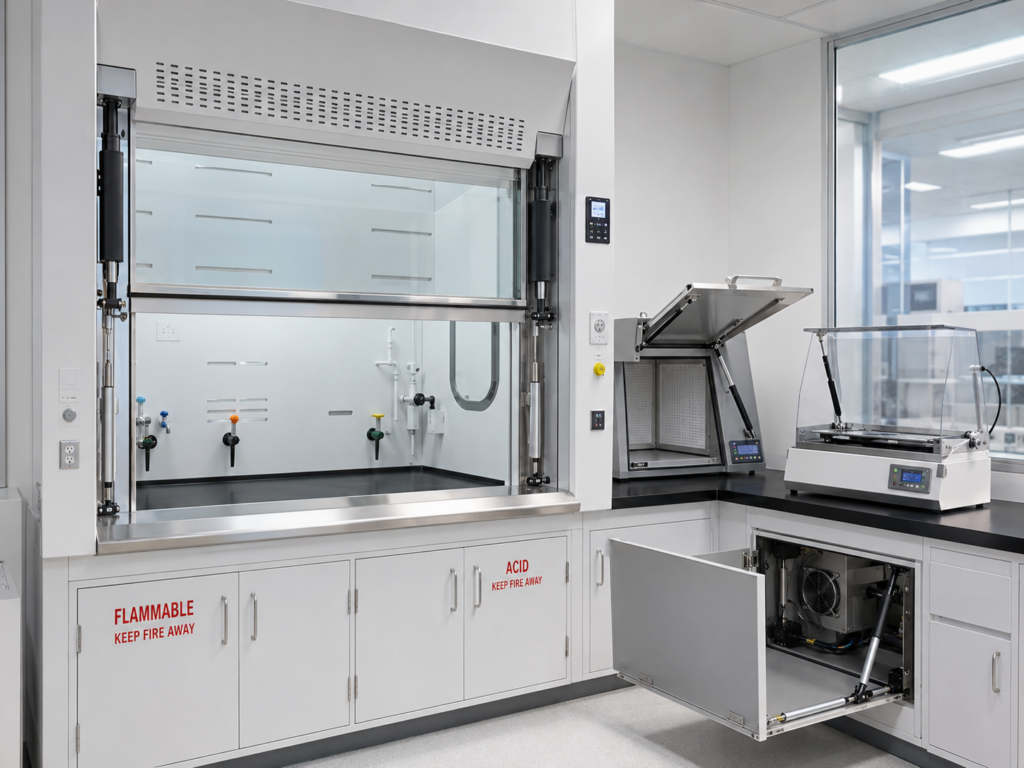
Real Application Context
Laboratory fume hoods protect personnel by exhausting chemical fumes and vapors from the work area. Biological safety cabinets use controlled airflow and HEPA or ULPA filtration to help protect personnel, samples and the environment from hazardous particulates. In both equipment families, front access, sash position and maintenance covers influence how users interact with the enclosure.
Many laboratory hoods use manual or counterbalanced sashes. Electric actuation becomes useful when the equipment builder needs controlled open/close travel, position indication, interlock logic, remote operation, reduced manual lifting effort or an automated service cover. The design must be conservative because sash movement can affect containment performance if it is not coordinated with the equipment’s airflow and safety logic.
Interactive Motion Demo
The demo below shows a simplified vertical sash. As the actuator extends or retracts, the opening height changes and the controller can display the sash position.
Common Use Cases
| Equipment Area | Typical Motion | Why Electric Actuation Helps |
|---|---|---|
| Fume hood sash | Controlled vertical opening | Supports position indication, remote operation and soft movement. |
| Biosafety cabinet access panel | Move a guarded front panel or service cover | Improves controlled access while preserving interlock logic. |
| Filtered cabinet cover | Open a maintenance or filter access panel | Reduces manual lifting effort during service. |
| Laminar flow module | Move a small door, shield or tray | Supports repeatable positioning inside compact equipment. |
| Instrument enclosure | Raise or lower a protective shield | Helps coordinate user access with process status. |
Product Parameter Selection Example
Assume a laboratory hood uses a powered vertical sash with counterbalance support. The actuator’s job is controlled positioning, not carrying the entire sash weight alone.
| Parameter | Example Choice | Selection Basis |
|---|---|---|
| Rated force | 500-2,000 N for balanced sashes; higher only after calculation | Based on residual sash load, friction, guide resistance and safety margin. |
| Stroke | 150-500 mm | Chosen from required opening height and actuator mounting space. |
| Speed | 3-12 mm/s | Slow movement reduces pinch risk and prevents abrupt airflow disturbance. |
| Voltage | 24V DC | Common for control boards, sensors, relays and interlock circuits. |
| Feedback | Hall feedback or potentiometer for position confirmation | Useful when the controller must confirm sash height before enabling operation. |
| Protection | IP54/IP65 depending on cleaning and exposure | Selected from cleaning method, chemical exposure and enclosure placement. |
| Safety | Anti-pinch input, current limit and manual release | Important because the moving sash is close to the operator’s hands. |
Engineering Notes
- Do not bypass airflow certification. Motorized sash movement must be validated with the hood or cabinet’s airflow and safety requirements.
- Use guides and counterbalance where appropriate. The actuator should control motion; rails, guides or counterweights should manage load and alignment.
- Control pinch points. Use slow speed, guarded edges, force limits or sensors where the sash moves near the operator.
- Coordinate with alarms and interlocks. Sash position may need to connect to airflow alarms, fan status or process lockout logic.
- Plan service access. The sash or cover should be movable for maintenance even if the control system is unavailable.
Information Needed for Accurate Sizing
- Sash or panel weight and counterbalance method
- Required opening height and actuator stroke
- Guide friction and available mounting geometry
- Required position feedback and interlock logic
- Cleaning method and chemical exposure
- Applicable laboratory safety, airflow and certification requirements
FAQ
Can a linear actuator motorize a laboratory fume hood sash?
Yes, if the sash is properly guided and the design is validated with the hood’s airflow and safety requirements. The actuator should not be treated as a substitute for containment testing.
Is position feedback required?
Feedback is recommended when sash position affects alarms, airflow modes, user access or process lockout logic.
What speed is suitable for a powered sash?
Slow speeds, often around 3-12 mm/s, are preferred because they reduce pinch risk and avoid abrupt motion near the operator.
What is the main design risk?
Assuming the actuator only needs to lift the weight. In practice, guide friction, sash balance, airflow requirements, pinch safety and service access all matter.