
Note: This guide discusses general engineering requirements for road-sign and warning-module equipment. Final actuator sizing should be checked against the actual sign area, wind load, linkage geometry and local road-safety rules.
Intro
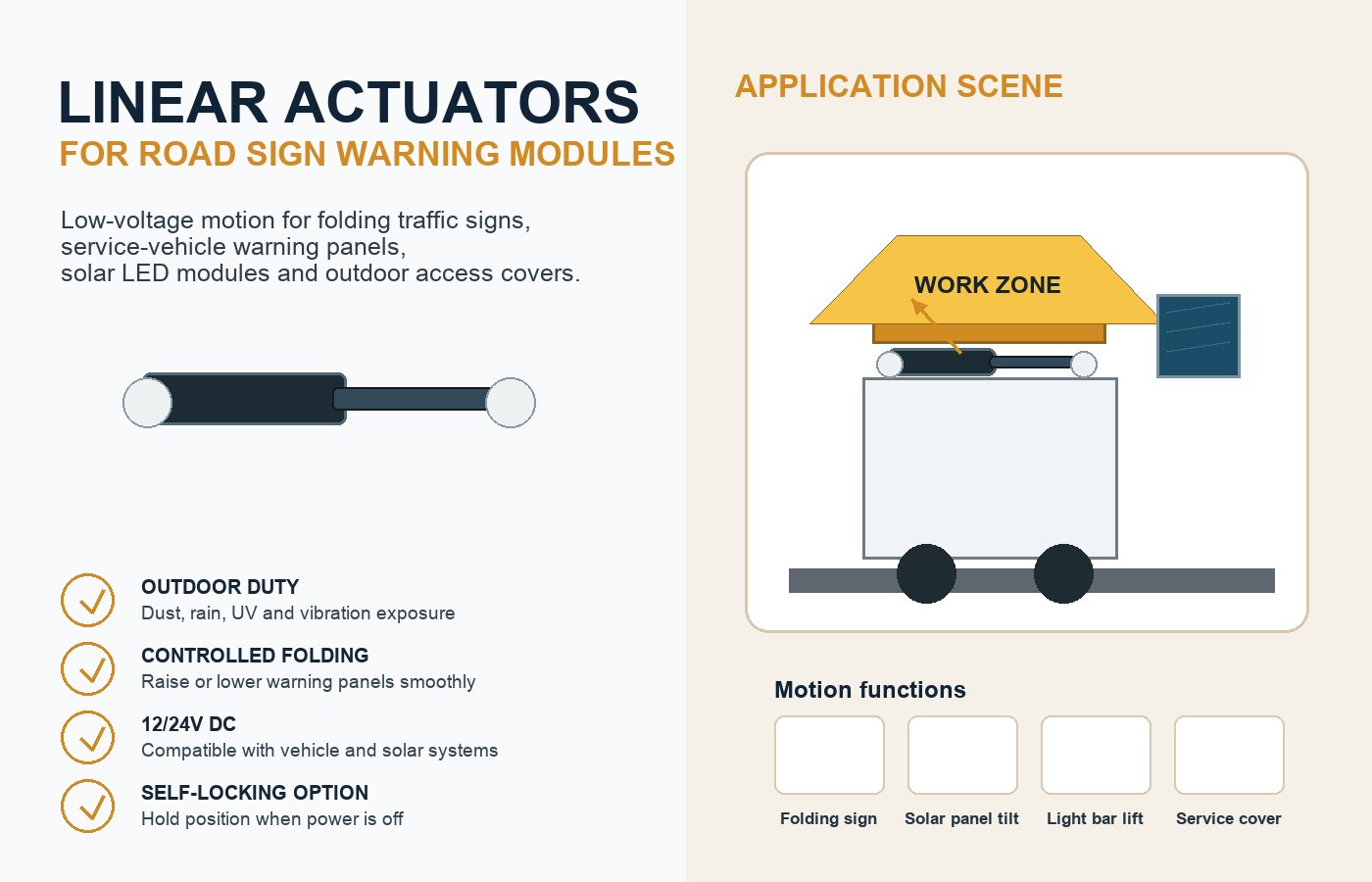
Linear actuators for road sign warning modules provide controlled electric motion for folding traffic signs, solar LED warning panels, service-vehicle warning triangles, access covers and small tilting mechanisms. The application is not about high speed; it is about reliable outdoor movement, stable holding and simple low-voltage control.
Roadside warning equipment often works in rain, dust, vibration, sunlight and wind. A sign panel may only move a few times per day, but it must deploy when needed and stay in position without drifting. This is a good fit for a sealed DC linear actuator with suitable brackets, self-locking capability and limit or position feedback.
Real Application Context
Modern traffic equipment increasingly combines LED visibility, solar power, batteries and compact control electronics. Solar-powered warning signs reduce the need for trenching and grid wiring, while vehicle-mounted warning systems help road-service teams work safely near traffic. Some systems also use folding or tilting structures so the warning panel can be stowed during transport and deployed during work.
Public product examples in this sector show solar LED signs, solar beacons, traffic-warning modules and service-vehicle signaling kits. Several vehicle kits include manual or electric raising functions for warning triangles. These products create a realistic need for compact 12V or 24V linear motion that can operate outdoors and hold a panel in a defined position.
Where a Linear Actuator Fits
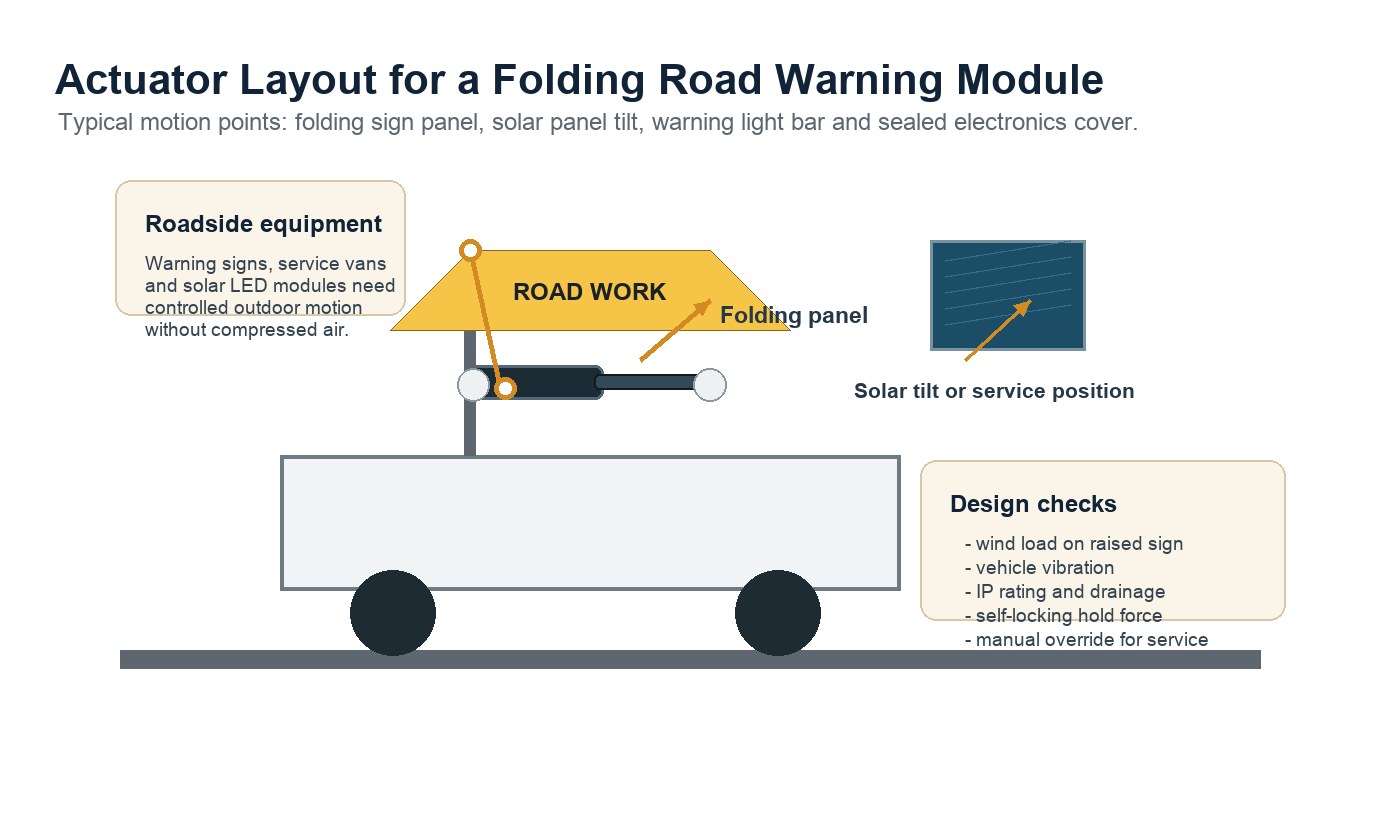
Folding warning sign panels. A linear actuator can raise a roof-mounted or trailer-mounted warning panel from a stowed position to a visible working angle. The key checks are wind load, bracket stiffness, self-locking and safe travel limits.
Solar panel tilt or service position. On solar-powered signs, a small actuator may be used where the solar module or equipment cover needs to move for maintenance, transport or seasonal adjustment.
Light bar and beacon modules. A compact actuator can lift or retract a warning light module when equipment has height limits during transport or storage.
Sealed electronics covers. Outdoor traffic equipment contains batteries, chargers, LED drivers and communication modules. A small actuator can open a protected service cover when remote or controlled access is required.
Interactive Folding Sign Demo
The simplified demo below shows how an actuator can raise a warning panel from a stowed position to a deployed position. Real force depends on the panel area, wind pressure, pivot location and actuator mounting angle.
Engineering Requirements
Wind load. A raised warning panel behaves like a small sail. The actuator force must be checked under expected wind conditions, not only under calm indoor testing. Large panels may need stronger brackets, mechanical stops or a lock that carries the wind load instead of leaving all load on the actuator.
Self-locking and position hold. For warning signs, drift is unacceptable. A self-locking actuator or a separate mechanical lock helps keep the sign deployed or stowed when power is off.
Outdoor protection. Road equipment may face rain, dust, road spray, UV exposure and temperature swings. Start with IP65/IP66-level protection, sealed connectors and cable routing that avoids water traps.
Vibration resistance. Vehicle-mounted modules and trailers vibrate during transport. Mounting brackets should keep the actuator loaded along its axis and avoid bending the rod.
Low-voltage control. 12V DC fits vehicle systems; 24V DC is common for solar and industrial control cabinets. The motor current, cable length and battery capacity must be checked together.
Product Parameter Selection Example
Assume a roof-mounted folding warning panel has a moving panel weight of 12 kg, a panel height of 700 mm and a target opening angle of 70 degrees. The actuator is mounted between the fixed frame and the back of the panel, with a short linkage that gives roughly 150 mm of actuator travel.
Force: 1,500-3,000 N. The static panel weight alone may not require this much force, but wind load, pivot friction, linkage angle and vibration justify a higher starting range. If the panel is larger or exposed to highway-speed wind during deployment, the structure should add a mechanical lock or stop.
Stroke: 100-200 mm. A compact folding warning panel usually needs a short stroke. The final stroke must be calculated from the hinge geometry so the actuator reaches both stowed and deployed positions without bottoming out.
Speed: 5-15 mm/s. Warning panels do not need fast motion. A moderate speed gives smoother deployment and reduces impact at the end of travel.
Voltage: 12V or 24V DC. Use 12V for direct vehicle systems. Use 24V when the equipment already has a solar charge controller, battery pack or industrial control cabinet designed around 24V.
Feedback: limit switches for simple systems; position feedback for controlled deployment. Simple open/close motion can use built-in limit switches. If the panel must stop at several angles, choose a feedback option.
Protection: IP65/IP66 with protected wiring. Select sealed cables and plan drip loops, connector placement and rod shielding before field testing.
Integration Checklist
Before selecting an actuator, prepare the panel size, panel weight, hinge location, expected wind exposure, desired opening angle, available voltage, duty cycle, required deployment time and whether the sign must hold position during power loss. A side-view sketch with pivot and bracket distances is the fastest way to calculate force.
For vehicle-mounted systems, also check transport vibration, legal height limits, manual override needs and the control logic that prevents accidental deployment while driving.
Why Electric Actuation Is Practical Here
Pneumatics are rarely available on small road-sign trailers or service vans. Hydraulics add pump, oil, hoses and maintenance. A compact electric actuator is usually easier to integrate because it combines motor, gearbox, screw and limit control in one package. It also works naturally with battery and solar-powered traffic equipment.
Related GeMinG Products
GeMinG supplies electric linear actuators for outdoor automation, traffic-related equipment and mobile machinery. For force and stroke basics, review our electric linear actuator selection guide. For vertical display or workstation motion, see electric lifting column resources.
Conclusion
Solar road signs and service-vehicle warning modules need dependable motion more than high speed. A properly selected linear actuator can raise panels, adjust solar modules, open protected covers and hold outdoor equipment in a stable position. The correct choice depends on wind load, geometry, voltage, IP protection and the required holding method.
FAQ
Can a linear actuator hold a warning sign in the raised position?
Yes, if the actuator is self-locking or the structure includes a separate mechanical lock. Wind load must be included in the calculation.
Is 12V or 24V better for road warning equipment?
12V is common on vehicles. 24V is often better for solar or control-cabinet systems because current is lower for the same power level.
What stroke is typical for a folding sign panel?
Many compact panels start around 100-200 mm, but the final stroke depends entirely on hinge and bracket geometry.
What protection rating should be used outdoors?
IP65/IP66 is a practical starting point. Road spray, dust, UV exposure and cable routing should be checked during design.