
Note: This application guide is based on public industrial automation context and general engineering requirements. It does not disclose any confidential project details.
Intro
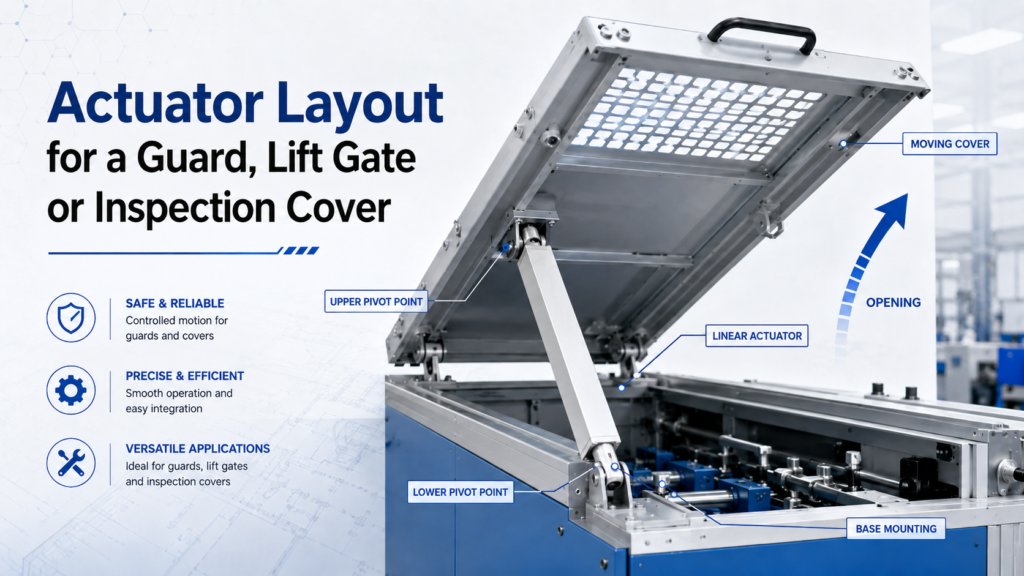
Industrial automation lines often need compact electric motion for conveyor gates, inspection hoods, adjustable robot fixtures, transfer modules, and service covers. A linear actuator or lifting column can replace manual adjustment or pneumatic movement when the system needs cleaner wiring, repeatable positions, and simple PLC control.
Why This Application Fits Electric Actuators
Factory automation equipment usually works in defined positions: open or close a gate, lift a small stop, adjust a fixture, or move a cover for maintenance. These are ideal motion cases for electric linear actuators because the stroke, speed, and end positions can be controlled without a large hydraulic or pneumatic package.
Public information from SilverSteel Engineering shows a focus on turnkey industrial automation, food process automation, customized machinery, processing machinery, packaging, motion technology, robot technology, AGV/AMR, inspection, and system integration. Those equipment categories commonly contain guarded moving panels, conveyor stops, robot tooling adjustments, and compact lift mechanisms.
Interactive Motion Demo
The demo below shows a simplified conveyor lift gate. The actuator stroke increases as the gate opens to create product clearance.
Common Use Cases
| Station Area | Typical Motion | Actuator Benefit |
|---|---|---|
| Conveyor stop or diverter | Raise, lower, or push a guide | Repeatable product routing with compact mounting. |
| Inspection cover or hood | Open a guarded panel | Cleaner service access with limit-controlled travel. |
| Robot fixture | Adjust tool height or position | Supports changeover between product sizes. |
| Packaging station | Move guides, clamps, or small presses | Simple electrical integration with PLC logic. |
| AGV/AMR transfer module | Lift a latch, pin, or compact platform | Low-voltage motion suited to mobile equipment. |
Product Parameter Selection Example
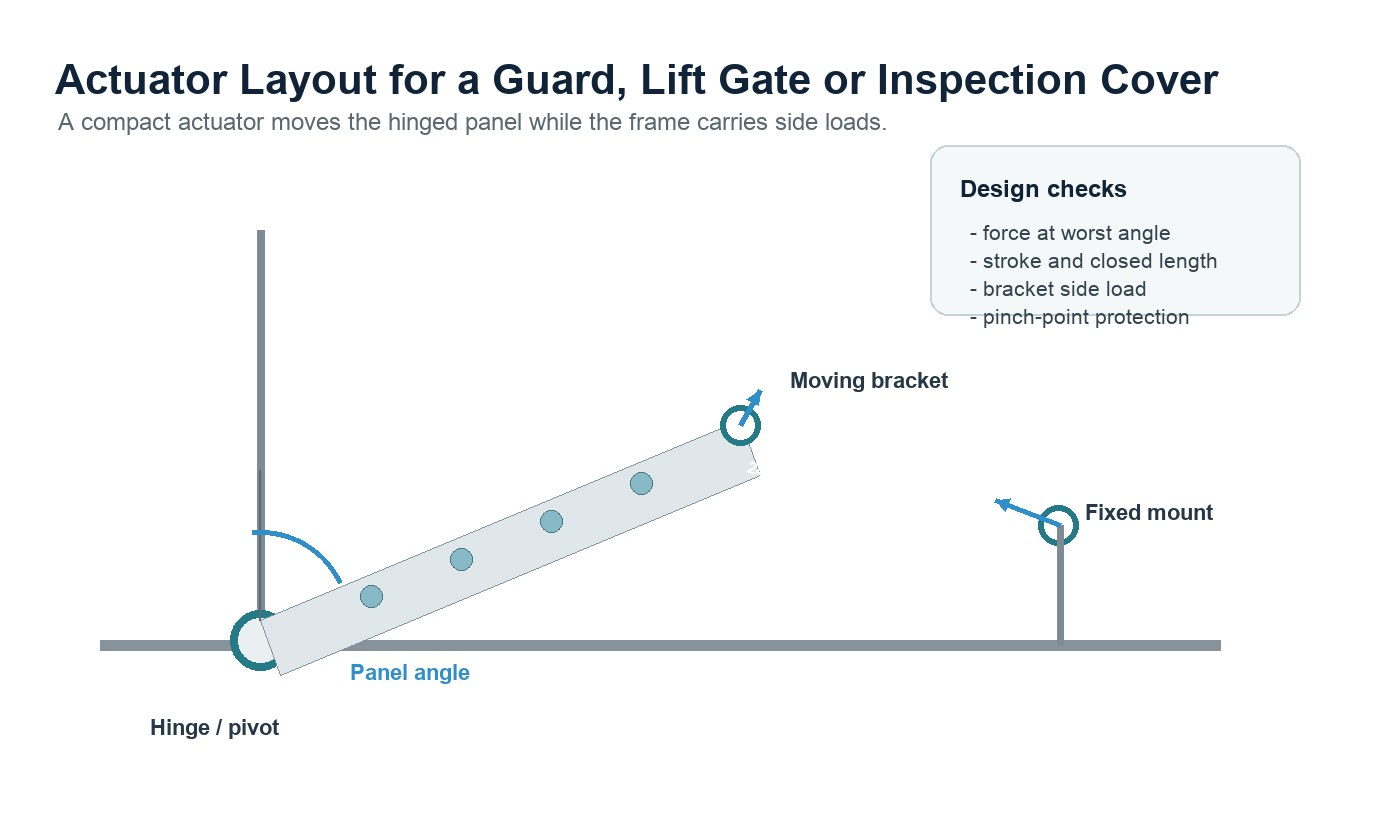
Assume an automated packaging line uses a hinged inspection cover and a small conveyor lift gate. The actuator must move slowly enough for safety, hold position when stopped, and connect cleanly to the machine controller.
| Parameter | Example Choice | Selection Basis |
|---|---|---|
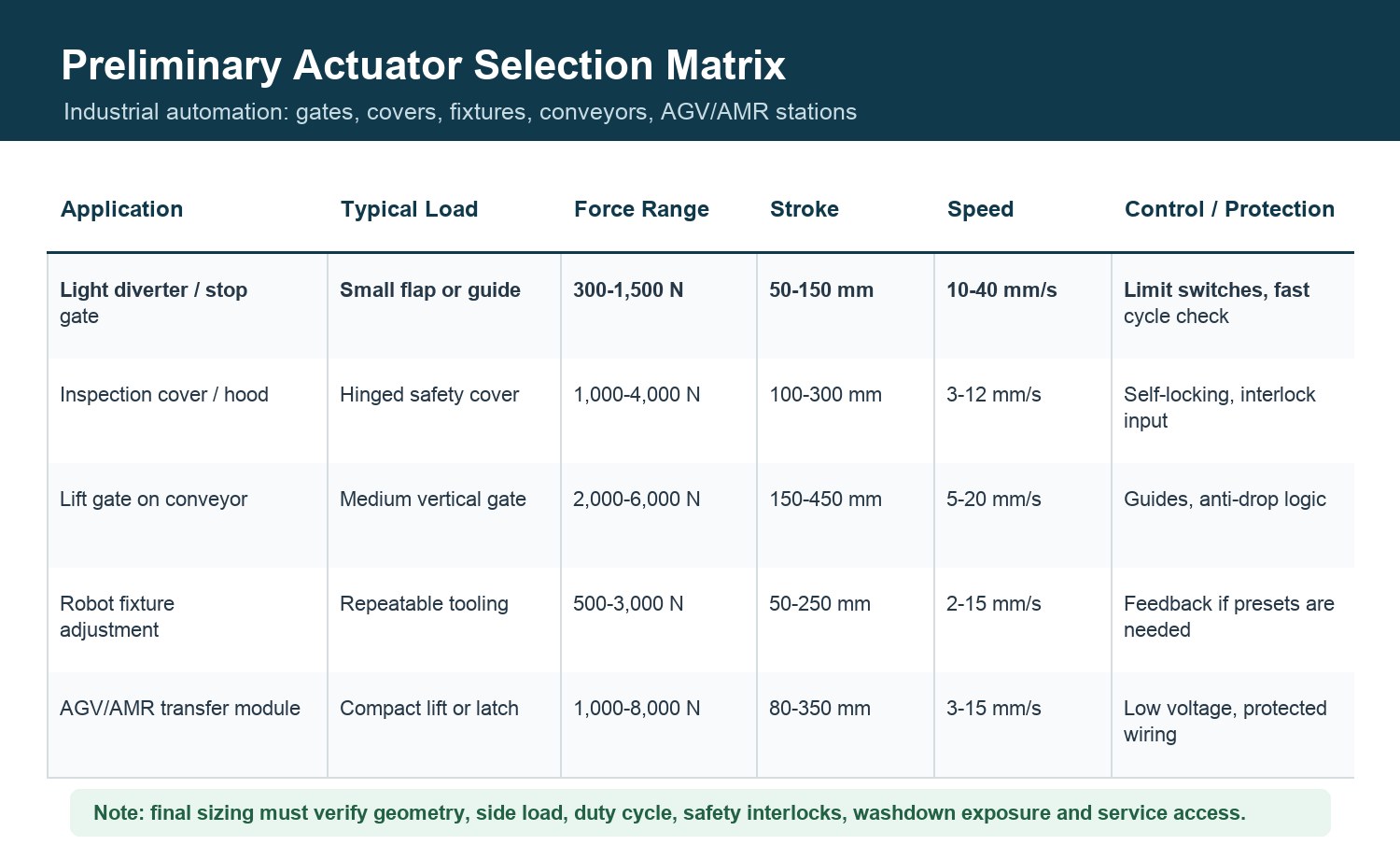
| Rated force | 1,000-4,000 N | Selected from cover weight, gate friction, hinge geometry, and a safety margin. |
| Stroke | 100-300 mm | Enough travel to create clearance without driving the actuator into poor angles. |
| Speed | 3-15 mm/s | Moderate speed improves operator safety and avoids harsh impact at end positions. |
| Voltage | 24V DC | Common in machine control panels, relays, sensors, and safety circuits. |
| Feedback | Limit switch or Hall feedback | Limit switches fit simple open/close motion; feedback supports repeatable presets. |
| Protection | IP54/IP65 depending on area | Choose higher protection near washdown, dust, food-processing residue, or coolant. |
| Control | PLC relay output or actuator controller | Allows interlock logic, emergency stop integration, and controlled sequencing. |
Selection Matrix
Engineering Notes
- Duty cycle matters. A gate that moves every few seconds needs a different actuator than a maintenance cover used a few times per day.
- Do not use the actuator as a guide rail. Side loading shortens life and can create unstable motion.
- Plan machine safety early. Interlocks, E-stop behavior, pinch-point guarding, and manual service access should be defined before installation.
- Use lifting columns when guidance is required. If the moving load needs vertical stability, a guided lifting column can be better than an exposed actuator.
Information Needed for Accurate Sizing
- Moving part weight and center of gravity
- Hinge, guide, or bracket dimensions
- Required stroke and open/closed positions
- Cycle frequency and expected duty cycle
- Voltage, controller type, and feedback requirement
- Dust, washdown, temperature, and cleaning exposure
After commissioning, establish a condition-based service routine using the Industrial Linear Actuator Maintenance and Troubleshooting Guide.
FAQ
Can a linear actuator replace a pneumatic cylinder in automation equipment?
Yes, when the required speed and duty cycle fit the actuator. Electric actuators are useful when position control, clean wiring, and lower air-system maintenance are priorities.
When should feedback be used?
Use feedback when the machine needs intermediate positions, recipe-based changeover, position confirmation, or synchronized movement.
What is the main design risk?
Poor mounting geometry. If brackets create side load or the actuator angle is too weak near the start of travel, the system may need much more force than expected.