
Note: This guide covers general engineering requirements for refuse collection vehicles and waste-handling equipment. Final actuator sizing should be checked against the actual mechanism, duty cycle, wash exposure and applicable machine-safety rules.
Intro
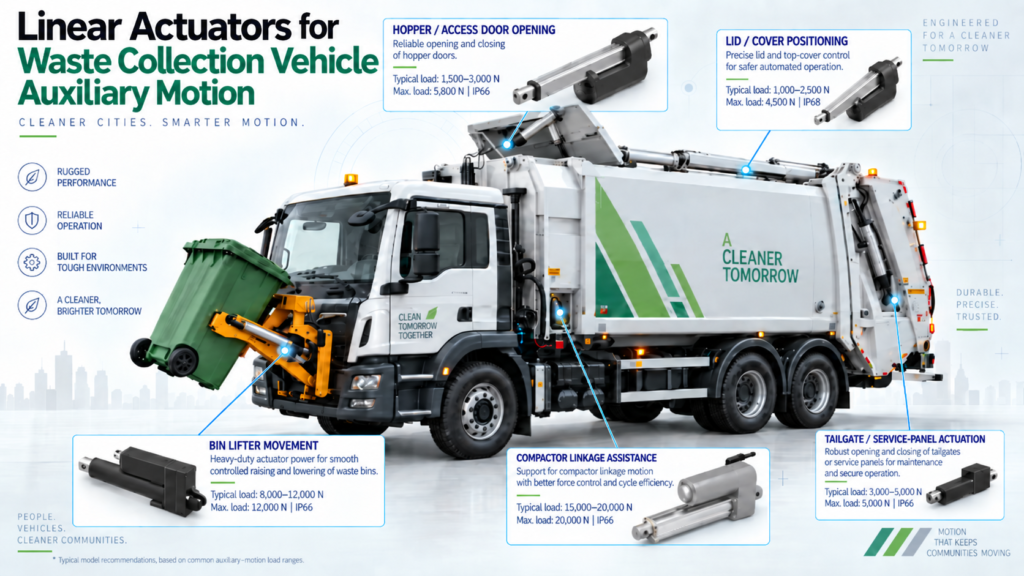
Linear actuators for waste collection vehicles are practical for auxiliary motion: service covers, inspection hatches, camera or sensor mounts, light safety guards, small diverter flaps and maintenance-position mechanisms. They should not be treated as a direct replacement for the main hydraulic bin-lift arm or compaction system, where hydraulic force remains the standard choice.
This distinction matters. Waste collection equipment is heavy, dirty and safety critical. Electric linear actuators are most useful where the load is moderate, the motion is controlled, the available power is 12V or 24V DC, and the design benefits from a compact self-contained drive.
Real Application Context
Modern refuse collection vehicles use a combination of heavy-duty hydraulic systems, electronic controls, cameras, container identification, weighing options and service-access structures. Side loaders and rear loaders often include bin lifting systems, compacting bodies, covers, guarding and operator assistance technologies. These systems create several secondary movement points where electric actuation can be useful.
Public examples from waste-equipment manufacturers show automatic bin lifters, rear and side loader bodies, container washing systems and electric product lines. In that environment, a linear actuator can simplify smaller mechanisms that do not justify a hydraulic circuit, especially when controlled position, clean installation or low-voltage operation is preferred.
Where a Linear Actuator Fits
Service covers and inspection hatches. Battery boxes, electronics compartments, sensor cabinets and access doors may need controlled opening during maintenance. An actuator allows the cover to move smoothly and stay in a defined service position.
Safety shields and light guards. Some machine areas need a guard that opens only when the equipment is stopped. A compact actuator can be paired with interlocks so maintenance access is controlled.
Sensor, camera and lighting positions. Waste vehicles increasingly use cameras, weighing sensors and container identification systems. A small actuator can move a protected sensor bracket between a working and stowed position.
Small diverter flaps and covers. Lightweight covers around organic waste, dry recycling, wash nozzles or small chute sections may use electric actuation when the movement is intermittent and load is moderate.
Interactive Service Cover Demo
The demo below shows an actuator opening a hinged service cover. It is a simplified model, but it reflects the real selection problem: the actuator stroke, hinge location and bracket angle determine both force and final open position.
Engineering Requirements
IP protection and wash exposure. Refuse collection vehicles may be washed frequently and can be exposed to road spray, waste liquid and fine debris. Select sealed housings, protected connectors and cable routing that avoids water traps.
Vibration and shock. Vehicle vibration can damage weak brackets faster than the actuator itself. Mount the actuator so the rod is loaded along its axis, and avoid using the rod as a structural guide.
Interlock logic. A moving cover or guard should not open during a compaction or lifting cycle unless the machine control system permits it. Limit switches, feedback and safety interlocks should be defined before hardware selection.
Manual service access. Waste equipment must be serviceable in the field. Consider a release pin, accessible fastener or mechanical support so the cover can be handled safely if power is unavailable.
Corrosion resistance. Stainless hardware, coated brackets and protected cable exits are often more important than a high force rating. The actuator environment should be treated as wet, dirty and vibration-prone.
Product Parameter Selection Example
Assume a refuse collection vehicle uses a hinged electronics service cover weighing 18 kg. The cover opens to 65 degrees for maintenance, and the actuator is mounted between the fixed frame and the inside face of the cover. The mechanism only moves during service, not during every bin-lift cycle.
Force: 1,500-3,000 N. The cover weight alone may be lower than this range, but the actuator must overcome hinge friction, seal compression, poor bracket angle near the closed position, vibration margin and possible contamination. A mechanical prop or stop should carry the open service load where practical.
Stroke: 150-250 mm. This range is a realistic starting point for a medium service cover. The exact stroke must come from the side-view geometry so the actuator reaches both closed and open positions without bottoming out.
Speed: 3-10 mm/s. Slow controlled opening is preferred. Faster movement adds impact at the end of travel and increases risk during service access.
Voltage: 24V DC. Many vehicle auxiliary systems and control cabinets can support 24V DC. For a 12V vehicle platform, check startup current and cable voltage drop before selecting the actuator.
Feedback: limit switches for simple covers; position feedback for controlled access. Built-in limit switches are enough for basic open/close motion. Choose Hall or potentiometer feedback if the cover must stop at intermediate positions or report status to the vehicle controller.
Protection: IP65/IP66 with guarded rod and connectors. Use sealed connectors, strain relief and a mounting position that avoids direct impact from debris or wash jets.
Integration Checklist
Prepare the cover weight, hinge-to-center-of-gravity distance, desired open angle, bracket locations, available voltage, duty cycle, wash exposure, operating temperature and control logic. A simple side-view sketch is enough to make the first force and stroke estimate.
Also define the safety state. Decide whether the actuator must hold the cover closed, whether a separate latch carries road vibration, and how the system behaves during power loss.
Why Electric Actuation Works for Auxiliary Motion
Hydraulic cylinders are ideal for bin lifting, tipping and compaction because those functions need high force and rugged duty. For smaller secondary mechanisms, adding hydraulic valves and hoses can be unnecessary. An electric linear actuator is cleaner, easier to wire into a controller and easier to install in a compact location.
The best design often combines both technologies: hydraulics for the main waste-handling load and electric actuators for covers, guards, sensors and controlled service positions.
Related GeMinG Products
GeMinG supplies electric linear actuators for outdoor automation, mobile machinery and industrial auxiliary motion. For force, stroke and duty-cycle basics, review our electric linear actuator selection guide. For high-load vertical adjustment outside the waste body, see our electric lifting column resources.
Conclusion
Waste collection equipment needs rugged systems that can survive vibration, moisture, dirt and repeated service. Electric linear actuators are not the answer for every moving part, but they are a strong option for auxiliary mechanisms where controlled low-voltage motion, sealed construction and simple integration matter.
FAQ
Can an electric linear actuator replace the main hydraulic bin lifter?
Usually no. Main bin lifting and compaction are high-force hydraulic functions. Electric actuators are better for covers, guards, sensor mounts and smaller auxiliary movements.
What force range is typical for a service cover?
Many medium covers start around 1,500-3,000 N, but the final value depends on hinge geometry, seal force, bracket angle and vibration margin.
Is IP65 enough for refuse collection equipment?
IP65 may be acceptable for protected positions. Direct wash exposure, road spray and dirty environments may require IP66-level protection and additional guarding.
Should the cover have a separate latch?
For vehicle-mounted equipment, a latch or mechanical stop is recommended so road vibration and wind loads are not carried only by the actuator.