
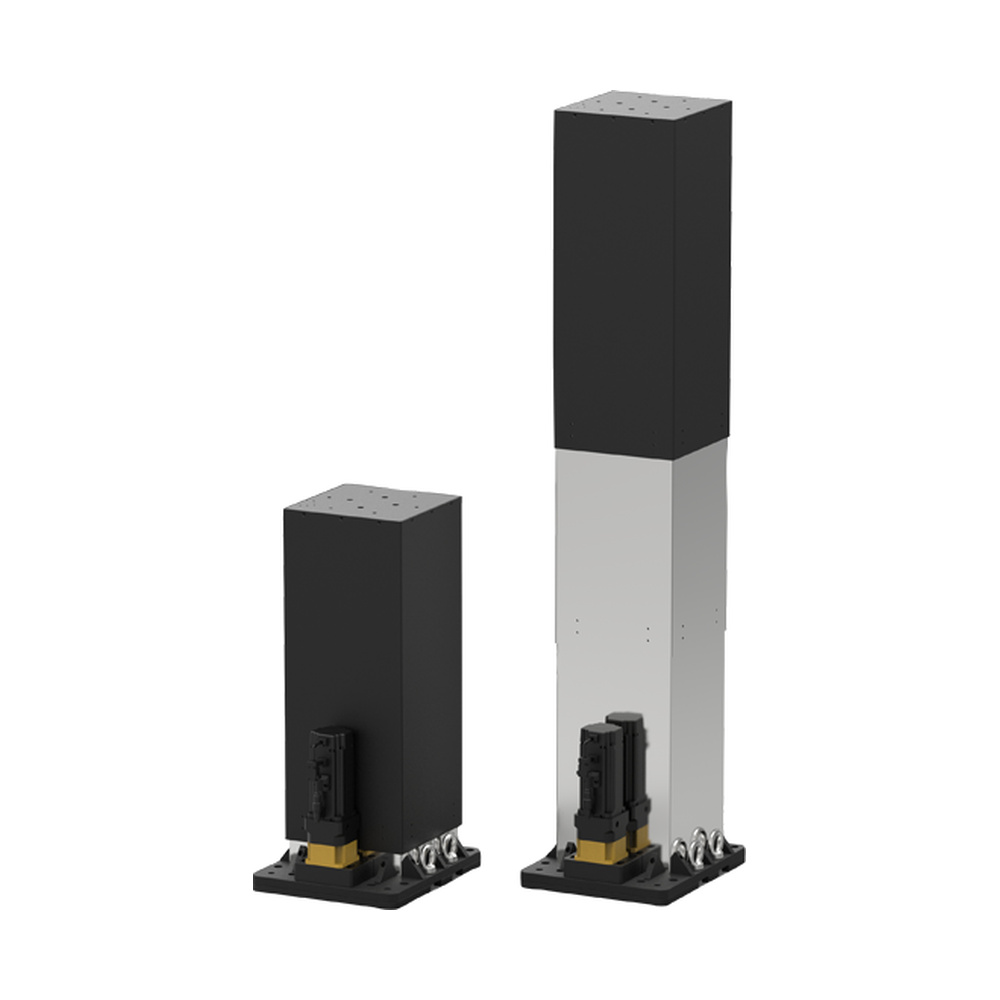
GEMING HTG3 Robotic Arm Lifting Column: Precision 7th Axis Solution Engineered by GEMING with 16 years of linear motion mastery, the HTG3 series is a high-performance 7th-axis vertical lift system designed specifically for industrial robotic arms and heavy cooperative robots. Built upon our rigorous engineering background—which includes designing stable, long-term multi-stage lifting solutions for nuclear power plant engineering and conducting extreme 10-meter high-altitude heavy-duty field tests—the HTG3 delivers unparalleled structural rigidity and exceptional dynamic resistance against high twisting moments generated during rapid robotic acceleration. Supporting custom integrations with AC Servo or Stepper motors, it ensures sub-millimeter level positioning accuracy for automated palletizing, welding, and smart warehousing.
Related Article: HTG3 industrial robotic arm lifting column article with video
| Voltage | 48V DC, 220V AC |
|---|---|
| Motor options | DC or AC servo motor |
| Maximum thrust | 8,000N, or customized |
| Speed under load | 100 mm/s at 8,000N load; 200 mm/s at 4,000N load |
| Minimum installation dimension | Stroke/2 + 350 mm |
| Dynamic lateral torque | 3,000 Nm |
| Static lateral torque | 4,000 Nm |
| Operating temperature range | -45 C to +75 C |
| Control options | CAN bus, EtherCAT bus, or customized |
| Structure | Three sections, 300 x 300 mm |
| Speed range | 100-300 mm/s |
With over 16 years of dedicated experience in electric linear actuators and lifting columns, GEMING (Zhejiang Ge Ming Driven Technology Co., Ltd.) supports OEM engineers with custom linear motion solutions for industrial automation, medical equipment, ergonomic workspaces, outdoor systems, and robotic applications. Our engineering team reviews load, stroke, speed, duty cycle, installation space, control logic, and environmental requirements before recommending a product configuration.
For safety-critical or heavy-duty projects, GEMING can provide application review, CAD/STEP support, technical documentation, and custom actuator or lifting column development based on verified project requirements.
HTG3 is designed for robotic arm elevation and vertical 7th-axis applications. It supports heavy robot workcells that require vertical reach expansion, synchronized motion, and stable structural support during repetitive industrial cycles.
Use this model when your project needs a configurable linear motion component rather than an off-the-shelf catalog-only part. For accurate selection, prepare the required load, stroke, voltage, speed, duty cycle, mounting direction, and control interface.
A: Electric lifting columns provide sub-millimeter positioning accuracy, zero risk of fluid leakage (crucial for cleanrooms, food processing, and high-tech assembly), and significantly lower maintenance overhead. Furthermore, electric columns offer seamless closed-loop feedback integration with the robot’s master controller (PLC/ROS), allowing real-time speed and position synchronization that hydraulic systems cannot match.
A: Robot 7th-axis lifts are engineered with reinforced, multi-stage telescopic aluminum profiles and heavy-duty, internal pre-loaded guiding shoes. When a cobot accelerates or decelerates violently at maximum reach, it generates massive dynamic overturning moments (lateral torque). Our columns are rated not just for static axial load, but explicitly for dynamic lateral torque (up to hundreds of Nm depending on the model) to prevent shifting, wobbling, or structural fatigue during high-speed robotic cycles.
A: To achieve smooth, multi-axis coordinated motion, the vertical lift must communicate with the robot control cabinet in real-time. Standard configurations support high-speed industrial fieldbus protocols, including CANopen, EtherCAT, Profinet, and RS485 (Modbus-RTU). This enables the robot arm to treat the vertical column as a fully integrated auxiliary axis (7th axis) rather than a disconnected digital I/O device.
A: Yes, heavy-duty robotic lifting pillars utilize high-efficiency ball screws or reinforced trapezoidal lead screws paired with industrial-grade brushless DC, stepper, or AC servo motors. For harsh environments involving heavy dust, metal shavings, or water splashing, columns can be customized with IP65 or IP66-rated sealing protection and anti-corrosive surface treatments to ensure non-degrading performance under 24/7 continuous factory production.
A: Palletizing robots require a massive vertical envelope to stack goods up to 2 meters high, but factory ceilings or transport dimensions often restrict the initial height of the machine. A 3-stage or 5-stage telescopic pillar architecture drastically optimizes the nested ratio. It provides an exceptionally low retracted profile (collapsed height), while multiplying the vertical stroke length once extended, replacing clumsy pneumatic masts with a compact, rigid vertical guide tower.
Please provide load, stroke, speed, voltage, duty cycle, installation space, mounting direction, environmental conditions, and any control or feedback requirements.
Installed in a woodworking saw table in 2017,
this linear actuator remained in continuous service for years without replacement.
In 2025, the same customer reordered the identical model for a new project.