
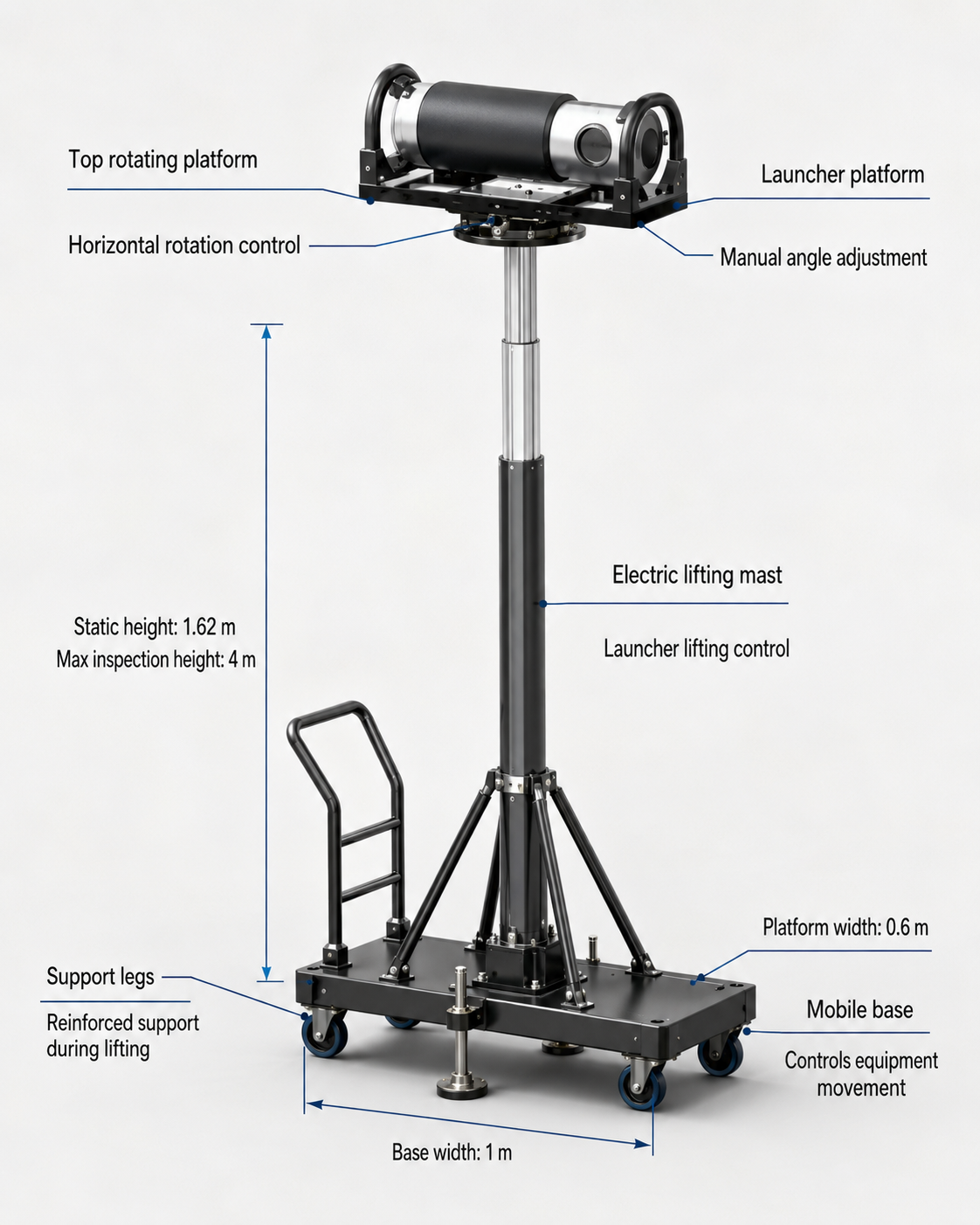
The TL461 electric lifting column for GIS inspection equipment is used here as the vertical axis of a mobile GIS inspection tooling system. The confirmed application load is about 30 kg. The equipment is designed for a compact on-site layout: about 1.62 m static height, up to 4 m maximum detection height, and a mobile base of about 1 m x 0.6 m.
This article replaces broad claims with the actual engineering logic of the case. The TL461 is not selected because “lifting columns are flexible”; it is selected because the GIS inspection device needs a controlled vertical stroke inside a narrow mobile frame, while the upper inspection module still needs rotation and angle adjustment.
Application Data From the GIS Inspection Tooling
The customer application is a push-type inspection structure for GIS equipment. The top section carries the imaging or inspection assembly. The upper module can rotate horizontally and adjust the ray source angle, while the vertical motion is handled by the electric lifting column.
- Application load: about 30 kg on the lifting structure.
- Static equipment height: about 1.62 m.
- Maximum detection height: about 4 m, based on the full inspection frame and upper adjustment layout.
- Mobile base size: about 1 m x 0.6 m.
- Function: vertical lifting plus top rotation and ray source angle adjustment.
TL461 Drawing Example
The drawing is marked TL461-S1200-L600. From the drawing, the column height is about 600 mm when retracted and about 1800 mm when extended. In practical terms, this gives about 1200 mm of column stroke. These values should be treated as the column geometry for this project, not as a universal rating for every GIS inspection frame.
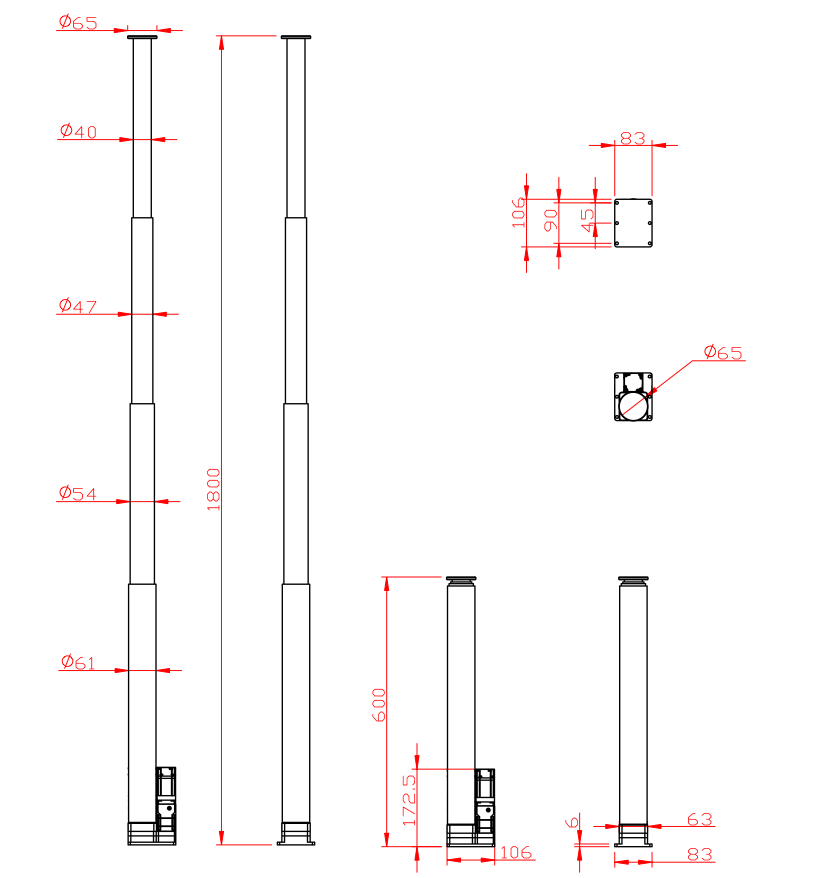
The drawing also shows a compact multi-stage round column structure with a small lower mounting area. That is relevant because the inspection cart has limited base space. A bulky lift would increase the footprint and make operation around GIS equipment harder.
Interactive Height Demo
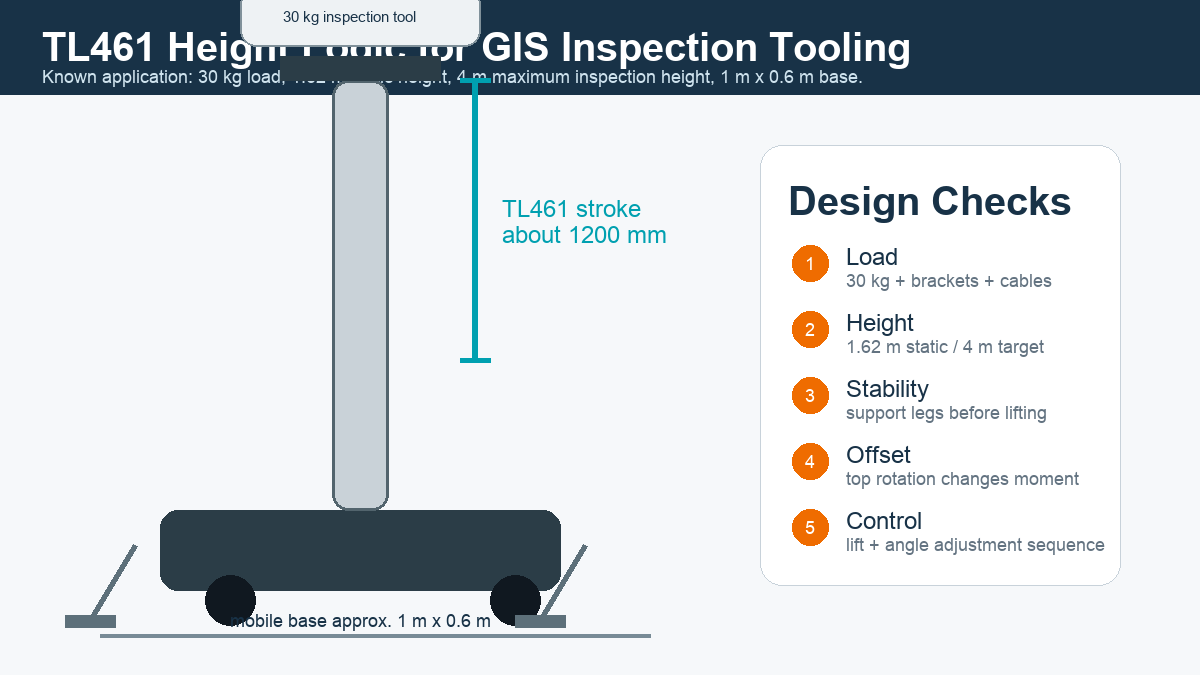
The demo below shows the selection logic in a simple way. It is not a final configurator. Use it to compare the TL461 stroke, 30 kg moving load, and offset distance. The important point is that the inspection load, top bracket and offset moment must be checked together.
Why TL461 Fits This Case
For this equipment, the load is moderate, but the height requirement is not trivial. The design needs a slim vertical axis that can retract into the frame and extend enough to support the full inspection geometry. TL461 is a reasonable match because its 600 mm retracted height and 1200 mm stroke help the machine stay compact during movement while still providing useful vertical reach during inspection.
Selection Risks That Need Checking
The most important risk is not simply vertical lifting force. The narrow mobile base and upper adjustment platform create stability questions. Before production, the designer should confirm whether the support legs are deployed before lifting, whether the wheels are locked, and how far the inspection head moves away from the column centerline.
- Offset load: rotation and angle adjustment can move the inspection head away from the column center.
- Base stability: a 1 m x 0.6 m mobile base needs support points or locking structure during lifting.
- Height stack-up: the 4 m detection height comes from the whole frame, not the column alone.
- Motion sequence: stabilize the cart first, then lift, then adjust angle.
- Environment: GIS inspection sites may have limited access space, cable constraints and uneven floor conditions.
What to Provide Before Ordering
To confirm the final TL461 configuration, provide the full lifted assembly weight, center-of-gravity position, maximum offset distance, required lifting speed, duty cycle, control method and installation drawing. If the actual upper module is heavier than 30 kg or has a long cantilever, the model or support structure should be reviewed again.
For related selection principles, see GeMinG guidance on choosing fully automatic electric lifting columns. Related product and application references are also available under electric lifting column, linear actuator, and industrial application.
Conclusion
For this GIS inspection equipment, TL461 is a practical lifting column choice because the known requirement is specific: about 30 kg moving load, compact mobile base, 600 mm retracted column height, about 1200 mm stroke, and a full tooling layout that reaches up to 4 m detection height. The final design should still be checked against offset moment, support stability and the actual inspection head configuration.
FAQ
Does the TL461 alone provide 4 m lifting height?
No. The 4 m value refers to the maximum detection height of the full inspection tooling layout. The TL461 drawing shows about 600 mm retracted height and 1800 mm extended column height.
Is 30 kg the maximum capacity of TL461?
No. In this article, 30 kg is the application load provided for the GIS inspection equipment. Final capacity depends on the complete lifted structure and offset moment.
Why is base stability important?
The mobile base is compact. When the inspection head is raised or offset, the support legs, wheel locks and center of gravity must be checked before operation.