
two linear actuators for lid operation are commonly used when one actuator is not enough to open a wide, heavy, or flexible lid safely. In many machines, a cover is not a small door with a single hinge. It can be a long industrial cover, a sealed hatch, a vehicle access panel, a generator enclosure lid, a processing machine cover, or an inspection hatch that needs balanced support on both sides.
Using two actuators in parallel looks simple, but the engineering is not the same as installing two separate devices. Both actuators must move one mechanical lid as one system. If one side moves faster, starts earlier, stops later, or becomes blocked while the other continues, the lid can twist, the hinge beam can bend, and the mounting brackets can be overloaded.
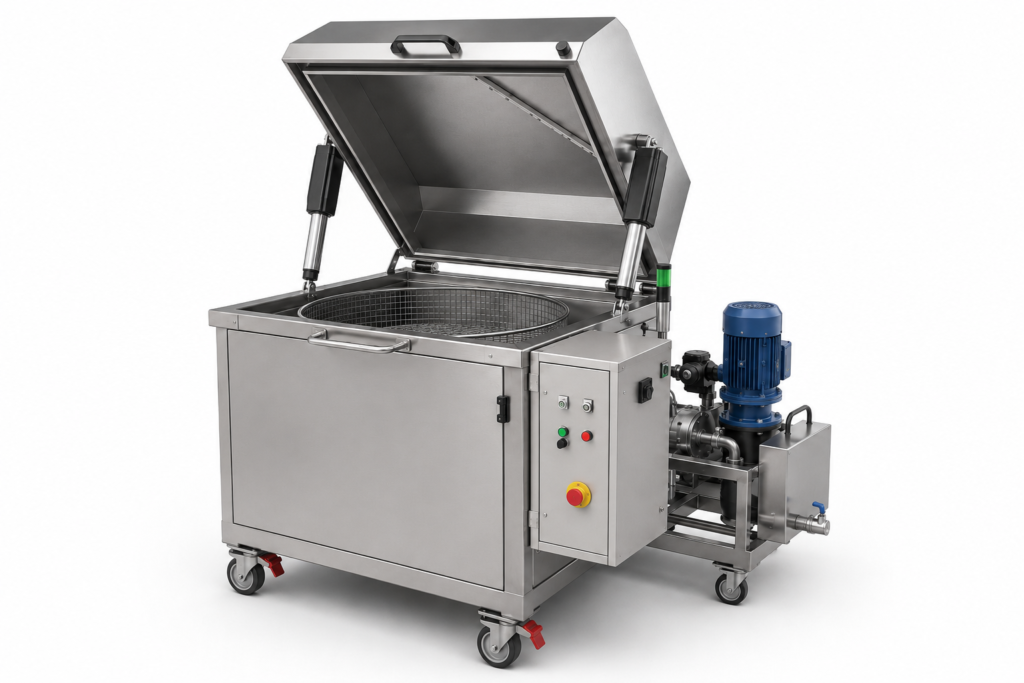
Why use two actuators instead of one?
A single actuator is suitable for many small covers. However, wide lids and long hatches often need support on both sides. If one actuator is installed near only one side, the opposite side may sag or lag behind. This can create uneven hinge load and can make the lid difficult to close against seals or latches.
Two actuators distribute force more evenly across the lid. They also help control the lid during opening and closing, especially when the lid is long, has a high center of gravity, includes gas struts or seals, or is exposed to wind load. In outdoor equipment, vehicle systems, and large industrial enclosures, this balanced motion can improve service access and reduce manual lifting effort.
Where this application is used
Parallel lid actuators are used in many practical applications. Examples include agricultural machine covers, generator set enclosures, battery cabinet lids, industrial processing equipment covers, marine hatches, utility vehicle access panels, machine safety covers, large storage boxes, outdoor equipment cabinets, and inspection lids for automation systems.
The common requirement is controlled opening. The lid must open to the correct angle, remain stable while technicians work, and close without forcing one side. If the lid is heavy or the equipment is used outdoors, the actuator system may also need holding force, weather protection, vibration resistance, and safe stop behavior.
The main engineering problem: synchronization
The most important issue is synchronization. Two actuators may have the same model number, but they can still move slightly differently because of load difference, friction, voltage drop, temperature, manufacturing tolerance, or bracket alignment. A small speed difference may not matter on a short, rigid lid. On a long lid, the same mismatch can create twisting force.
For low-risk covers, matched actuators with identical stroke and careful mounting may be enough. For wide lids, sealed hatches, or covers where twisting cannot be tolerated, feedback control should be considered. Hall sensor feedback, encoder feedback, or potentiometer feedback allows the controller to compare actuator travel and stop both actuators if one side is out of range.
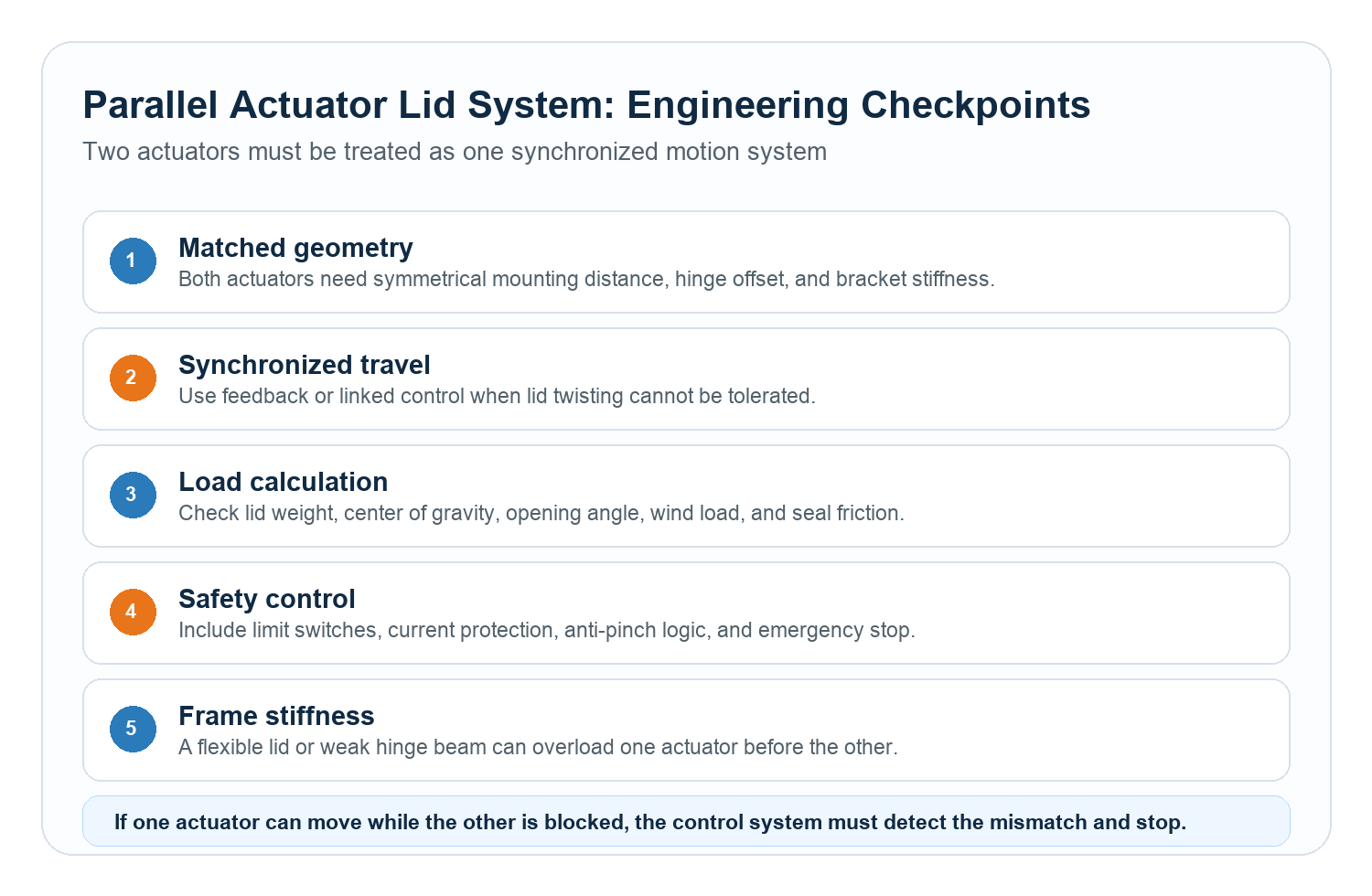
What to calculate before selecting actuators
The first calculation is lid torque around the hinge. The required force depends on lid weight, center of gravity, hinge position, actuator mounting points, and the opening angle. The force is usually highest near the closed position, where the actuator angle may be poor and the lid’s center of gravity creates high torque.
The second calculation is the force per actuator. In a perfect symmetrical system, two actuators share the load. In real machines, the load is rarely shared perfectly. One side may carry more force because the lid is not perfectly rigid, the hinge has uneven friction, the brackets are slightly different, or one side meets a seal first. A reasonable safety margin is necessary.
The third calculation is stroke. The actuator stroke must match the desired opening angle without reaching mechanical end stops too early. The actuator should not become the hard stop unless the design intentionally uses limit switches and safe load paths. A separate mechanical stop is often better for protecting the actuator and brackets.
Control options for two actuators in parallel
There are three common control levels. The simplest is parallel power control, where both actuators receive power at the same time. This is only suitable when the lid is rigid, the load is moderate, and small movement differences are acceptable.
The second option is current monitoring and limit control. The controller can stop motion if one actuator draws abnormal current, which may indicate blockage, overload, or seal sticking. This improves safety but does not directly measure position.
The third option is position feedback synchronization. This is the preferred approach for wide lids, precision covers, or systems where twisting can damage the structure. Feedback allows the controller to keep both sides within an acceptable travel difference. GeMinG can support actuator selection, control box matching, and application review for different linear actuators used in lid systems.
Selection matrix for lid applications
The following matrix summarizes common lid scenarios and the main selection focus. The final actuator size still depends on hinge geometry, lid weight, center of gravity, opening angle, voltage, duty cycle, and operating environment.
Installation details that affect reliability
Mounting accuracy matters. Both actuators should have symmetrical bracket positions unless the lid design intentionally requires different geometry. The brackets must be strong enough to resist peak force near the closed position. The pins should allow rotation without binding, and the actuator body should not be forced into side load.
The lid itself must also be stiff enough. If the lid frame twists, the actuators may appear to be out of sync even when they are moving correctly. In that case, the problem is not only electrical control. The hinge beam, lid ribs, bracket plates, and mounting surface may need reinforcement.
For outdoor or vehicle applications, check the actuator IP rating, corrosion protection, cable routing, vibration resistance, and connector sealing. For a vertical lifting application rather than hinged lid motion, an electric lifting column may be more suitable than two hinged actuators.
Safety requirements
Any powered lid can create pinch and crush hazards. A safe system should consider momentary control, emergency stop, current protection, limit switches, soft start, soft stop, and anti-pinch logic. If the lid is large enough for a person to access the equipment underneath, the design should also include a safe maintenance position or mechanical support.
When two actuators are used, the controller should stop both actuators if one side is blocked. Continuing to run only one side can twist the lid and increase risk. For high-value equipment, feedback synchronization is often less expensive than repairing bent covers, broken hinges, or damaged actuator brackets.
How GeMinG supports parallel actuator lid systems
GeMinG can help evaluate actuator force, stroke, speed, voltage, feedback type, control box, mounting bracket, duty cycle, and environmental protection for lid operation. If the project is still in concept design, a sketch with hinge position, lid size, estimated lid weight, desired opening angle, and available mounting space is enough for a preliminary review.
If the project has multiple height or stroke options, the multi-stage column height calculator may help with other vertical motion projects, while lid systems should still be checked by hinge torque and actuator geometry. For customers comparing motion products, GeMinG also provides guidance on choosing fully automatic electric lifting columns when the application is not a hinged cover.
Information needed before quotation
To recommend two actuators for lid operation, prepare the lid weight, lid width, lid depth, hinge location, center of gravity, target opening angle, available mounting points, voltage, operating environment, duty cycle, expected opening speed, and whether synchronization feedback is required. Photos, drawings, or a simple side-view sketch can greatly improve the accuracy of selection.
FAQ
Can two actuators simply be wired together?
Sometimes, but only for low-risk applications where small travel differences are acceptable. Wide or heavy lids usually need matched actuators, rigid mounting, and sometimes feedback synchronization.
Do two actuators double the lifting capacity?
Not exactly. Two actuators can share load, but real force distribution depends on lid stiffness, hinge friction, bracket geometry, and synchronization. A safety margin is still necessary.
What is the best actuator feedback for parallel lid motion?
Hall sensor, encoder, or potentiometer feedback can all be used depending on the control system. The goal is to detect travel difference and stop or correct motion before the lid twists.