
Optimizing Vision, Sensor Deployment, and Payload Dynamics in Autonomous Inspection and AGV/AMR Applications
Related product: HTL461 Telescopic Lifting Mast
Introduction
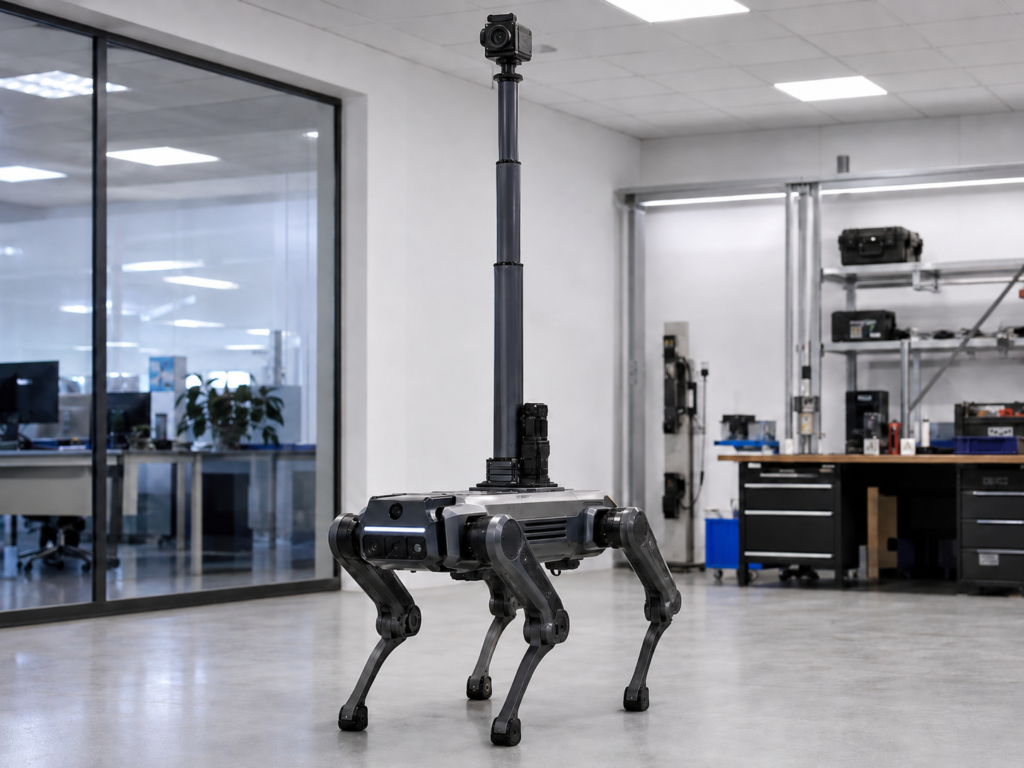
A compact electric telescopic mast gives an AMR, AGV, or inspection robot adjustable sensor height without permanently raising its center of gravity. Selection should consider stroke, retracted length, payload offset, structural stiffness, DC power, duty cycle, and position feedback.
The robot can travel with the mast retracted and raise a LiDAR, camera, thermal imager, gas detector, or light payload at the inspection point. The required height and stability must be verified on the complete mobile platform.
Why Mobile Robots Require Vertical Actuation
A low travel height helps a mobile robot pass under obstacles and limits changes to its center of gravity. At the work point, a telescopic mast can raise sensors for:
- Dynamic Field of View (FoV): Elevating a 3D LiDAR or PTZ camera eliminates ground-level blind spots, allows scanning over obstacles, and dramatically improves mapping efficiency in large spaces.
- Precision Industrial Metrology: Rigid telescopic profiles allow Cobots (Collaborative Robots) and measurement probes mounted on AMRs to accurately reach multi-level workpieces without losing structural stability.
- Operational Safety: Equipping a mobile unit with an elevated warning light or multi-stage signaling indicator ensures visibility and safety compliance in busy human-robot shared workspaces.
Design note: Compare the required extended height with the available retracted space. Also check DC power, payload offset, acceleration, and the stiffness of the robot’s mounting frame.
Key Technical Considerations for Robot-Mounted Lifting Columns
Integrating an electric telescopic column onto a mobile platform presents unique engineering challenges compared to static factory automation. Actuator selection must prioritize the following parameters:
1. Stroke-to-Retracted Length Ratio & Multi-Stage Geometry
Two- or three-stage telescopic designs can provide a longer stroke within a shorter retracted package. The correct stage count depends on the required height, profile overlap, stiffness, cost, and available installation space.
A three-stage column may reduce retracted length compared with a one- or two-stage design of similar travel. Confirm the actual stroke-to-retracted-length ratio from the selected model rather than assuming a fixed multiple.
Retracting the mast during travel can reduce the height of the payload. Robot stability still depends on total mass, center of gravity, wheelbase, acceleration, terrain, and control limits.
2. High Bending Moment Resistance & Rigidity
Mobile platforms vibrate, accelerate, and occasionally encounter uneven terrain.
Profile clearance and structural deflection can increase sensor movement when the mast is extended. Review guide design, overlap length, payload offset, robot acceleration, and mounting rigidity, then test the sensor on the moving platform.
3. Efficient DC Power Management & Feedback Integration
Mobile robots commonly use 24 VDC or 48 VDC power, but voltage, peak current, duty cycle, and protection must match the selected mast. Closed-loop position feedback is recommended when the robot needs repeatable sensor height or coordinated motion.
Hall sensors, encoders, CAN bus, or Modbus can support position monitoring when available in the selected control package. Position resolution and accuracy depend on the sensor, mechanics, controller, and calibration.
GEMING Advanced Solutions for Mobile Robotics
HTL461 Lifting Column Dimensions
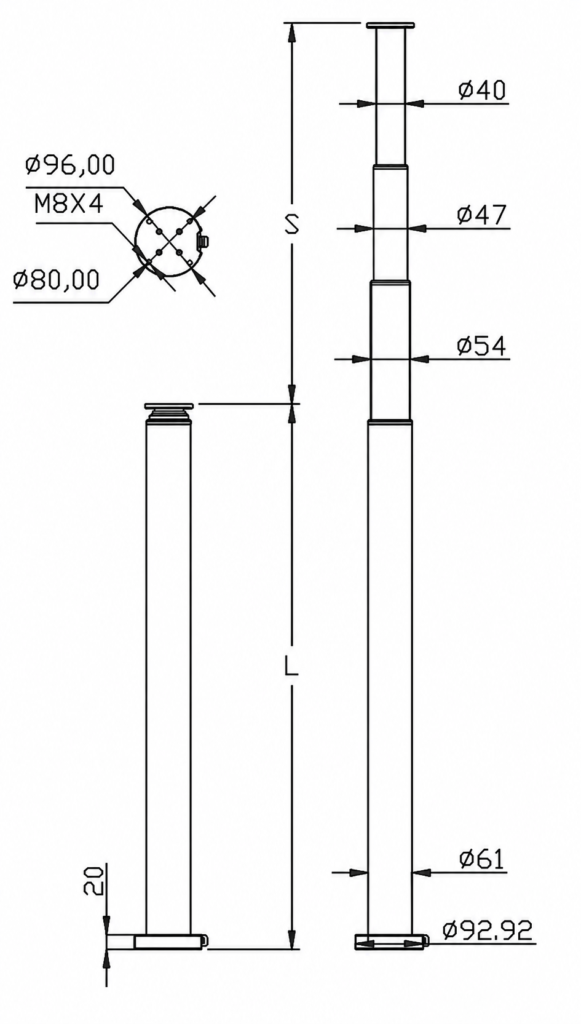
GEMING provides electric lifting columns and telescopic mast configurations for mobile equipment. Available options should be reviewed against the robot’s load, travel height, mounting layout, power supply, control interface, and operating environment.
- High-Precision Profiles: Extruded aluminum alloy profiles treated for minimal friction and maximum structural rigidity, minimizing sensor sway during robot movement. Our TL461 Electric Lifting Column is specifically engineered to handle limited installation space mobile inspection tasks, such as robotic lifting systems, camera masts, inspection equipment, mobile platforms, and intelligent automation devices.
- Seamless Robotic Integration: Available with 24V/48V DC motors, equipped with integrated bus control interfaces for precise positioning and safety limits. For highly compact chassis designs, the HTG3 Robotic Arm Lifting Column offers the ideal balance of payload and integrated space.
- Proven in Demanding Environments: From multi-stage columns supporting precision equipment in stable, high-tech environments to rugged inspection assemblies, our engineering delivers reliability. For specialized multi-stage high-reach elevation, explore the HTD5 5-Stage Lifting Column or our dedicated Embodied Robot Pillar for next-generation automated systems.
- High-Precision Profiles: Extruded aluminum alloy profiles treated for minimal friction and maximum structural rigidity, minimizing sensor sway during robot movement.
- Seamless Robotic Integration: Available with 24V/48V DC motors, equipped with integrated bus control interfaces for precise positioning and safety limits.
- Proven in Demanding Environments: From multi-stage columns supporting precision equipment in stable, high-tech environments to rugged inspection assemblies, our engineering delivers reliability.
Conclusion
Adjustable sensor height can expand the inspection range of a mobile robot when fixed-height sensors cannot reach the required viewpoint. The mast should be treated as part of the complete stability, power, controls, and safety design.
For a technical review, provide the payload, center-of-gravity offset, required extended and retracted heights, robot acceleration, supply voltage, duty cycle, control interface, and environmental conditions.
Frequently Asked Questions (FAQ)
A multi-stage mast provides more travel for a given retracted length, which helps a robot remain compact during transit. The final stage count should be selected from the required height, closed-length limit, payload, and stability analysis.
Check profile stiffness, guide clearance, overlap length, payload offset, robot acceleration, and mounting rigidity. Validate LiDAR or camera performance on the complete moving platform because vibration cannot be assessed from the mast alone.
Some mast configurations can operate from 24 VDC or 48 VDC supplies. Confirm voltage range, peak current, duty cycle, holding current, protection, and available battery capacity for the selected model.
Hall sensors or encoders can provide position feedback, while CAN bus or Modbus may be used when the selected controller supports them. Define the required position resolution, update rate, interface, and error-handling behavior before choosing the control package.