
Note: This application guide discusses general special vehicle and VIP van interior automation. It does not describe any specific customer project.
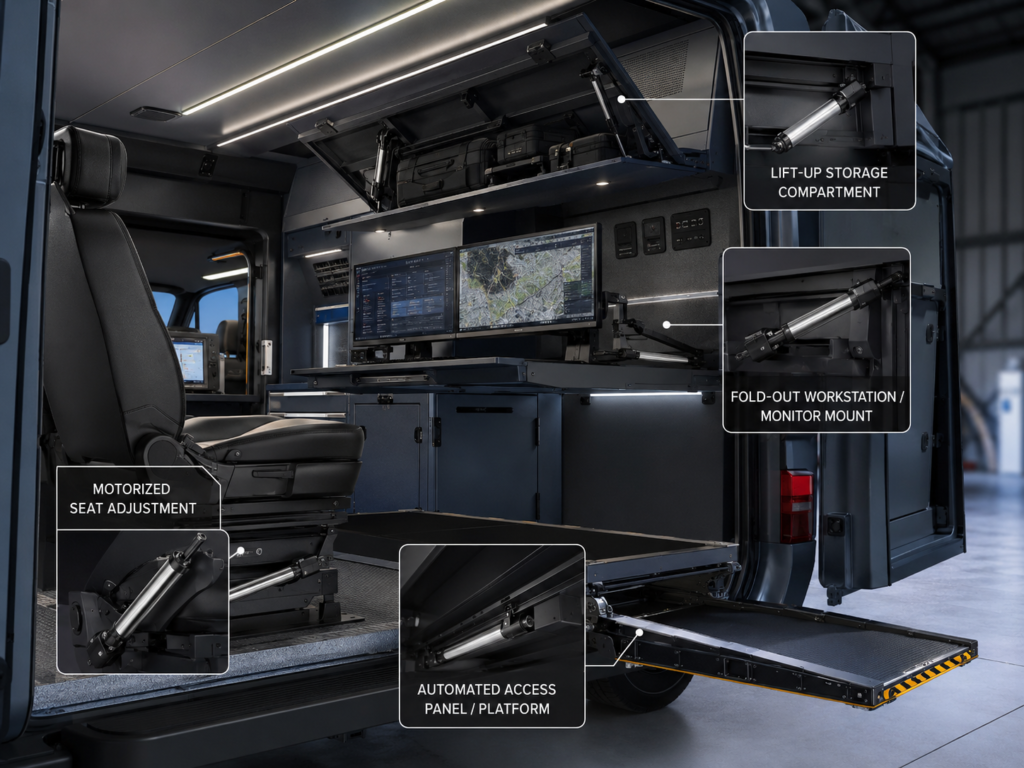
Electric actuators support controlled movement in vehicle tables, displays, storage covers and interior modules.
Intro
Linear actuators for vehicle interiors provide quiet, compact and controlled motion for passenger-facing modules. In special vehicles, VIP vans, mobile offices and service vehicles, actuators can move fold-out tables, display lifts, privacy partitions, storage covers, footrests, bed platforms and equipment shelves.
Real Application Context
Modern converted vans and special-purpose vehicles increasingly include mobile-office layouts, face-to-face seating, electric tables, video displays, minibar modules, privacy partitions and integrated control systems. These features create small but important motion tasks where manual hinges or gas springs may not provide enough control.
Electric linear actuators are useful when the interior module needs a defined stroke, smooth travel, stable holding and simple low-voltage control. The design must also consider vibration, limited mounting space, hidden cable routing, passenger safety and service access.
Common Use Cases
| Interior Module | Typical Motion | Why Electric Actuation Helps |
|---|---|---|
| Fold-out table | Deploy, lift or fold a tabletop | Creates a controlled business or dining surface without manual force. |
| Display lift | Raise, lower or tilt a screen | Allows clean stowing and repeatable viewing positions. |
| Privacy partition | Slide or tilt a divider panel | Improves passenger privacy with simple control integration. |
| Storage cover | Open a hidden compartment or equipment hatch | Supports clean interior design and service access. |
| Seat accessory | Adjust footrest, leg support or small platform | Improves comfort while keeping the mechanism compact. |
Product Parameter Selection Example
Assume a converted van uses a powered fold-out table and a small display lift. The system operates near passengers, so motion quality, low noise and safe end positions are more important than maximum speed.
| Parameter | Example Choice | Selection Basis |
|---|---|---|
| Rated force | 500-2,000 N for tables and covers; 1,000-4,000 N for heavier lifts | Based on panel weight, hinge geometry, friction, vehicle vibration and safety margin. |
| Stroke | 50-250 mm for tables/covers; 150-400 mm for lift modules | Chosen from required deployment angle, bracket location and stowed package size. |
| Speed | 3-12 mm/s | Slow movement improves perceived quality and reduces pinch risk around passengers. |
| Voltage | 12V DC or 24V DC | Depends on the vehicle electrical architecture and controller design. |
| Noise | Low-noise gearbox | Passenger cabins expose gear noise more clearly than industrial equipment. |
| Feedback | Limit switches for end positions; Hall feedback for presets | Feedback is useful for stored positions, app control and status confirmation. |
| Holding | Self-locking actuator or mechanical support | Interior modules should remain stable during vehicle vibration and braking. |
Engineering Notes
- Design for vibration. Brackets, pins and fasteners must tolerate vehicle movement, not just static bench testing.
- Use guided motion where needed. Slides, hinges or linkages should carry side loads so the actuator is not used as a guide rail.
- Control pinch points. Moving tables, covers and partitions need safe clearances and sensible speed limits.
- Plan cable routing early. Hidden interiors leave little room for moving cables, connectors and service loops.
- Provide service access. A luxury-looking panel still needs practical access for repair or actuator replacement.
Information Needed for Accurate Sizing
- Moving panel or module weight
- Hinge location and required deployment angle
- Available actuator mounting space
- Vehicle voltage and control method
- Target speed, noise level and feedback requirement
- Crash, vibration, service and manual override requirements
FAQ
Can a linear actuator be used for a fold-out vehicle table?
Yes. It is suitable when the table weight, hinge geometry and actuator stroke are sized correctly, and the mechanism includes safe clearances.
Should vehicle interiors use 12V or 24V actuators?
Both are possible. The choice depends on the vehicle electrical system, controller, current draw and wiring design.
Is feedback necessary?
Feedback is recommended for stored positions, app control, display lifts and systems that need position confirmation. Basic open/close covers may only need limit switches.
What is the main design risk?
Side load and vibration. The actuator should push axially while hinges, slides or brackets carry bending loads and vehicle vibration.