
Note: This application guide discusses general agricultural machinery design. It does not describe any specific customer project.
Intro
Linear actuators for agricultural machinery are useful for controlled auxiliary movement: gates, covers, pickup-height linkages, crop-flow deflectors, inspection panels and compact service mechanisms. They are not a universal replacement for hydraulic cylinders, but they can simplify smaller electric adjustment points on modern farm equipment.
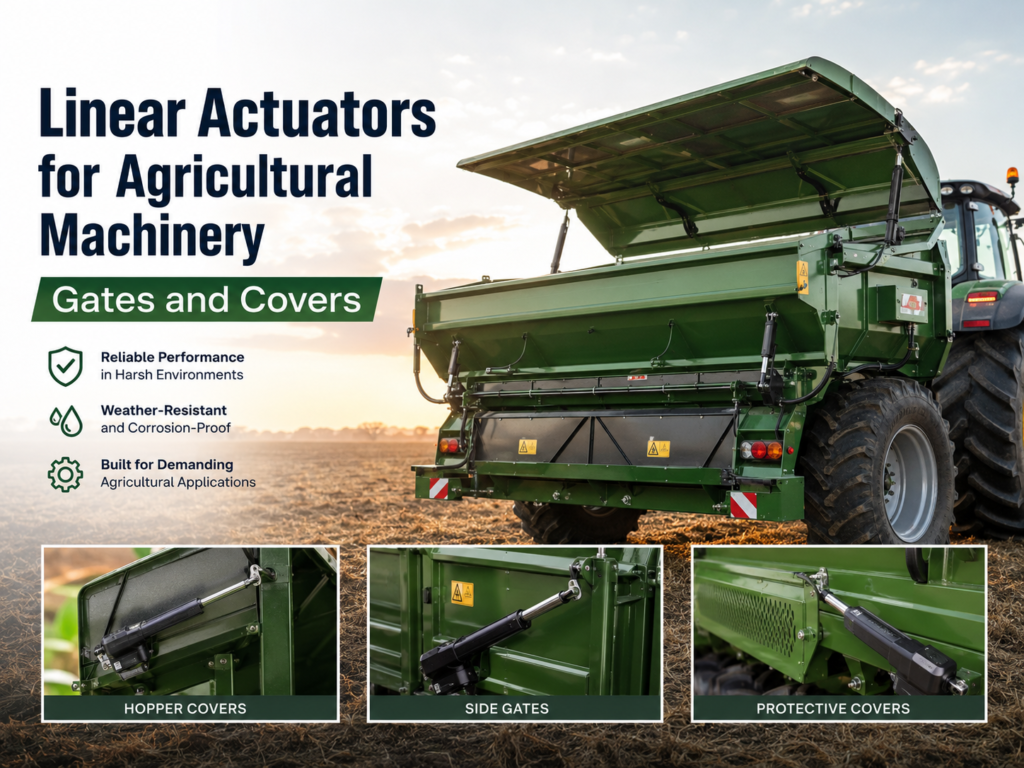
Real Application Context
Farm machinery such as hay balers, straw balers, combine harvesters, planters, rotary rakes, rotavators and work trucks includes many guarded or adjustable mechanical points. Some are heavy power functions that remain hydraulic. Others are lighter auxiliary movements where electric actuators are practical because they offer defined stroke, simple wiring and repeatable positions.
Typical electric-actuator opportunities include opening a service cover, adjusting a crop deflector, moving a light discharge gate, changing pickup height, locking a transport position or operating a small shield. The design must still handle outdoor dust, mud, rain, crop residue, vibration and operator safety.
Common Use Cases
| Machine Area | Typical Motion | Why Electric Actuation Helps |
|---|---|---|
| Discharge gate or chute cover | Open, close or hold a light gate | Provides repeatable travel without manual levers. |
| Pickup-height adjustment | Raise or lower a pickup or guide assembly | Allows quick setting changes for crop conditions. |
| Crop-flow deflector | Adjust a flap or direction guide | Supports cleaner material routing and operator control. |
| Service cover | Open an inspection or maintenance panel | Improves access while allowing interlock logic. |
| Transport lock or latch | Move a small lock, pin or support | Reduces manual effort around foldable machinery sections. |
Product Parameter Selection Example
Assume a baler, rake or harvesting attachment uses a powered light discharge gate and a small crop-flow deflector. The actuator must survive outdoor work while moving at a safe, controllable speed.
| Parameter | Example Choice | Selection Basis |
|---|---|---|
| Rated force | 1,000-4,000 N for light gates; 500-2,000 N for deflectors | Based on panel weight, hinge geometry, crop residue friction and safety margin. |
| Stroke | 80-300 mm | Chosen from required opening angle, bracket location and available machine space. |
| Speed | 3-15 mm/s | Slow to moderate speed improves safety and reduces impact at end positions. |
| Voltage | 12V DC or 24V DC | Depends on tractor, implement or onboard controller electrical architecture. |
| Protection | IP65 or higher where exposed | Outdoor farm equipment faces dust, mud, rain and washdown exposure. |
| Feedback | Limit switches for end positions; Hall feedback for position control | Feedback is useful when the operator interface needs position confirmation. |
| Mechanical holding | Self-locking actuator or separate lock | Moving parts should remain stable during vibration, transport and machine shutdown. |
Engineering Notes
- Do not replace every hydraulic function. High-force bale ejection, primary lifting and heavy folding sections may still need hydraulic cylinders.
- Protect against side load. Use hinges, pivots or guides so the actuator is not used as a structural guide rail.
- Design for crop residue. Dust, straw, husk and mud can increase friction and block moving parts.
- Plan cable routing carefully. Wires need protection from vibration, sharp edges, rotating shafts and crop flow.
- Include manual service logic. A cover or gate should remain serviceable if power is unavailable.
Information Needed for Accurate Sizing
- Moving gate, cover or deflector weight
- Hinge position and target opening angle
- Available mounting points and closed length
- Expected dust, mud, water and crop residue exposure
- Cycle frequency and duty cycle
- Vehicle voltage, controller type and feedback requirement
FAQ
Can electric linear actuators be used on farm machinery?
Yes, especially for auxiliary gates, covers, deflectors and small adjustment points. Very high-force primary work functions may still be better suited to hydraulics.
What protection rating is suitable?
For exposed agricultural machinery, IP65 or higher is often preferred, along with protected cable routing and corrosion-resistant mounting hardware.
Should the actuator have feedback?
Feedback is useful when the operator needs position indication or repeatable intermediate settings. Simple open/close covers may only need limit switches.
What is the main design risk?
Side load and contamination. Poor brackets or crop residue buildup can overload the actuator even when the rated force looks sufficient.