
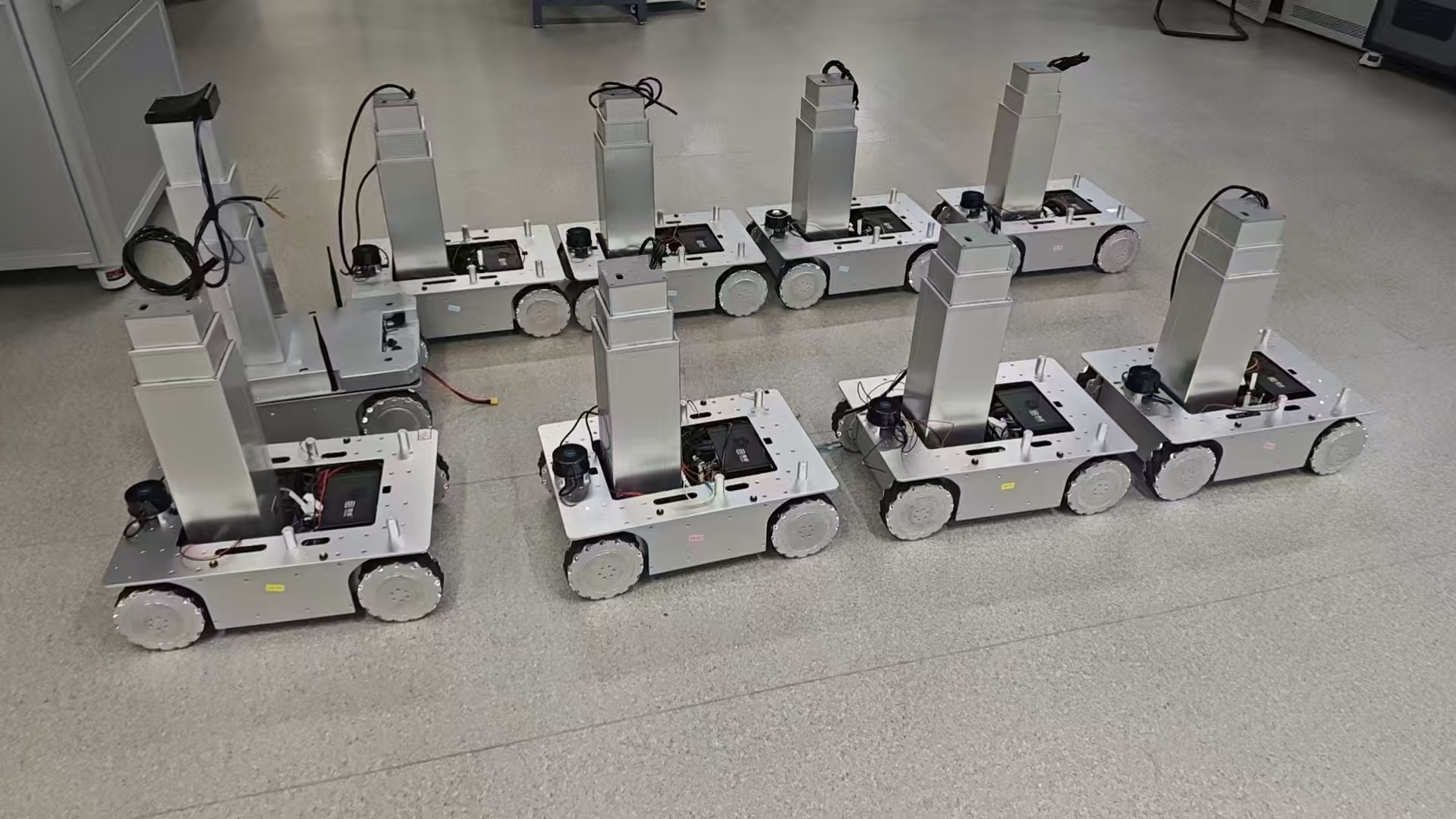
An HTD3 servo lifting column for embodied robots becomes valuable when a mobile manipulator must work at several heights while keeping the arm compact. The installation photograph below shows a real multi-unit deployment: several mobile robot platforms have already been fitted with telescopic HTD3 lift modules. For an OEM buyer, that batch installation is evidence of repeatable mechanical, electrical and production integration rather than a one-off laboratory concept.
Why embodied robots need a vertical lift axis
A mobile base solves horizontal travel, while the robot arm handles local manipulation. Neither automatically provides an efficient vertical workspace. If the arm must reach a low bin, a workbench and a high shelf, engineers can use a longer arm, reposition the base repeatedly, or add a controlled vertical axis. A guided electric lifting column can expand that workspace without making every arm joint carry the penalty of additional reach.
This architecture is already used across the mobile-manipulator field. Commercial robots combine autonomous bases with vertical lifts for multi-level operation, while research platforms use telescopic lifts to coordinate navigation and manipulation. The key engineering point is simple: vertical travel should be treated as part of whole-body motion, with the column, arm and mobile base controlled as one system.
HTD3: a configurable servo lift platform
The published HTD3 robot-lifting platform is configurable rather than a single fixed specification. GeMinG lists 24V DC, 48 V DC and 220 V AC supply options, AC or DC servo motor options, and application-dependent speed and thrust combinations. The robot version is designed for guided vertical motion with a compact retracted height. The exact column section, stroke, motor, brake, feedback and controller must be matched to the project.
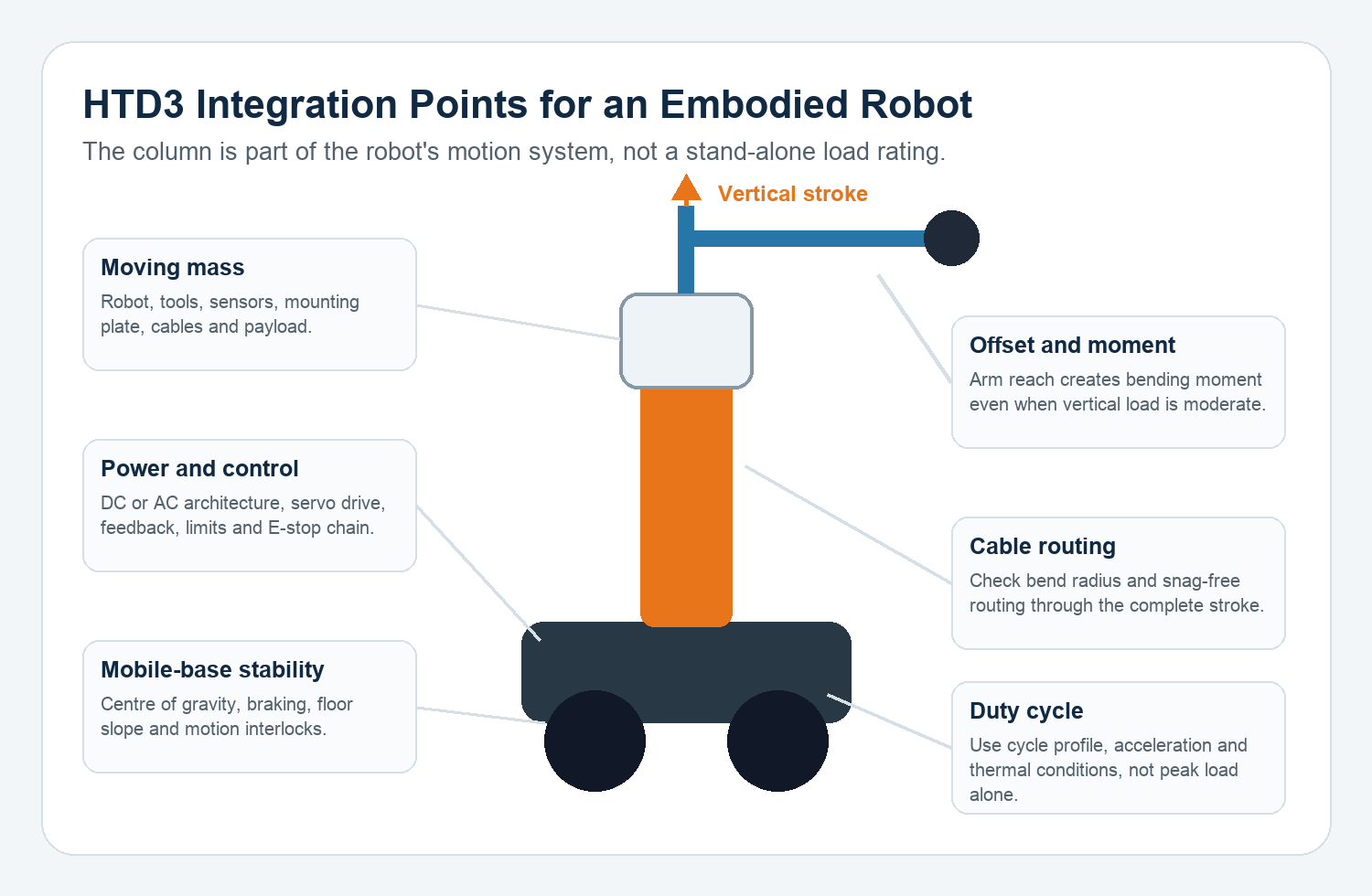
For a battery-powered mobile platform, the power architecture often favors a DC solution, but the battery voltage alone is not enough to select a motor. Peak current, regenerative energy, controller compatibility, cable losses and emergency-stop behavior must also be reviewed. Fixed robot stations may use an AC servo solution when it fits the plant power and controls standard.
Engineering details that separate a prototype from a fleet
Moving mass is not the same as payload
The column carries more than the object in the gripper. The moving mass can include the robot arm, end effector, sensors, top plate, cables and the handled object. Their centre of mass creates bending moment and side load, especially when the arm reaches away from the column. Selection by vertical thrust alone is incomplete.
Servo tuning must match the real structure
A fast unloaded column can behave differently after the arm and tooling are installed. Acceleration, deceleration, jerk, brake release timing and position feedback should be commissioned with the real moving assembly. Smooth motion protects the column guides and also reduces disturbance to cameras, force sensors and robot localization.
The mobile base needs stability logic
Raising the robot changes its centre of gravity. The allowable lift height and arm reach may therefore depend on base speed, floor slope, wheel braking and payload position. A safe design can use software envelopes: for example, limiting drive speed when the column is extended or restricting arm reach above a defined height.
Interactive project brief
Use the controls below to describe the application. The demo does not select a model automatically; it creates a practical checklist for the engineering discussion.
Product Parameter Selection Example
Consider a mobile manipulator that needs to reach floor-level bins and a high work surface. The integrator should not begin with “we need a 600 mm lift” and stop there. A useful requirement set would include the total moving mass above the column, the horizontal load-centre distance in the worst arm pose, 600 mm required travel, target speed, moves per hour, battery voltage, available base footprint, maximum retracted height and the safety state required during an emergency stop.
GeMinG can then evaluate the HTD3 section size, servo configuration, reduction ratio, braking method, feedback, limits and top/bottom interfaces. If the combination of reach and moving mass produces excessive moment, the correct answer may be a wider guide structure, lower acceleration, a different column size or revised robot motion limits. This review is more reliable than choosing from one headline load value.
Why a telescopic column instead of a standard linear actuator?
A standard linear actuator is useful when the machine already has external guides and the actuator only supplies push-pull force. A telescopic column combines actuation with a guided structural profile, which can simplify a robot’s vertical axis and protect the internal transmission. The choice depends on the required moment capacity, installation envelope and guidance already present in the robot.
What to send for an HTD3 quotation
- Robot type and a drawing of the mobile base or fixed station.
- Required stroke, retracted height and maximum extended height.
- Total moving mass and centre-of-gravity location in the worst arm pose.
- Target speed, acceleration preference, moves per hour and daily operating time.
- Supply voltage, command interface and feedback requirement.
- Brake, limit switch, homing and emergency-stop requirements.
- Indoor/outdoor environment, temperature, dust, splash and corrosion conditions.
- Prototype quantity, expected annual volume and target delivery schedule.
For early concept work, the multi-stage column height calculator can help compare stroke and installation length. Final robot selection should still be confirmed from the complete load case.
From a successful unit to a repeatable robot platform
The HTD3 installation shown here represents the outcome buyers care about: a servo lifting solution integrated repeatedly into real mobile robot platforms. GeMinG supports the path from initial envelope review and prototype configuration to interface control and batch supply. That combination of product range, robot-specific engineering and installed-project experience is why more integrators are evaluating GeMinG for embodied robot vertical axes.
Start an inquiry: send your robot layout, moving mass, load centre, stroke, speed, voltage and expected quantity. Our engineers will review the application and recommend an HTD3 configuration for prototype testing.
FAQ
What does an HTD3 servo lifting column add to an embodied robot?
It adds a guided vertical axis so the robot can reach work at different heights without relying only on arm reach or base repositioning.
Can the HTD3 be integrated into a mobile robot or AMR?
Yes, but the final configuration must be checked against moving mass, load centre, base stability, power architecture, duty cycle and the robot safety system.
Why is batch installation important for an OEM buyer?
A multi-unit build requires repeatable interfaces, controlled revisions, consistent servo settings, inspection records and service access across the fleet.
Which details are needed for a quotation?
Provide the required stroke, retracted height, total moving mass, load-centre distance, speed, cycle profile, voltage, control interface, environment and robot drawings.