
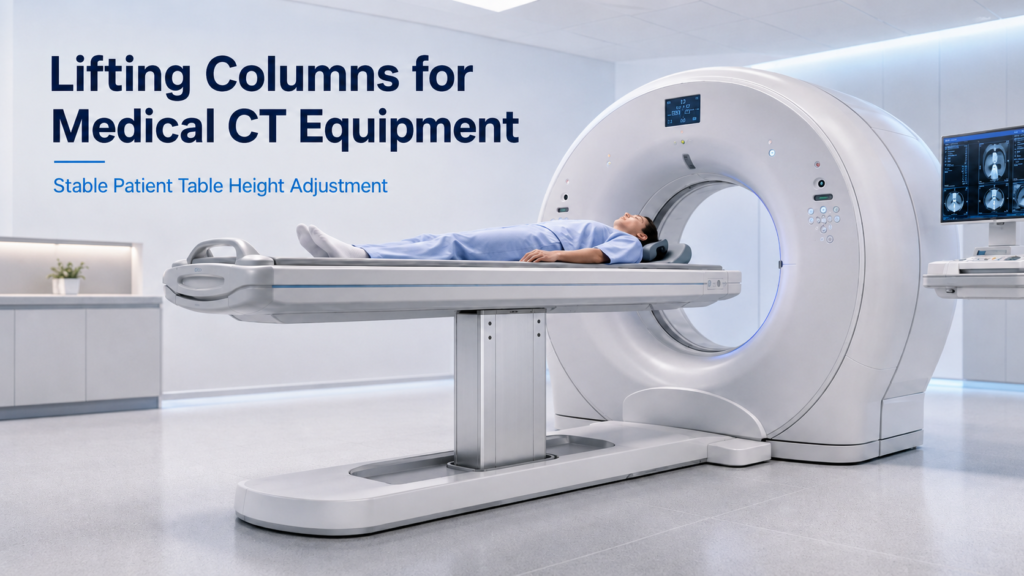
lifting column for CT equipment is a critical motion component in many medical imaging systems because the CT patient table must help operators position the patient safely and accurately before scanning. In a CT room, vertical movement is not a decorative function. It supports patient transfer, scan-center alignment, operator workflow, and emergency handling.
For equipment manufacturers, the challenge is to make the lifting system stable, quiet, compact, cleanable, and reliable enough for daily clinical use. A poorly selected actuator may still move the table in a basic test, but it can create problems later: vibration, slow workflow, difficult cleaning, limited service life, insufficient load margin, or unsafe pinch points around the table base.
Why CT patient tables need controlled vertical movement
Public CT operating manuals show that patient tables are moved by gantry or scan-control buttons, and that vertical table positioning is used to adjust the region to be scanned. One Philips Access CT instruction manual, for example, describes table up/down movement for vertical positioning, one-press fine movement, patient release movement, and emergency stop behavior. This confirms an important engineering point: CT table motion is part of the imaging workflow, not just a simple lift.
In normal use, the table should be low enough for the patient to sit and lie down more safely. After the patient is positioned, the table is raised and moved into the gantry so the region of interest can be aligned for scanning. A stable lifting column helps reduce unnecessary movement during setup and supports a smoother workflow for technicians.
Patient size, table height, and gantry clearance are connected
CT equipment selection must consider both patient weight and body size. UCSF Radiology notes that CT scanners have weight and diameter limits, and that the patient table further constrains the vertical diameter available inside the gantry. This is important for lifting system design because the table, tabletop, accessories, and lifting structure all affect the usable space around the patient.
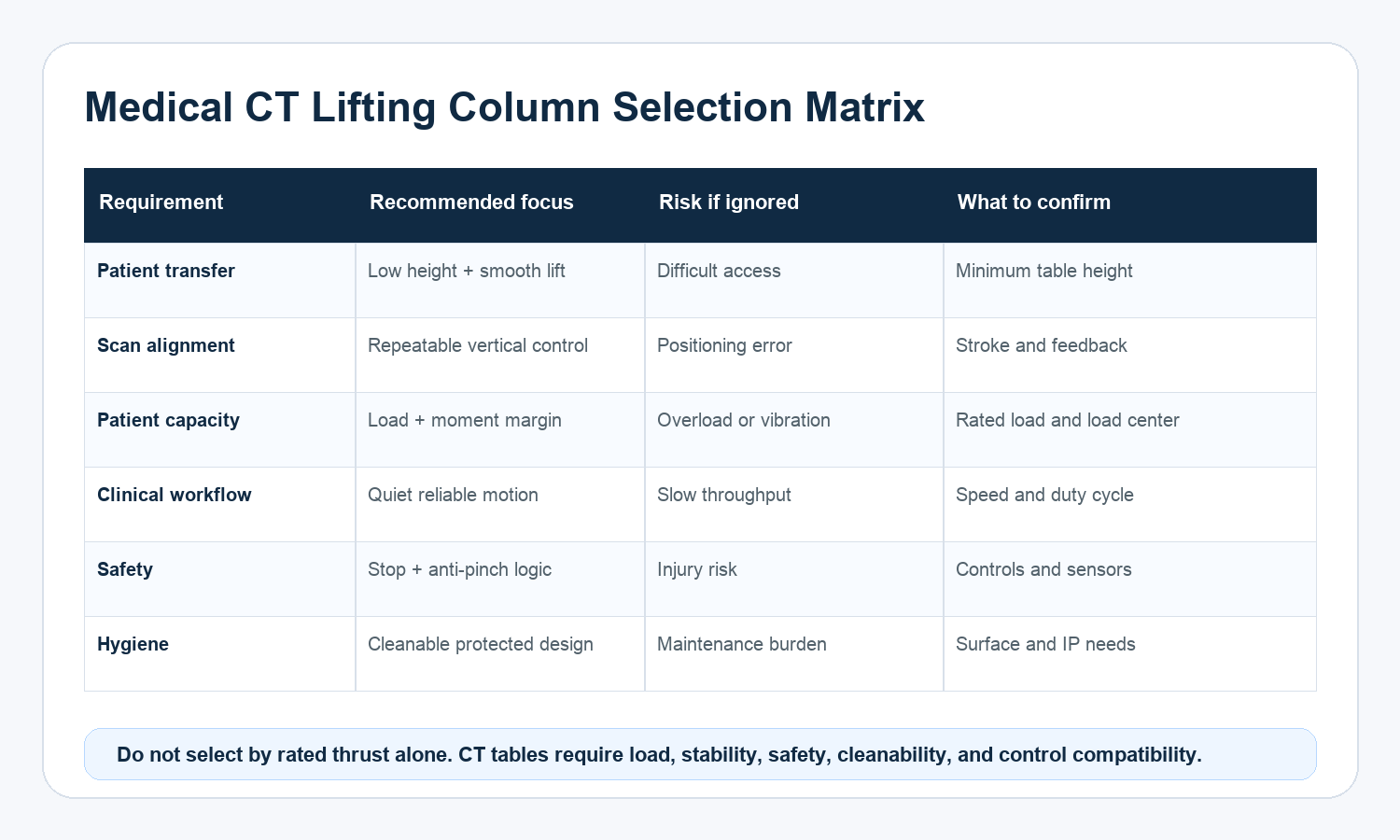
For this reason, the lifting column should not be selected only by rated thrust. Engineers should also review minimum table height, maximum scan height, tabletop thickness, frame structure, load center, patient capacity, and collision zones. If the table base becomes too tall or too wide, it can make patient transfer harder or reduce effective clearance around the scanner.
What the lifting column must do in CT equipment
A medical CT table lifting column usually needs to support several functions at the same time. It must lift the patient table smoothly, keep the structure stable under load, stop safely when the operator releases the control, and fit inside a clean medical equipment design. The motion should be quiet enough for a clinical environment and predictable enough for repeatable positioning.
The lifting column also needs to work with the OEM control system. Depending on the CT table design, this may involve limit switches, position feedback, hand or foot controls, emergency stop logic, soft start and stop, synchronized movement, or communication with the main machine controller. The safest solution is always designed together with the complete table structure, not selected as a separate spare part at the end.
Interactive check for CT table lift selection
The demo below is a simplified engineering tool. It does not replace OEM design validation, but it shows why patient load, vertical travel, lift speed, and daily workflow intensity should be reviewed together before selecting a lifting column.
Selection considerations for medical CT equipment
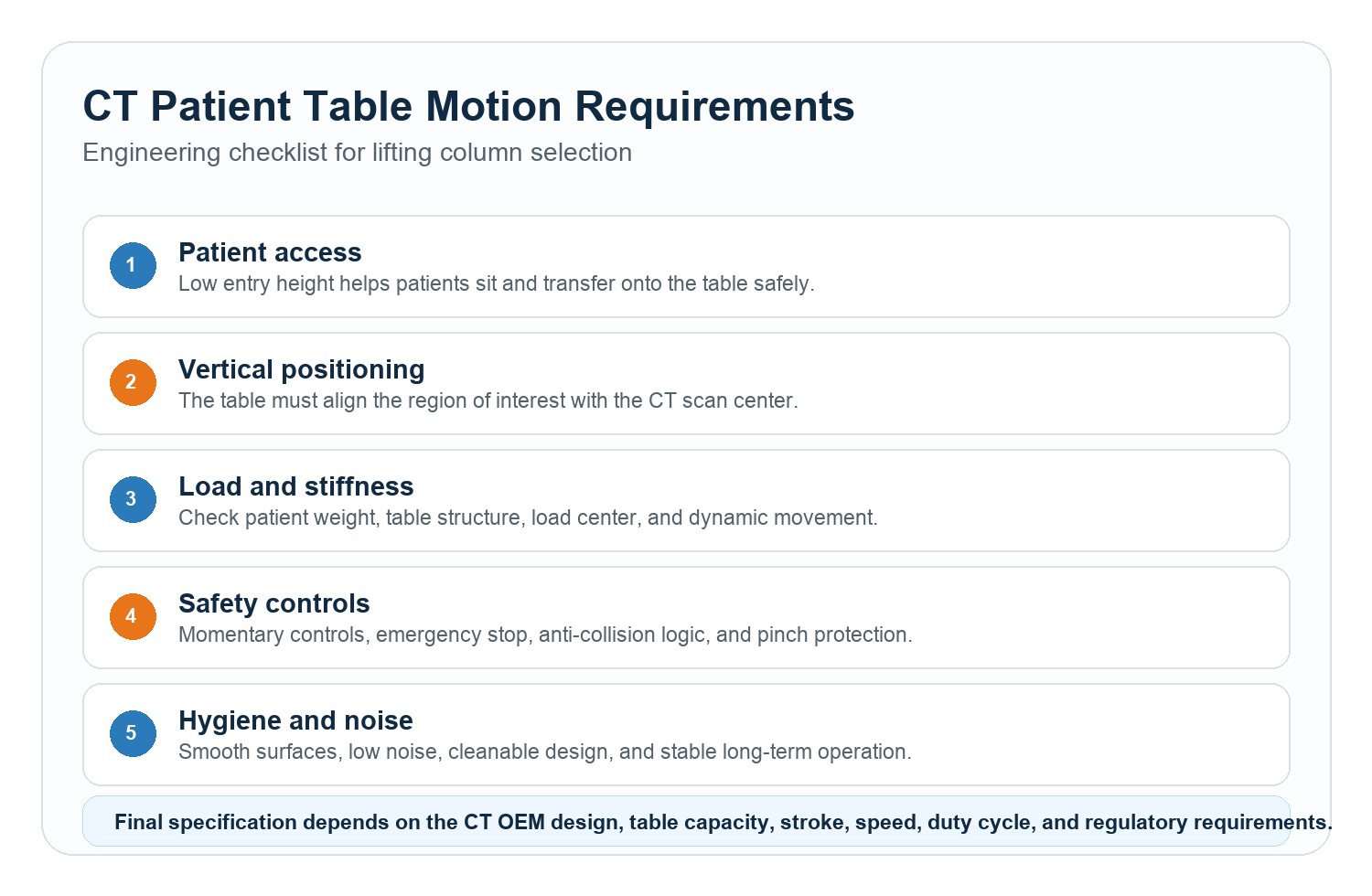
For a real CT equipment project, GeMinG recommends reviewing the following items before confirming a lifting column specification. The first is load capacity. The design should include patient weight, tabletop weight, accessories, blankets, positioning aids, and dynamic movement. The second is stiffness. Even if the column can carry the load, the table must remain stable enough for patient comfort and image workflow.
The third is stroke and installation height. A lower entry height improves access, while the raised height must match the scan-center requirement of the CT system. The fourth is motion control. CT tables need smooth movement, reliable stopping, and fine adjustment. Some public CT manuals describe one-press fine movement and controlled table motion, which reflects the need for precise operator control.
The fifth is safety. The lifting structure should be reviewed for emergency stop behavior, anti-pinch design, collision avoidance, cable routing, overload protection, and service access. The sixth is hygiene. Medical imaging equipment should use surfaces and structures that are easier to clean and maintain, with protected internal motion components where possible.
Why electric lifting columns are suitable for CT table systems
Compared with hydraulic lifting, electric lifting columns can reduce leakage risk and simplify control integration. Compared with pneumatic motion, electric systems can provide better controlled positioning and easier feedback options. Compared with a bare actuator and separate guide structure, an integrated lifting column can provide a more compact and protected vertical module.
However, the best solution depends on the complete machine. Some CT table designs may require one central column, while others may use synchronized columns or a guided lifting frame. For compact equipment, the column shape and mounting plate are important. For higher-load equipment, stiffness and safety margin become more important than maximum speed.
How GeMinG supports OEM CT equipment projects
GeMinG can support medical equipment manufacturers with electric lifting columns, linear actuators, servo lifting solutions, control boxes, and customized mounting structures. For CT patient table applications, the engineering discussion normally starts with load, stroke, minimum height, maximum height, installation space, voltage, control method, feedback requirement, duty cycle, and environmental protection.
GeMinG also provides broader electric lifting column and linear actuator solutions for medical and industrial equipment. For customers comparing actuator types, our guide on choosing fully automatic electric lifting columns can be used as a starting reference.
Information needed before quotation
To recommend a reliable lifting column for CT equipment, please prepare the table load, patient capacity target, required stroke, minimum and maximum table height, speed requirement, number of cycles per day, available installation space, mounting direction, control interface, safety requirements, cleaning requirements, and any regulatory or OEM validation constraints.
If the project already has a 3D layout, GeMinG can review whether the column position, cable movement, and base structure are suitable. If the project is still in concept design, GeMinG can provide a preliminary actuator direction and help the OEM avoid common space and load-margin problems.
FAQ
Can one lifting column be used for every CT patient table?
No. CT table design varies by OEM. The correct lifting system depends on patient capacity, stroke, table geometry, load center, control system, and safety requirements.
Is rated load the only important parameter?
No. Rated load is only one part of the selection. CT equipment also requires stiffness, smooth motion, safe stopping, low noise, cleanability, installation space, and control compatibility.
Can GeMinG provide custom CT table lifting solutions?
Yes. GeMinG can review OEM requirements and provide customized lifting column or actuator solutions based on load, stroke, mounting structure, power supply, feedback, and control logic. eg. HTA2, HTB2 lifting columns