
The HTD2 servo lifting column for humanoid robots has been selected for a planned batch-production program, marking a transition from individual prototype integration to repeatable robot assembly. The production-floor image shows multiple wheeled humanoid platforms at different build stages, with identical two-stage vertical columns integrated between the mobile bases and upper-body structures.

The image supports a practical engineering milestone: the HTD2 is no longer being evaluated only as a loose component. It is being incorporated into a repeatable robot architecture. Project identity, quantities and configuration values remain confidential, so this article focuses on the integration and production lessons that matter to other robot developers.
Why the HTD2 servo lifting column for humanoid robots matters
Many practical embodied robots use a wheeled base instead of bipedal legs. This architecture offers stable indoor mobility and more room for batteries, drives and computing hardware. A servo-controlled vertical axis then gives the upper body an additional degree of freedom, allowing the robot to work at floor level, workstation height and higher shelves without relying entirely on arm reach.
The HTD2 shown here is a project-specific two-stage servo configuration. It connects the mobile chassis to the torso and sensor assembly. By changing torso height, the robot can keep its manipulators or perception system inside a more useful working envelope. This is why searches for humanoid robot lifting column, embodied robot lifting column and robot vertical axis increasingly describe the same underlying engineering need.

What the production-floor image confirms
The image shows a fleet-scale build environment rather than one finished demonstration unit. Visible evidence includes:
- Multiple mobile bases using the same central lifting-column layout.
- Columns at different extension and assembly states.
- Upper-body modules, wiring and electronics being integrated in parallel.
- Repeated mounting positions and comparable cable-routing zones.
- Production fixtures, component racks and work-in-process units around the line.
This does not reveal the final production quantity or prove that every unit has completed acceptance testing. It does show that the mechanical architecture has progressed beyond a single prototype and is being prepared for repeatable manufacturing.
Batch production requires more than a working prototype
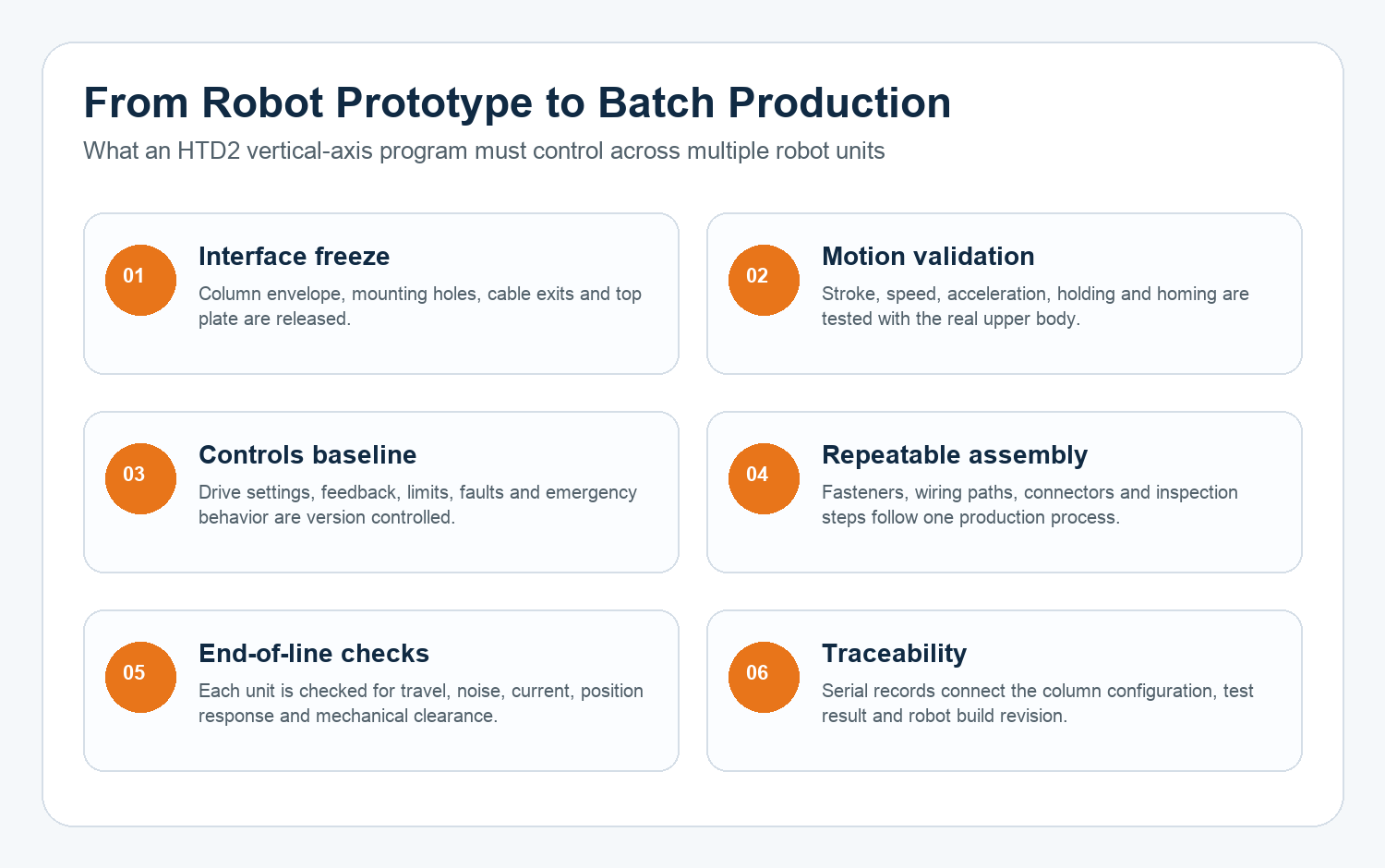
A prototype can succeed even when parts are adjusted by hand. A production program cannot depend on hidden adjustments. For the HTD2 vertical axis, the following items must become repeatable across every robot:
Mechanical interfaces
The base plate, upper-body adapter, fasteners, alignment features and available service space must be controlled by released drawings. Small interface changes can affect column alignment, friction, noise and the robot’s centre of gravity.
Servo and motion settings
Speed alone is not a sufficient specification. The production configuration must define acceleration, deceleration, jerk, homing, position limits, holding behavior and fault recovery. Settings should be validated with the actual moving upper-body mass rather than an unloaded column.
Cable routing and electrical interfaces
Power, feedback, communication and upper-body cables must move through the complete stroke without snagging or exceeding their bend radius. Connectors and harness lengths need controlled part numbers so that one robot is not wired differently from the next.
Safety and whole-body coordination
The robot controller should coordinate lift height with driving speed, torso motion and manipulation. Depending on the application, the safe operating envelope may restrict base acceleration or upper-body reach when the column is extended. Brake, limit and emergency-stop behavior must be verified at system level.
Why a two-stage servo column fits this robot architecture
A two-stage column provides a direct compromise between compact installation, useful vertical travel and structural overlap. In the photographed platforms, the column occupies the center of the mobile base and supports the torso above it. This central layout can simplify packaging and load distribution compared with an offset external mast, although final stability still depends on the complete robot geometry.
A servo drive allows controlled position, speed and acceleration rather than only basic up/down movement. That matters when the vertical axis participates in whole-body behavior: lowering for transport, matching a workstation, adjusting sensor height, or positioning the arms for manipulation. The column should be treated as part of the robot motion system, not as furniture hardware.
Interactive batch-production readiness planner
Use the controls below to identify the records still needed before a robot lift moves from prototype to repeat production. The result is an engineering checklist, not a certification.
Product Parameter Selection Example
Consider a wheeled humanoid robot whose head, torso electronics, arm mounts and cabling all move with the lift. The value used for selection is the complete moving mass, not just the nominal payload in the hands. Engineers should also locate the combined centre of gravity in the robot’s most demanding pose and include forces caused by acceleration and emergency braking.
The required stroke comes from the difference between transport height and the highest useful working posture. Retracted height must fit inside the chassis and body envelope. Speed should be selected from the task cycle and stability requirement, then validated with realistic acceleration. GeMinG can use these inputs to define the HTD2 profile, drive, feedback, brake, limits, mounting interfaces and cable arrangement. Without those values, publishing a generic load or speed number would be misleading.
From component supply to robot-program support
A batch program changes the supplier’s responsibility. The work expands from delivering a motion component to maintaining a controlled production configuration. GeMinG supports this transition through drawing review, interface coordination, prototype validation, production documentation and repeat supply.
The broader Embodied Robot Pillar range covers servo vertical axes for mobile robots, service robots and embodied intelligence platforms. Engineers comparing structures can also review GeMinG’s electric lifting column portfolio and the earlier HTD3 embodied robot batch-deployment case. Together, these pages form a practical knowledge cluster around robot vertical-axis selection rather than repeating the same generic article.
What to prepare before requesting an HTD2 proposal
- Robot CAD layout and available column envelope.
- Required stroke, retracted height and maximum working height.
- Complete moving mass and centre-of-gravity coordinates.
- Target speed, acceleration, motion profile and duty cycle.
- Power supply, feedback, communication and controller requirements.
- Brake, limits, homing, fault response and emergency-stop logic.
- Expected environment, floor conditions and robot acceleration.
- Prototype quantity, annual forecast and planned ramp schedule.
For early packaging work, the multi-stage column height calculator can help compare stroke and installation height. The guide to choosing fully automatic electric lifting columns explains the wider selection process.
HTD2 moves toward repeatable embodied robot production
The HTD2 servo lifting column for humanoid robots has reached an important program milestone: planned batch production. The production-floor image demonstrates repeat integration across multiple wheeled robot platforms, while the engineering work behind that image is configuration control, validation and traceability.
Request an HTD2 project review: send the robot layout, moving mass, stroke, speed, controls and forecast quantity. GeMinG will assess a servo lifting-column configuration for prototype validation and production planning.
FAQ
What role does the HTD2 play in a wheeled humanoid robot?
It acts as a guided servo vertical axis between the mobile base and the upper body, allowing the robot to change working height while retaining a compact platform.
What does planned batch production indicate?
It indicates that the program is moving beyond a single prototype toward repeatable assembly. Production release still depends on controlled drawings, validation, supply planning and acceptance tests.
Are the HTD2 load, stroke and speed public?
This announcement does not publish project-specific performance values. Final specifications are configured from moving mass, load centre, stroke, speed, duty cycle, voltage, controls and safety requirements.
Why use a servo lifting column instead of a fixed torso?
A servo lifting column expands the robot’s vertical workspace and can coordinate height with navigation and manipulation. A fixed torso is simpler but cannot adapt its working height.
What information is needed for an HTD2 quotation?
Provide robot drawings, moving mass, centre of gravity, required stroke and heights, speed profile, duty cycle, power supply, communication interface, safety logic, quantity and ramp schedule.